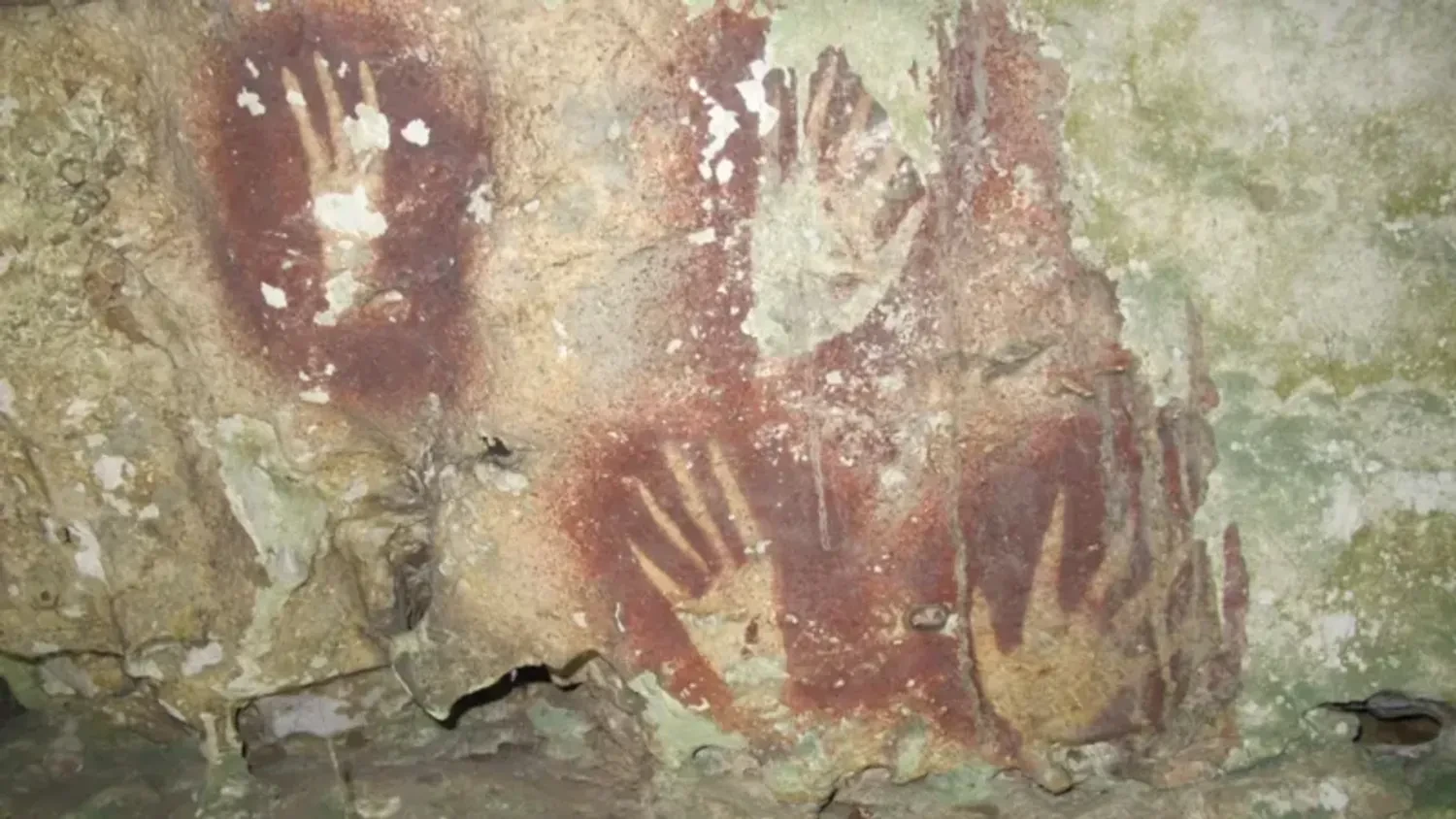
Quiet on the cave wall — a hand left almost 68,000 years ago. At Liang Metaduno on the Indonesian island of Muna, archaeologists recorded a reddish hand stencil whose age, according to a study published in the journal Nature, is no less than 67,800 years. This is a new world record among rock images and an important marker of human creativity.
The dating was done using uranium-series analysis of mineral layers that formed over the pigment. This technique allows determination of a minimum age for the painting — and it is this method that confirmed the print is about 1,100 years older than the previous record-holder in Spain, which had been associated with Neanderthals.
The image was created by spraying pigment over a hand pressed to the wall. A distinctive feature is the sharpened fingertips, which give the print a "claw-like" appearance; this suggests complex symbolic intent on the part of the maker, rather than a merely accidental mark.
What this changes in our understanding of Homo sapiens migration
The discovery strengthens the argument that early Homo sapiens populations were settling the archipelagos of Southeast Asia and reaching Australia and New Guinea earlier than previously thought. Archaeologists suggest that people used an "island" network of routes and possessed skills for at least simple coastal seafaring or crossings between islands.
The key point: it's not just the date. The combination of age, application technique, and the stylistic choice of the fingers indicates that symbolic and artistic thinking were already developed in those populations — and therefore culture and technology were spreading along with the people.
Why this matters for us
For Ukraine and for everyone who values culture, it's a reminder: the history of humanity is a continuous network of contacts and ideas that do not recognize modern borders. Such discoveries underscore the importance of investment in science and in the preservation of heritage sites — because every artifact detail adjusts our shared chronology.
"This discovery pushes back the boundaries of the emergence of prehistoric art and testifies to complex symbolic thinking in early Homo sapiens."
— Authors of the study, article in Nature
Archaeologists continue excavations on the island of Muna in the hope of finding additional traces of settlements and material culture that will help reconstruct the routes and lifestyles of ancient travelers. The next step is a comparative analysis with finds in Australasia and Southeast Asia, which could finally clarify how exactly humans crossed the oceanic expanses.
The question that remains open: will this discovery and other aspects revise our approaches to studying migrations and cultural evolution — from scientific programs to museum exhibitions and school textbooks?