When the National Bank issues a coin, it's usually not news. But when it features an artist who dared to become an abstract painter where Picasso, Braque, and Léger stopped — that's already a conversation about something more than numismatics.
An octagon as a manifesto
The NBU presented a commemorative coin "Ukrainian Avant-Garde. Oleksandra Ekster" — the first in a new series dedicated to Ukrainian avant-garde artists. The presentation took place during the opening of the exhibition "Avant-Garde Women" at the Museum of Avant-Garde — not in a bank hall, not at a press conference. The format itself already speaks to a different approach.
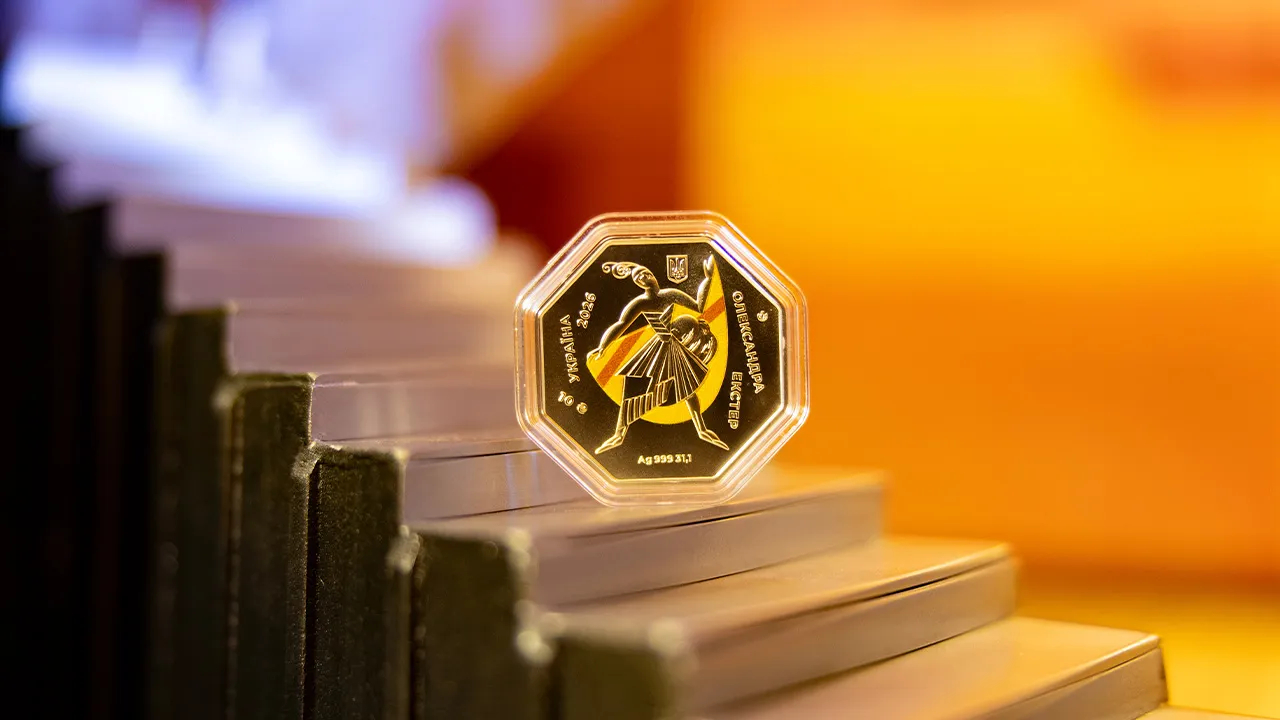
The commemorative coin with a face value of 10 hryvnia is made of 999 silver in the shape of an octagon — weighing 31.1 g, with a circulation up to 10,000 pieces, in the special uncirculated minting category. The obverse features a colored sketch of a theatrical costume for a Spanish dance by Ekster, while the reverse shows a stylized fragment of a theatrical stage as a reference to her scenography work. The design was created by artist Mykola Kovalenko and sculptor Anatoly Demyanenko. It can be purchased from June 2 in the NBU online store and from distributor banks.
Who is Ekster and why not "also"
Oleksandra Ekster was born in 1882 in Białystok and spent 35 years living in Kyiv, studying at the Kyiv Art School alongside Bohomazov and Archipenko. She later did what her Parisian friends did not dare to do: she became an abstract painter. She lived in four cities — Kyiv, Moscow, St. Petersburg, and Paris — and carried new ideas between them like contraband.
In Paris, she met Picasso, Braque, and Léger. But it was in Kyiv that she opened a studio that became the center of Ukrainian avant-garde — where painters, writers, poets, and musicians would gather. Later, her innovations in theatrical design were adopted in Europe and America. Together with the founders of art deco style, she shaped the visual language of an entire era.
"Oleksandra Ekster found no place in the empire — and she brought Ukrainian context, rhythm, and colors to European culture"
— NBU Governor Andrii Pyshnyi at the coin presentation
Why this for the NBU — and why for us
The regulator frankly articulates its goal: to prove that Ukrainian culture was self-sufficient long before any "common space" with the empire. The avant-garde series is not the NBU's first similar initiative; a coin program dedicated to art has existed since 2005, but this new direction focused on avant-gardists is a separate conceptual step.
There is also a practical dimension: in times when discussions about cultural restitution and reattribution are ongoing, a coin is cheaper than a court case but more tangible than an academic article. Ten thousand physical objects bearing a Kyiv name — in wallets, display cases, collections.
- Form: octagon — a departure from the standard circle, referencing the geometric nature of avant-garde
- Image: theatrical costume rather than a portrait — emphasizing the work, not the person
- Context of issue: the "Avant-Garde Women" exhibition, meaning a conscious connection to a broader cultural moment
The question that remains open: if the NBU is truly building a series rather than a one-time action — who comes next in line and will there be enough institutional consistency to see it through when budgetary pressure increases?