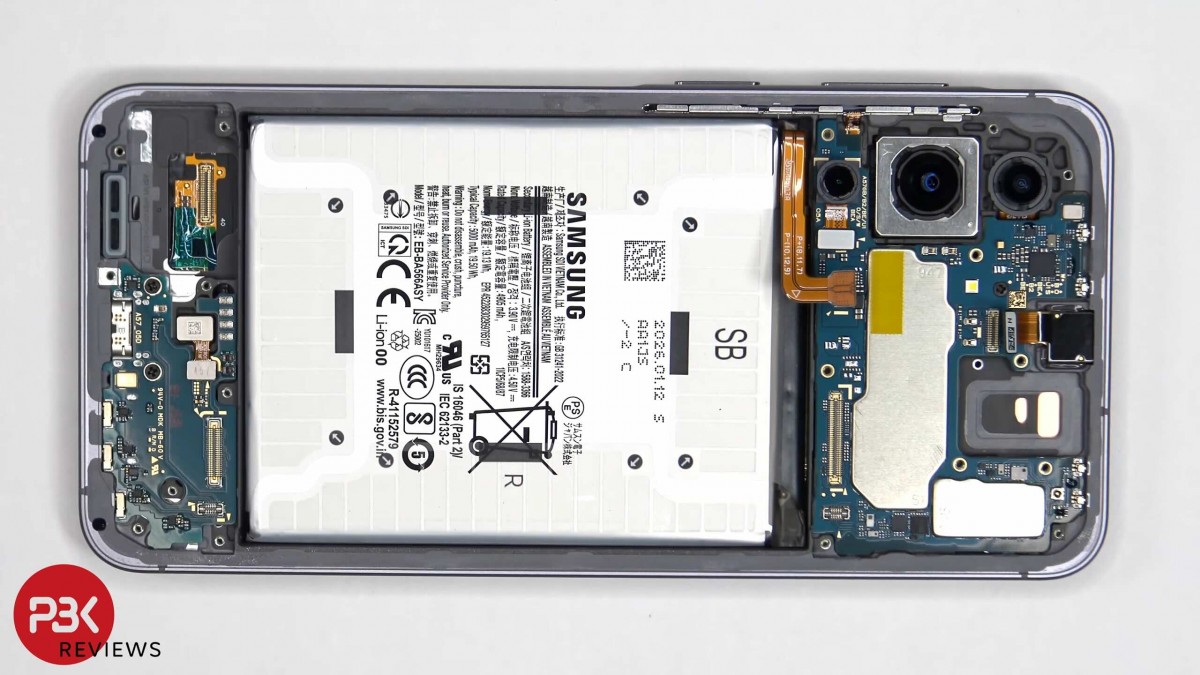
After the official presentation on March 25, PBKreviews experts published a detailed teardown of the Samsung Galaxy A57. This is not just a technical curiosity: analyzing the internal construction helps understand how the phone will perform in real life, how easy it will be to service, and what compromises the manufacturer made.
Construction and main modules
The teardown confirmed Samsung’s typical approach: the glass back panel is secured with adhesive and removed after heating, then screws are unscrewed and flex cables disconnected to access the motherboard and modules. At the center of the configuration is the Exynos 1680 processor, positioned as an energy-efficient midrange solution. The camera array consists of a 50 MP main sensor with optical stabilization, a 12 MP ultrawide and a 5 MP macro module — a configuration that matches A-segment expectations.
“The teardown confirmed: the Galaxy A57 is a pragmatic device focused on a balanced camera, long battery life, and easier servicing”
— PBKreviews, technical reviewer
Battery, heat dissipation and repairability
The smartphone received a 5000 mAh battery, secured with adhesive tape, which simplifies its removal in service conditions. Under the battery is an enlarged vapor chamber for heat dissipation — a solution intended to reduce heating under load and extend stability during gaming or recording. Following the teardown, PBKreviews rated the device’s repairability at 9 out of 10, making the A57 friendly to repair shops and users who value the ability to replace components.
Context: why this matters
For the user this means two practical things: first, the balanced hardware platform Exynos 1680 provides energy efficiency and adequate performance for everyday tasks; second, high repairability reduces the total cost of ownership in the long term — an important factor for buyers and service centers. Against the backdrop of the recent Galaxy S26 teardown (which also received 9/10 for repairability), this confirms Samsung’s trend toward more service-oriented solutions across different price tiers.
Bottom line: the A57 doesn’t change the rules of the game, but it cements a practical formula — current components, attention to thermal management, and high repairability. For buyers and service centers, this means fewer surprises and lower operating costs. Whether the model will become a sales hit depends on pricing and market reaction, but technically the A57 is ready for everyday workloads.