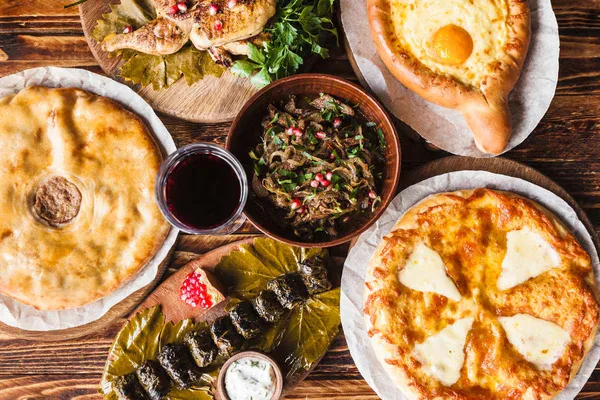
In 2023/2024, the authoritative culinary guide TasteAtlas — based on ratings of over 395,000 dishes — ranked Georgian cuisine 26th among the best in the world. For the cuisine of a small Caucasian country, this is not just a line in a list: it is the result of several millennia of culinary architecture that cannot be reproduced from an internet recipe.
Spices that exist in no other tradition
The foundation of Georgian taste is not individual herbs, but complex blends, where each component serves a function. Khmeli-suneli — a mixture of several dozen ingredients — gives dishes the characteristic "Caucasian note." Utskho-suneli (blue fenugreek) softens the spiciness, enhances the nutty flavor in satsivi, and creates a sense of richness in lobio without excess fat.
Svaneti salt has its own history. Its homeland is the mountainous Svaneti region, where due to a salt shortage, local residents began mixing sea salt with utskho-suneli, Imeritian saffron, cumin, walnuts, and garlic. What began as forced economy became one of the most recognizable spices in the world.
Even adjika here is not what it seems. In Georgian tradition, it is primarily a dry spice blend, not a paste. The word comes from Abkhaz and simply means "salt."
Sauces as a separate language
If spices are grammar, then sauces are sentences. No Georgian dish is served without sauce: tkemali — made from sour plums with spices, satsebeli — tomato-based, adjika — spicy paste of peppers, garlic, and herbs. Each meat, each cheese has its own sauce, and this attention to detail is not excessive; it is the norm.
Supra: a feast as philosophy
Khachapuri and khinkali are the face of the cuisine, but not its essence. The essence lies in the tradition of supra: a Georgian feast where people gather at the table not to eat, but to be together. The tamada — the toast master — conducts the conversation as carefully as a chef prepares dishes. Wine, which Georgia, according to most scientific versions, invented about 8,000 years ago, is integral to this ritual.
"Each dish is paired with its own type: dry wine with meat, semi-sweet with khachapuri, light — with vegetable dishes."
Tradition of the Georgian feast
Bread called shoti is baked in a clay oven called tone — directly on the walls from the inside. This technology has not changed over centuries not because there are no alternatives, but because any other way simply doesn't taste the same.
What stands behind global expansion
Georgian restaurants are opening all over the world — from Berlin to Tokyo. But the real test of popularity is not the number of establishments, but whether they maintain authenticity. In Tbilisi, they already distinguish between "traditional Georgian" and "modern Georgian fusion" as two different genres, and tourist guides separately warn: if you want the real thing, look for an establishment without a performance stage and with a handwritten menu.
In Ukraine, Georgian cuisine has long ceased to be exotic — from chain restaurants to homemade khinkali recipes. But the distance between "making something similar" and "making it the same" is measured in Svaneti salt, proper fenugreek, and understanding that supra is not a dinner format, but a way of communicating.
If Georgian cuisine continues to rise in world rankings, the key question will become not popularity, but preserving authenticity in the context of scaling: will it remain a cuisine of tradition when it is cooked by millions of people who have never been to Svaneti?