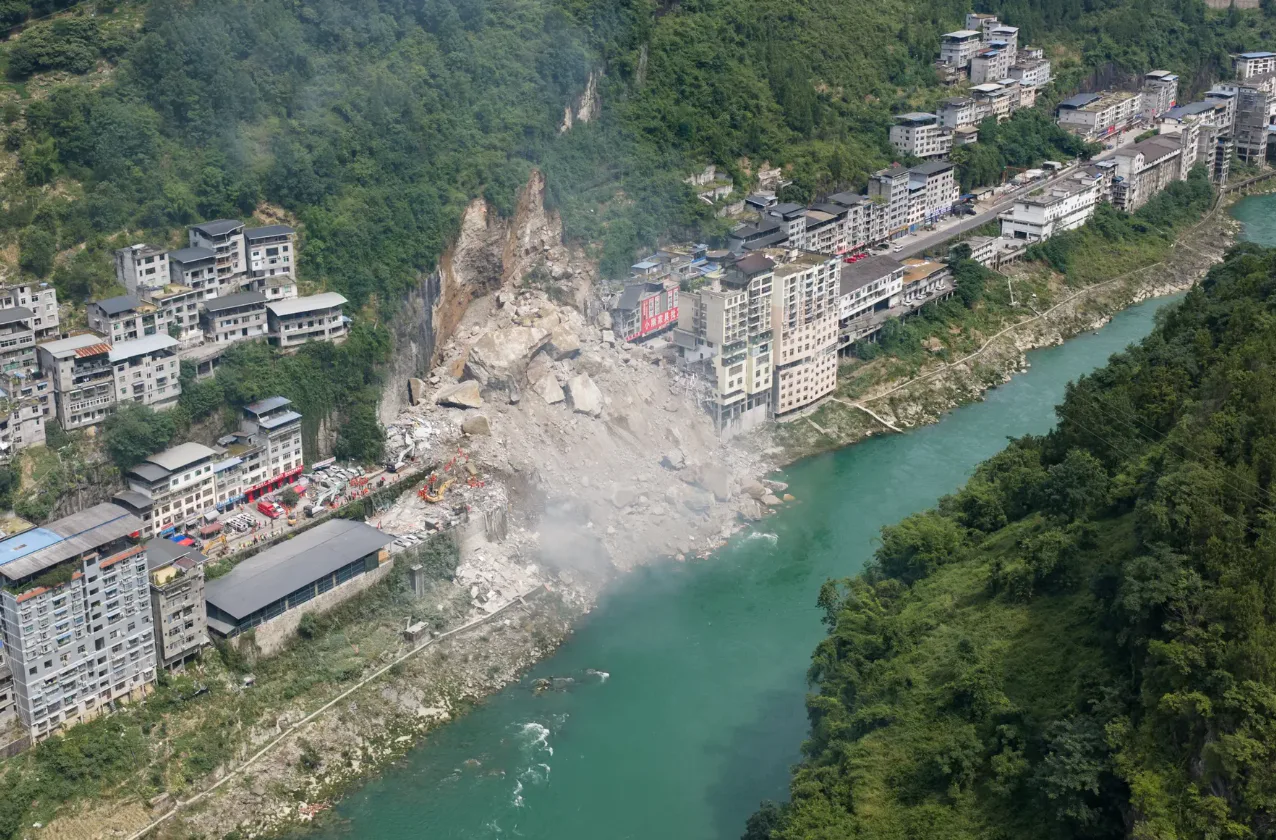
In Pengshui县 county in the megacity of Chongqing, the death toll from a landslide has risen to 51 people, with another 10 still missing. This is the deadliest such disaster in China since 2015, according to Bloomberg.
What is most paradoxical about this tragedy is that it was not a surprise for authorities. Before the ground mass came down, local services detected warning signs and managed to evacuate approximately 1,100 residents. The warning system worked. And yet 51 people still died.
When evacuation does not save everyone
On July 17, masses of stone and soil slid down a slope and covered residential buildings on the banks of the Wujiang River. Dozens of people found themselves buried under debris — those who either were not in the evacuation zone or remained in buildings, unaware of the scale of the threat.
This is a key problem with landslides, unlike, for example, floods: the affected area is determined by the topography of a specific slope, and even an accurate risk model can underestimate the area of soil mass ejection. The correct number of people were evacuated — just not from the right territory.
18,000 cubic meters against rescuers
Local authorities reported that the search and rescue operation is significantly complicated by the volume of debris — approximately 18,000 cubic meters of stone and soil accumulated on a limited area. For comparison, this is roughly 900 dump trucks worth of material that needs to be sorted through manually or with heavy machinery, risking causing repeated collapses.
Chinese leader Xi Jinping ordered intensification of the rescue operation and measures to prevent similar tragedies in the future. The wording is typical for such orders, but the essence of the problem is not in the post-facto response.
Rainy season as a systemic risk
Bloomberg notes that the tragedy once again confirmed the danger of the summer rainy season in southwestern China. Prolonged rainfall destabilizes mountain slopes in regions with unstable topography, and the risk of landslides there is not one-time but annual.
This is already the second such incident in a short time — earlier there was a landslide with 8 deaths and 34 missing in another area. The question is not whether the next landslide will occur this season, but whether China can move from evacuation based on warnings to more accurate mapping of risk zones before the rains begin.