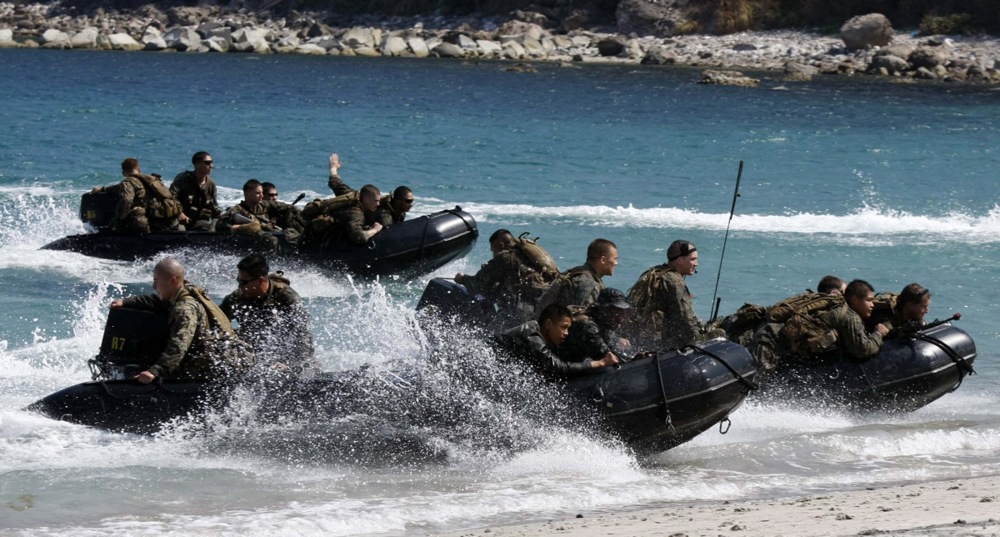
Michael Davis is a Marine from Camp Lejeune. Last week he was in North Carolina. Now — somewhere in the Middle East with 2,500 colleagues. The Pentagon does not disclose his exact location. There are more than 50,000 like him.
The New York Times, citing an unnamed U.S. military official, reports: the U.S. has concentrated in the region a force unprecedented in recent years. The usual figure is about 40,000 troops spread among Saudi Arabia, Bahrain, Iraq, Syria, Jordan, Qatar, the UAE and Kuwait. Now there are 10,000 more.
To the recently arrived Marines and 2,500 sailors were added about 2,000 soldiers from the 82nd Airborne Division — the Army’s elite rapid-response unit. Where exactly they were sent is not disclosed.
There is force. It's not enough
The key detail of the NYT piece is not the number itself, but its assessment. According to the U.S. military official, even 50,000 is insufficient for a full-scale ground operation against Iran. That is an important distinction: a buildup signals pressure, but does not mean readiness to invade.
At the same time, Trump, according to the NYT’s interlocutor, is considering the option of a larger-scale ground attack — but for now he is only considering it, not making a decision. The administration publicly insists on a diplomatic track: talks over Iran’s nuclear program continue, and the U.S. side has declared its readiness to reach an agreement.
So the U.S. is simultaneously increasing its military presence and sitting at the negotiating table. This is not a contradiction — it is the classic posture of negotiating from a position of strength. The question is whether Tehran interprets the signal correctly.
What this means for the region
50,000 American troops is not an abstraction. It is logistics, bases, agreements with host governments, obligations. Each of the eight countries hosting forces has its own interests and its own risks from escalation.
Iran has so far not changed its public rhetoric. But right now indirect U.S.-Iran talks are taking place in Oman — the fourth round in a few weeks. The presence of the 82nd Division at an undisclosed base and the parallel negotiations in Muscat are the real conflict of the moment: between pressure and diplomacy, between demonstrating force and trying not to use it.
If the talks reach a dead end — will Trump be ready to order an operation for which, according to his own military’s assessment, he currently lacks sufficient forces?





