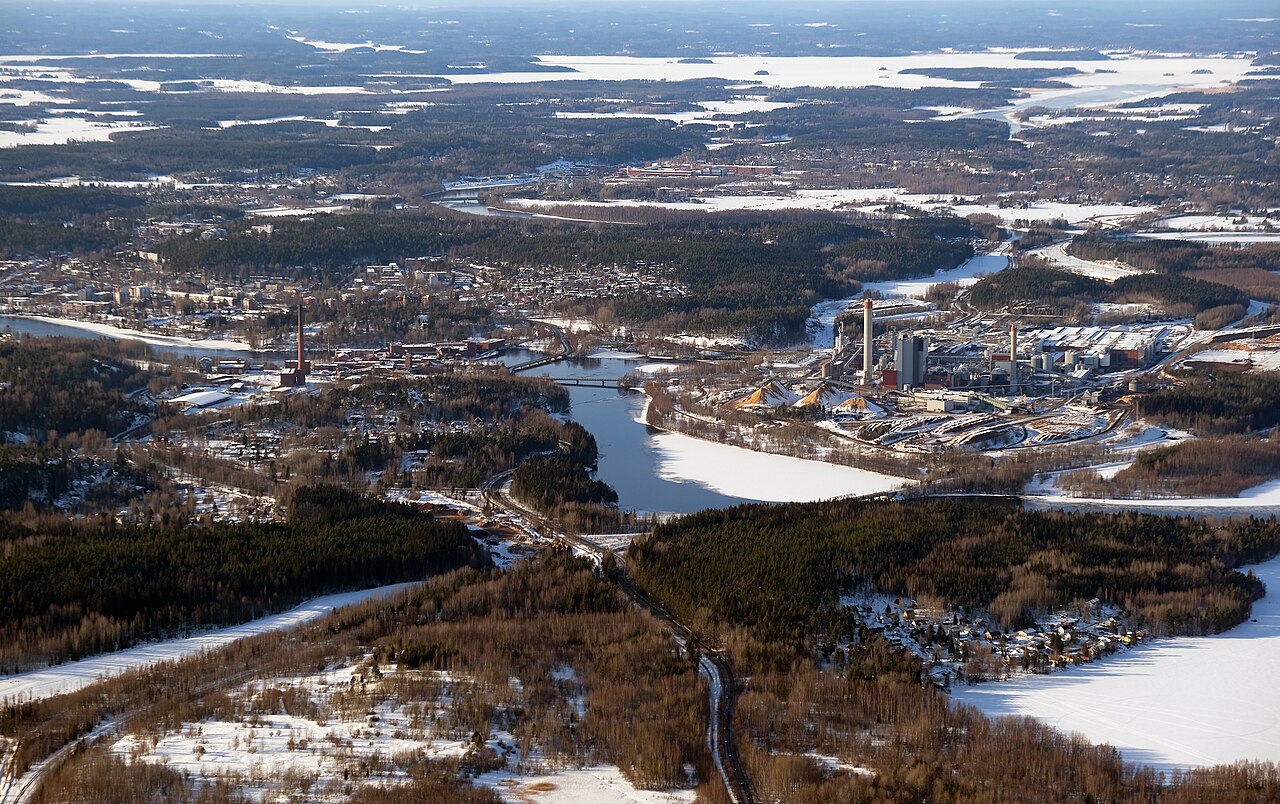
On the military map of the Baltic, the distance from Ust-Luga to Kouvola is approximately 200 kilometres. For a drone programmed to strike an oil terminal, that is the remainder of the route after a miss. For NATO — another incident on a list that is gradually ceasing to be a list of coincidences.
What happened
On the morning of 29 March the Finnish Air Force scrambled F/A-18 Hornet fighters after detecting several small, slow craft over the country’s southeastern districts and the sea. At least one of them was identified as an AN-196 “Lyutyi” — a strike drone developed by Ukroboronprom and designed to hit targets at depths of over a thousand kilometres. The Hornet pilot did not open fire — to avoid collateral casualties. The drone crashed north of Kouvola on its own.
Another craft the same day descended onto sea ice off the coast of Espoo — a suburb of Helsinki. Police cordoned off the area, and the Ministry of Defence confirmed an investigation. In total at least three unmanned aerial vehicles were detected.
Context without which the figures mean nothing
On the night of 29 March the Security Service of Ukraine for the second time in a week struck terminal facilities in Ust-Luga — a key Russian oil port on the Baltic. According to Ukrpravda and satellite images from the OSINT community Dnipro, one of the berths burned out completely, two more were damaged, and five oil storage tanks were put out of operation. The ports of Ust-Luga and Primorsk suspended operations.
The “Lyutyi” that ended up over Finland was flying as part of that same wave or one of the previous attacks. Its range — over a thousand kilometres at standard load — means the drone had enough fuel to deviate significantly from its course.
Not the first, not the last
Finland became the fourth NATO country in the region where similar incidents have been recorded in recent months. Earlier, wreckage or the devices themselves were also found in Estonia, Latvia and Lithuania after Ukrainian strikes on Russia. According to Defense News, in 2025 alliance members recorded 18 airspace incursions by Russia — three times more than in 2024. Ukrainian drones that stray off course add another dimension to that tally.
The Estonian defence minister, after the Baltic incidents, put the position clearly: responsibility lies with Russia, which is waging an aggressive war and profiting from oil exports through those very ports. Finnish Prime Minister Petteri Orpo did not go that far — he called the incident “undesirable” and demanded increased European responsibility for its own defence.
“Drones flew into Finnish territory. We take this very seriously. The investigation will continue, and more detailed information will be provided after the facts are confirmed.”
Antti Häkkänen, Minister of Defence of Finland
Where the real conflict is
Finland has been a NATO state since April 2023 and shares a 1,340-kilometre border with Russia. Kouvola is located 60 kilometres from that border and 40 kilometres from the Gulf of Finland. The appearance of a strike drone there, even without an active payload, is not simply a navigational error. It is a demonstration of how difficult it is, in conditions of a mass drone campaign, to keep strikes within the intended theatre.
So far Helsinki and Kyiv have not confirmed direct diplomatic contacts regarding the incident. Investigations are ongoing. The question is not whether Ukraine will apologise — it has already done so in similar situations. The question is whether the alliance will develop a joint protocol for responding to drones that stray off course before one of them lands not on ice, but on something else.





