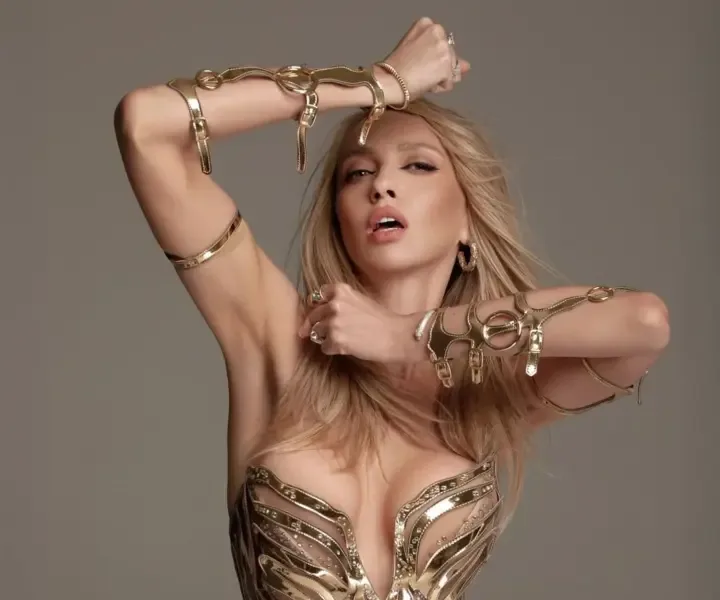
Olya Polyakova published an official letter in Instagram signed by the head of the Temporary Investigative Commission of the Verkhovna Rada Alexei Goncharenko — and commented with a single word: "I've sung enough..."
The hearing is scheduled for July 13 at 3:00 PM in the hall of the Kyiv City Council. The singer is required to confirm her participation by July 10 through a special link.
What the commission is investigating — and why it matters
In the invitation itself, as reported by RBC-Ukraine, it is stated that the TIC is checking possible violations of legislation in the field of defense, anti-corruption legislation, as well as compliance with human rights and freedoms during martial law. The reason for Polyakova's summons is not officially disclosed.
However, there is context. In April, her former producer Irina Kovalska accused the singer's husband Vadim Buryakovsky of abuse and appealed to the police — whether this is related to the summons is unknown.
Eurovision as a prequel
A parallel story provides a broader picture. Olya Polyakova submitted an application for the national selection for "Eurovision-2026," but "Suspilne" rejected her due to her performances in Russia after 2014. The broadcaster reminded that the rule prohibiting artists who performed in Russia or on occupied territories after 2014 is not subject to change.
Polyakova's team chose a different tactic. As reported by "Telegraph," producer Mikhail Yasinsky sent letters to the European Broadcasting Union (EBU) and warned:
"If the court finds the disputed provisions unlawful, this could lead to the cancellation of the national selection results and a relaunch of the contest."
Mikhail Yasinsky, Olya Polyakova's producer
So by July 13, Polyakova is simultaneously suing "Suspilne," waiting for a response from the EBU — and now must also appear before a parliamentary commission. Three fronts, different institutions, one person.
Why this is not just about a star
Goncharenko's TIC is not a specialized body on show business matters. Its mandate covers defense, anti-corruption, and human rights during martial law — matters of fundamentally different weight. The fact that a public figure is summoned to a commission with such a broad mandate without public explanation of the reasons is either pressure or a genuine investigation. The difference between the two scenarios will become clear when (and if) the meeting protocol is made public.