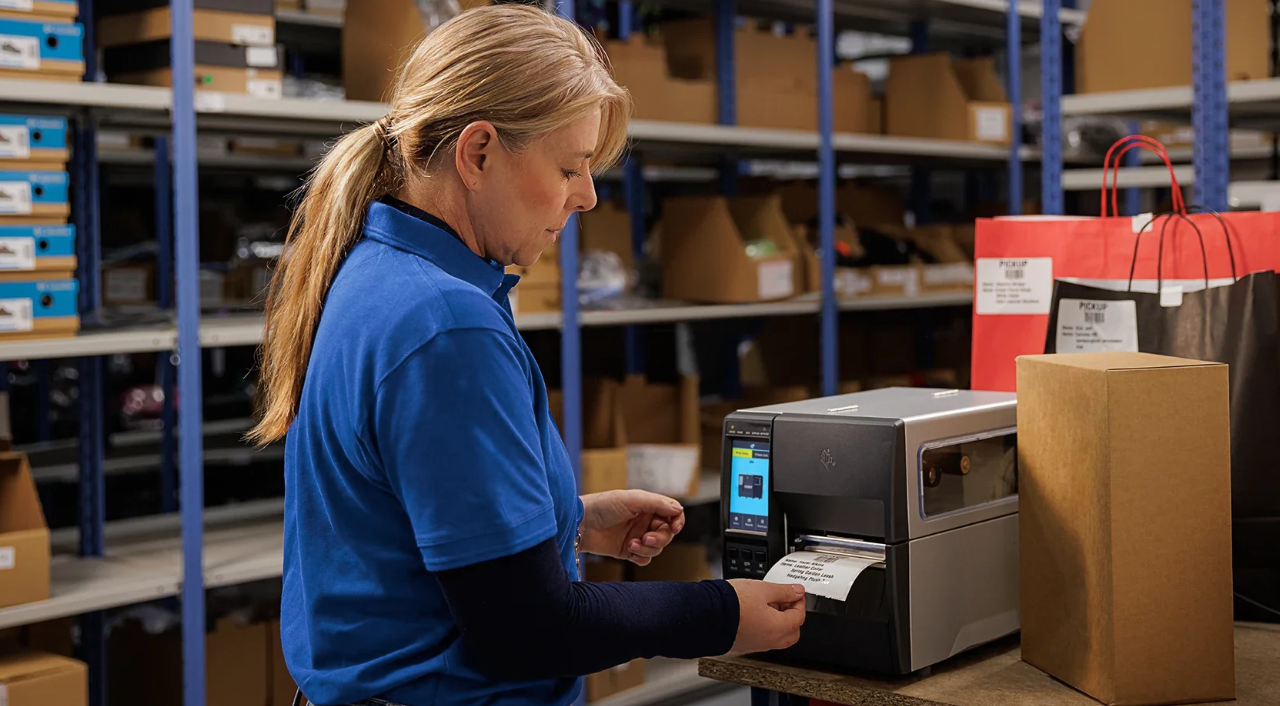
Why the choice of printer matters for business and supply chain security
In large chains and warehouses, labeling performance directly affects the speed of goods processing, inventory errors and costs. The correct label is a safety point: from the proper operation of cash registers to batch tracking in logistics. GS1 standards and the technical requirements of the Ukrainian market place specific demands on barcode quality and label durability; therefore the choice of printing technology must be justified.
How modern label printers work: briefly and to the point
There are two key thermal printing technologies:
- Direct thermal — printing on heat-sensitive paper without a consumable ribbon. Pro: fast and simple. Con: labels are less resistant to light and mechanical impact; suitable for short-term labeling (fast-moving goods).
- Thermal transfer — via a ribbon (ink ribbon). Pro: resistance to abrasion, moisture and ultraviolet; suitable for warehouses, industry and long-term storage.
Analysts from manufacturers (Zebra, Honeywell, SATO) note that in the high-turnover segment thermal transfer often becomes the standard due to the durability of labeling.
Main categories of printers
- Mobile — compact, battery-powered; useful for inventory and retail operations on the sales floor.
- Stationary — for points of sale and back office; can operate using both technologies.
- Industrial — metal housings, high speed and durability; intended for warehouses and production with a high label throughput.
Checklist: how to choose a printer for high turnover
- Print speed: assess in mm/s or labels/min — for warehouses with intensive movement you need models with high speed without overheating.
- Resolution: 203 dpi is suitable for basic barcodes; 300–600 dpi for small elements and QR codes with high information density.
- Ресурс друкуючої головки та механіки: важливо для передбачуваних витрат і часу на сервіс.
- Label type and width: check compatibility with existing materials and ribbons.
- Integration: support for USB, Ethernet, Wi‑Fi and compatibility with POS/WMS/ERP — to avoid manual operations and errors.
- Availability of consumables and service: a local network of service centers and spare parts reduces downtime.
- Label durability: for outdoor storage or aggressive conditions you need thermal transfer solutions with appropriate ribbons.
Practical parameters managers pay attention to
In addition to technical specifications, TCO (total cost of ownership) indicators are important: expenses on consumables, frequency of printhead replacements, downtime due to service. High-turnover businesses choose solutions that provide predictable operation and fast spare-parts logistics.
"For large warehouses, it's critical not only to have print quality but also regular service: quickly replacing a printhead or mechanism means maintaining throughput and avoiding delays in supply"
— Ihor Koval, Technical Director, Hold
Where to order and how to vet a supplier
Choose a supplier with a portfolio of work for chains and warehouses, certified service and the possibility of a trial run of equipment. Reputation in the industry, customer reviews and the availability of local spare parts are key signals of reliability. Companies that work with large retailers usually also offer consulting on integration with your WMS/ERP.
Brief conclusion
High turnover requires a systematic approach: choosing a label printer is a decision about operational speed, accounting accuracy and supply chain resilience. Investing in the right technology and service means reducing the risk of downtime and preserving competitiveness. If your business is rethinking labeling processes, start with a needs audit and pilot runs in real conditions.
For consultation on selecting a model and integration with accounting systems, contact certified equipment and service providers — it saves time and guarantees the operation of supply chains.





