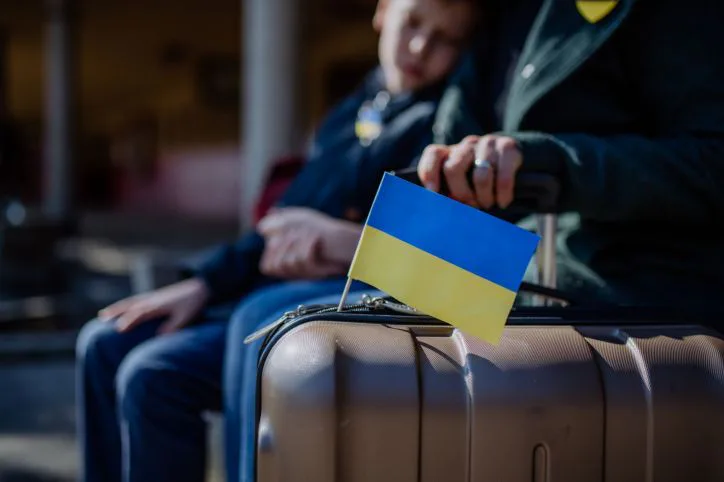
The figure itself is not impressive: 953.1 thousand Ukrainians with temporary protection in Poland is still the largest Ukrainian community in the EU after Germany. But the dynamics tell more than statistics alone. In July, 8.11 thousand people lost their status, in June — 6.3 thousand. This is not a mass exodus, but a persistent trend that has lasted for over a year.
Where are these people disappearing to? Some return to Ukraine — this is evident from overall return statistics. But a noticeable share simply crosses the border in the other direction and settles in Czechia, where by the end of June, approximately 381 thousand Ukrainians already had protection.
What Makes Czechia More Attractive
Formally, the conditions of temporary protection in Poland and Czechia are similar — both countries operate within a single EU directive. The difference lies in details that are felt at the level of a family's monthly budget.
- Rent for housing in Prague and regional Czech cities for newcomers often turns out to be cheaper than comparable accommodation in Warsaw or Wrocław, where the market has already overheated from years of demand.
- The labor market in Czechia feels an acute shortage of workers in industry and logistics, which gives Ukrainians easier employment access with higher hourly rates.
- After nearly four years of war, Poland has had time to become "tired" of the refugee topic politically — this is felt in the rhetoric of some parties and at the everyday level of tension, although official support remains.
At the same time, direct comparison does not support simplified conclusions: Czechia has a smaller diaspora and less developed infrastructure of Ukrainian schools, doctors who speak Ukrainian, legal support — all the things that Poland has built up over the years of war.
This is an Effect of Accumulation, Not a One-Time Spike
Romania (219.4 thousand), Slovakia (149 thousand), and especially Spain (272.3 thousand) also show consistently high figures — meaning this is not about panic-driven flight from Poland, but rather a slow redistribution of the Ukrainian community in the EU depending on where it is easier to find work and housing at an acceptable price.
The total number of temporary protection recipients in the EU at the end of June exceeded 4.4 million people — and this figure has remained practically unchanged for two years despite local fluctuations between countries.
The practical conclusion for those currently choosing a country: a difference of 8-10 thousand people per month is not a mass trend of "everyone leaving Poland," but rather a signal that one should calculate not the average salary in a country, but the specific cost of rent and actual demand for one's profession in a specific city. If Czechia's labor market continues to accept Ukrainians faster and cheaper than the Polish market, can Warsaw withstand the competition for human capital that it itself taught the language to and integrated over three years?