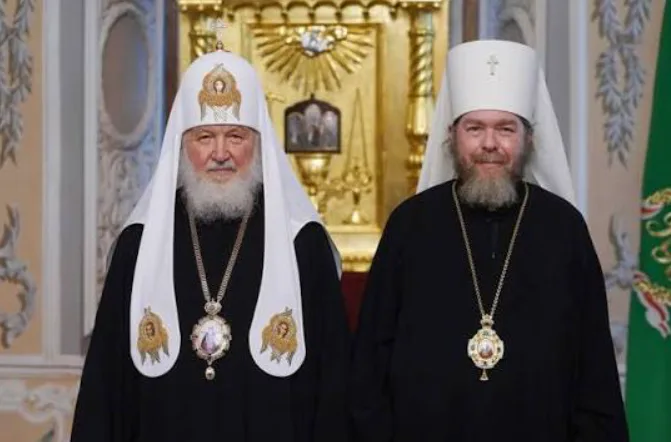
The FSB of Russia has put a period on a case that looked like a demonstrative performance from the very beginning: final charges have been brought against Denis Popovich and Nikita Ivankovych, who are accused of preparing an assassination attempt on Metropolitan Tikhon of Simferopol and Crimea (Shevkunov) — a person who has been called Putin's personal confessor for years.
Popovich now additionally appears in the case on aiding an enemy and undergoing terrorist training. Ivankovych has been charged with state treason. Previously, both were only charged with illegal trafficking in explosive devices.
Why these two specifically
Popovich is a Ukrainian native who lived in the Stretensky Monastery and was the personal secretary and treasurer of Tikhon. In other words, a person with maximum access to the closest circle of an influential church hierarch. Ivankovych studied with him at the same theological seminary, but had no direct connection with the metropolitan.
This very asymmetry — one close to Tikhon, the other not — is the practical key to the case: the FSB needed not only an "executor," but also a chain of connections that could be called a network. The treason of one automatically entails accusations for the other, even if there is no real operational connection between them.
Torture as a method of proof
Both figures deny guilt and claim that testimony against them was obtained under torture.
This is not the first or last case where confessions obtained by force become key evidence in Russian cases about "Ukrainian agents." The practical point here is simple: in a system where courts do not verify the origin of testimony, any confession becomes legally sufficient — regardless of how it was obtained.
The function of the case, not the facts
Metropolitan Tikhon is considered one of the most influential hierarchs of the Russian Orthodox Church and a person with direct access to the Kremlin. An assassination attempt on him is a narrative that allows simultaneously: to demonstrate the "treachery" of Ukrainian special services, to justify tightened control within the Russian Orthodox Church, and to divert attention from internal conflicts in the church leadership.
The question that remains open is: will at least one piece of evidence appear in this case that does not rely on confession under pressure — and does such a requirement even matter to a Russian court.