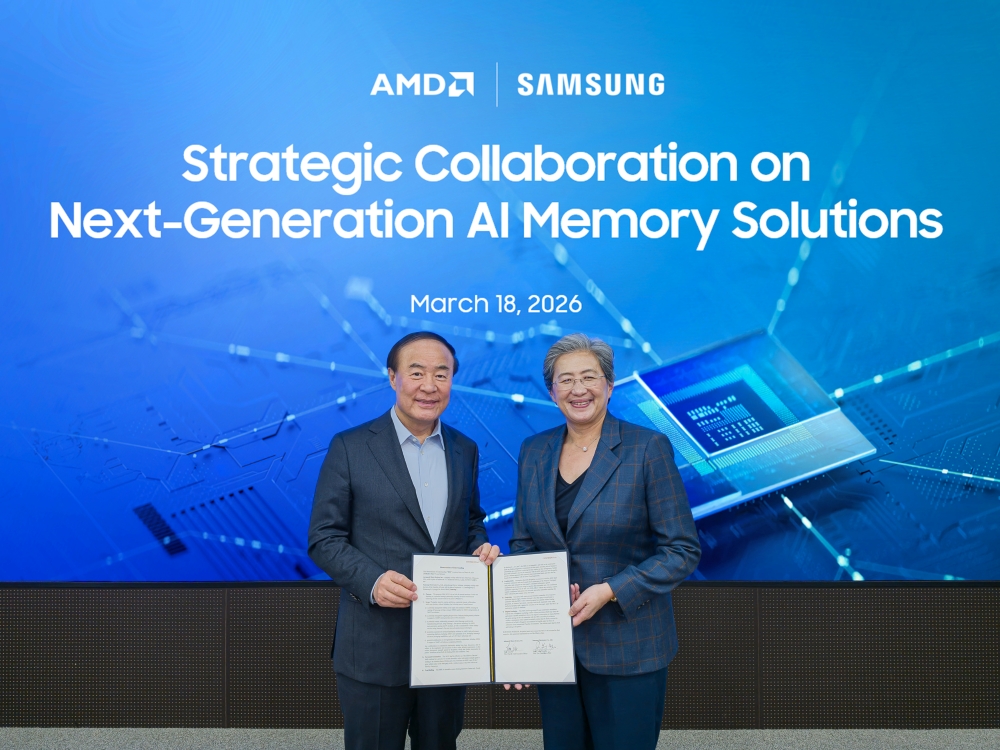
What happened
AMD has signed a memorandum of understanding with Samsung Electronics to supply high‑speed HBM4 memory for future artificial intelligence solutions. The memory is planned for use in the Instinct MI455X accelerator and in sixth‑generation EPYC server processors codenamed Venice. A source reports the agreement was signed at Samsung’s Pyeongtaek manufacturing site with AMD CEO Lisa Su and Samsung leadership in attendance.
Technical summary (short)
"Samsung Electronics' HBM4 memory is manufactured on a 10‑nm process with a 4‑nm logic die and delivers speeds up to 13 Gb/s and bandwidth up to 3.3 TB/s."
— Samsung Electronics (press release)
Explanation: the high bandwidth and low latency of HBM4 enable faster processing of large AI models, and combined with EPYC CPUs allow building dense, rack‑level solutions — important for data‑center operators and cloud providers.
Why it matters
This is not just another contract between chipmakers. HBM4 shifts the balance between memory bandwidth and compute power for modern AI architectures. For data‑center operators this means fewer memory constraints, faster model training and inference, and therefore savings in time and money when scaling infrastructure.
What this means for Ukraine
The industrial impact of such a partnership is global, but it has concrete implications for Ukraine. First, Ukrainian cloud providers and AI startups will be able to compete on a qualitatively higher level of hardware if they have access to platforms based on EPYC and HBM4. Second, faster and denser server solutions are important for defense applications: intelligence analysis, real‑time video processing, autonomous systems — all of these benefit from larger, higher‑bandwidth memory.
Risks and next steps
The partnership also highlights dependence on global supply chains. Ukrainian players should work on diversifying supplies and building local expertise in integrating such components. In addition, a memorandum is a beginning, not the final deal: industrial partners need to turn the agreement into actual deliveries and service support.
Summary
This deal is a market signal: manufacturers are investing in next‑generation memory, and platforms built on it will accelerate the development of AI applications. For Ukraine, it is an opportunity to strengthen positions in cloud services and applied AI systems, provided the agreements become real deliveries, with investments in infrastructure and training of specialists. The ball is now in the industry’s and operators’ court to turn the technical possibility into a practical advantage.








