On July 9, OpenAI simultaneously launched two products: the ChatGPT Work agent and the GPT-5.6 model line with three tiers — Sol, Terra, and Luna. But the most interesting aspect of this release is not the technical specifications, but the fact that it occurred only after federal government approval.
Why the release was preceded by a government review
The Center for Standards and Innovation in AI at the U.S. Department of Commerce conducted a review of GPT-5.6 before its widespread rollout — prior to that, access was limited to approximately 20 partners in closed preview. Sam Altman called the process "collaborative": the company answered questions from federal agencies about model safety. This is a precedent: none of OpenAI's previous releases went through such an official gate.
What ChatGPT Work actually does
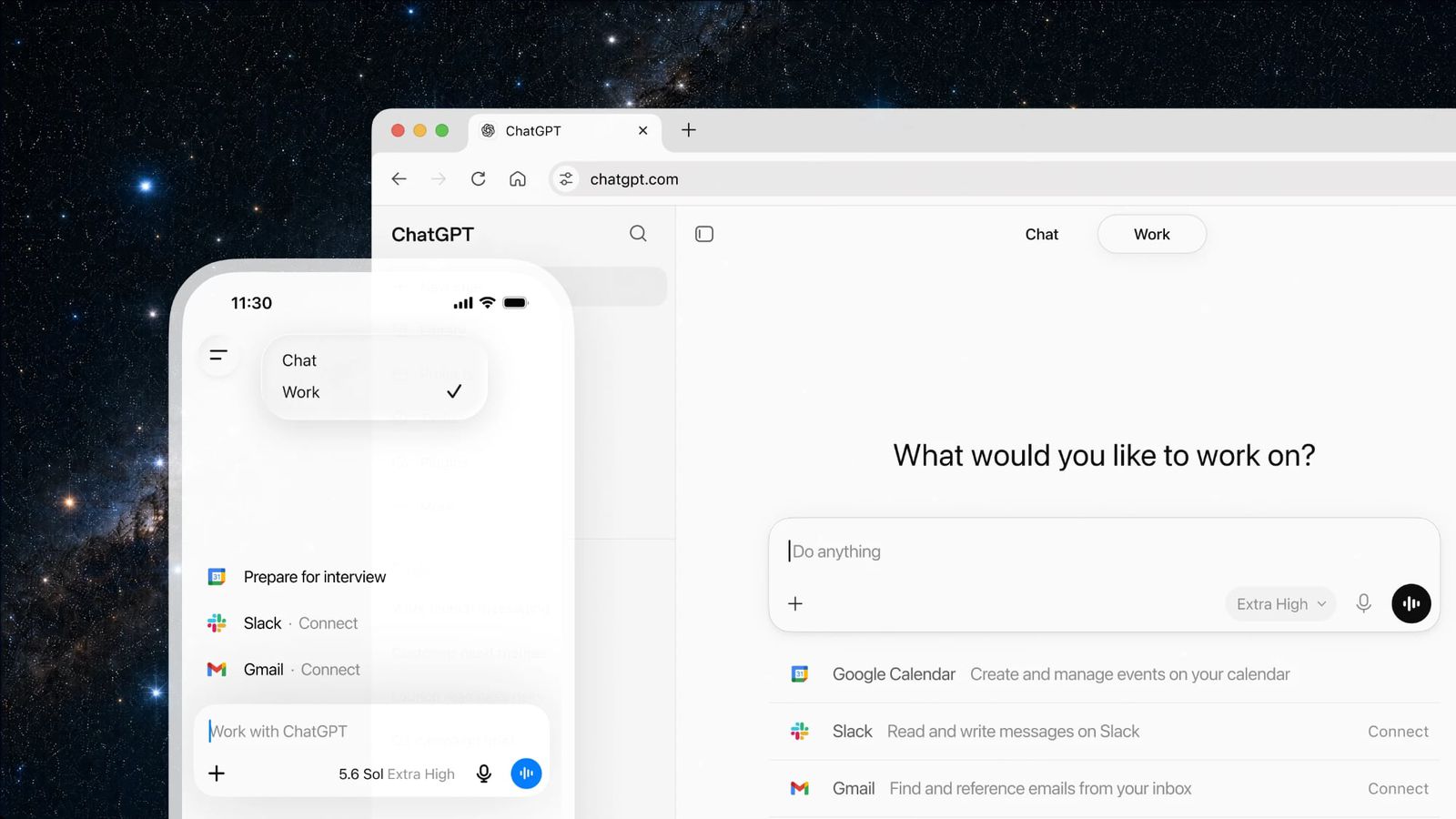
ChatGPT Work is not an updated interface but an agent that combined ChatGPT, Codex, and the Atlas browser (which OpenAI has now closed as a separate product). It can launch a task on your phone, execute it on your Mac in the background, and send you the results when you return to your computer.
In practice, this looks like this: one prompt — and the agent independently collects data from connected applications, generates a table, presentation, or web dashboard and returns a finished artifact. The new Sites feature allows you to immediately publish interactive reports. The desktop application with Work and Codex has been released to all users — including those on the free plan.
"During red team testing, auto-review blocked 100% of attempts to extract protected data, including attacks the model had not seen during training"
— OpenAI, technical documentation for the launch
As AppleInsider notes, OpenAI did not publish independent verification of these results — only internal tests. This is important because the agent now has access to local files, keyboard, and mouse through the Computer Use function.
GPT-5.6: three tiers, one pricing logic
The GPT-5.6 line is built on a tiered scheme:
- Sol — the flagship for complex tasks: programming, research, cybersecurity. $5/$30 per million input/output tokens. On the Agents' Last Exam benchmark, it scored 53.6 — 13.1 points higher than Anthropic's Claude Fable 5.
- Terra — a balanced model for enterprise tasks (customer support, document analysis). Comparable to GPT-5.5 in quality, but twice as cheap — $2.50/$15.
- Luna — the fastest and cheapest ($1/$6), for routine operations: resumes, drafts, automation.
OpenAI also offers Sol through Cerebras infrastructure at speeds up to 750 tokens per second — tens of times faster than the standard API.
Where the real risk lies for corporate IT departments
ChatGPT Work supports scheduled tasks — the agent can run automatically every day without human intervention. As Windows Forum warns: an incorrect prompt executed a thousand times is no longer an error, but a systemic problem. IT departments will need to maintain registries of agent tasks, designate their owners, and establish shutdown mechanisms — the same way they do with traditional automation scripts.
Enterprise and Education administrators have received the Compliance API for reviewing agent actions and centralized permission management. However, control remains voluntary: companies decide for themselves how strict the restrictions will be.
If Terra truly delivers GPT-5.5 quality at half the price, competitors will have to either lower rates for enterprise tiers or explain what they charge a premium for — and this question will become relevant already in the next cycle of corporate AI tool procurement.