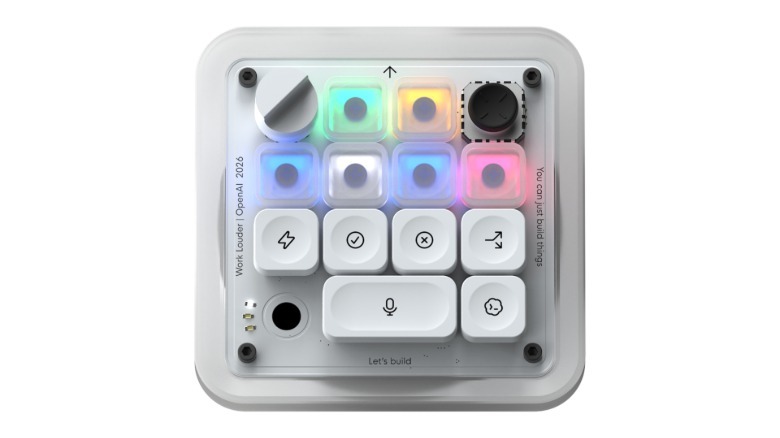
OpenAI, known primarily as the creator of ChatGPT, has entered the hardware market for the first time. The company presented Codex Micro — a compact mechanical keyboard developed together with Work Louder, an American manufacturer specializing in minimalist input devices for programmers.
The device costs $230 and is aimed not at mass consumers, but at developers who regularly work with the Codex AI agent — OpenAI's tool for writing, reviewing, and editing code in automatic mode.
What is it and what is it for
Codex Micro is not a full-fledged keyboard, but rather a specialized control module: a compact device with a set of programmable keys and encoders, designed for quick access to AI agent commands. The idea is to reduce the number of clicks and interface switches while working with Codex: launch a task, view the result, confirm or reject changes — all from a separate device without distracting from the main keyboard.
Work Louder has experience with similar solutions: the company previously released Creator Board and Creator Micro — devices for video editors and designers working with Adobe Premiere or Figma. The logic is the same: if a particular tool occupies most of your work time, it makes sense to move its control to a separate space.
Why now
OpenAI is actively promoting Codex as a full-fledged AI agent for development — not just an assistant that suggests lines of code, but a system capable of independently executing tasks in the background. A hardware device tied to this agent is a way to make Codex part of a physical workspace, not just a window in a browser.
This is also the first signal of the company's hardware ambitions. After acquiring the startup io — a team working on AI devices with former Apple designer Jony Ive — OpenAI is clearly testing how its products can exist beyond the screen.
The real limitation
$230 for a peripheral device that is maximally useful only when paired with one specific AI tool is a narrow bet. If OpenAI changes the Codex interface or the agent itself evolves into a different interaction model, the keyboard's value as a specialized device would drop sharply.
The question is not whether Codex Micro is convenient — the question is whether Codex will remain in its current form long enough to justify the investment in hardware binding to it.