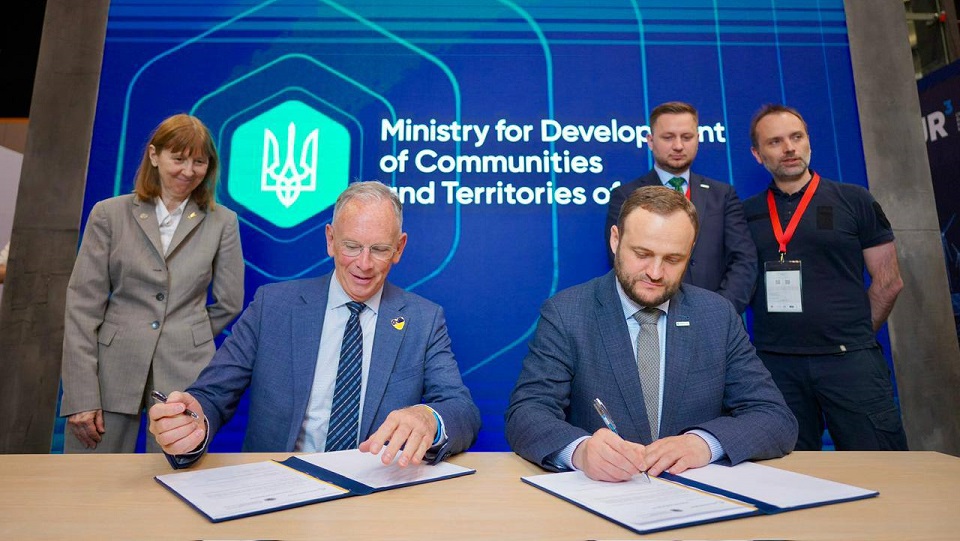
In the first quarter of 2026, Russians carried out 541 attacks on railway infrastructure and rolling stock — according to data from Ukrzaliznytsia itself. This is not statistics for statistics' sake: each attack stops evacuation trains, breaks supply chains, cuts off farmers from ports. This is why the $18 million attracted at the URC 2026 recovery conference in Gdańsk on June 25–26 is not about repairing tracks after victory.
What was signed and what the money is for
According to Interfax-Ukraine, citing Vice Prime Minister for Recovery Oleksiy Kuleba, the funds will be directed toward two parallel areas — resilience during combat operations and eurointegration of the railway network.
The first direction — situational security centers. Dispatchers operating 24/7 online coordinate responses to air alerts: stop trains, change cargo routes, organize people evacuation. Centers have already been deployed across the country, and international funds are intended to scale them up.
The second direction — preparation for ERTMS (European Railway Traffic Management System). According to Kuleba, together with the Swedish development fund Swedfund International AB, approximately 1 million euros in grant financing is being attracted for a feasibility study and a roadmap for implementing the system — without which Ukrainian trains physically cannot integrate into the EU network.
"These are decisions that will help simultaneously strengthen the resilience of Ukrainian railways in the conditions of war and continue their integration into the European transport system."
— Oleksiy Kuleba, Vice Prime Minister for Recovery
In parallel — hundreds of millions, but for something else
$18 million is only one line item on the Gdańsk agenda. According to the 24 TV channel, at the same conference Ukraine signed agreements with the EBRD and the EIB for over 470 million euros in recovery financing — for housing, roads, border infrastructure, and water supply. Separately — 90 million euros from the EBRD for energy.
Additionally, according to AIN.ua, the URC 2026 officially launched the Support Fund for Ukrainian Transport. Initial contributions were confirmed by Lithuania, Sweden, Norway, and Estonia — approximately €1 million each, except for Estonia (€100 thousand). The funds will be used for the restoration of roads, bridges, railway and port infrastructure.
What's missing from the picture
None of the public statements so far reveal the mechanism for verifying expenses: who controls whether the $18 million goes exactly where declared, and doesn't disappear in the operational gaps of the monopoly.
Economist Oleg Nivyevsky from the Kyiv School of Economics previously explained that linking railway financing to macroeconomic indicators is wrong, and the effectiveness of investments directly depends on structural reforms of the company. Ukrzaliznytsia still combines the functions of a carrier and infrastructure operator — a separation that is a mandatory condition for full integration into the EU market, scheduled no earlier than 2029.
- 541 attacks on railways in Q1 2026
- ~$18 million attracted at URC 2026 for UZ projects
- 1 million euros — Swedfund grant for ERTMS feasibility study
- Support Fund for Ukrainian Transport: initial contributions from 4 countries
- UZ structural separation — no earlier than 2029
If by the end of 2026 the Verkhovna Rada does not pass the law "On Safety and Interoperability of Railway Transport" — without which ERTMS cannot legally be implemented — the 1 million euros for the feasibility study will remain a document in a drawer.