What was announced
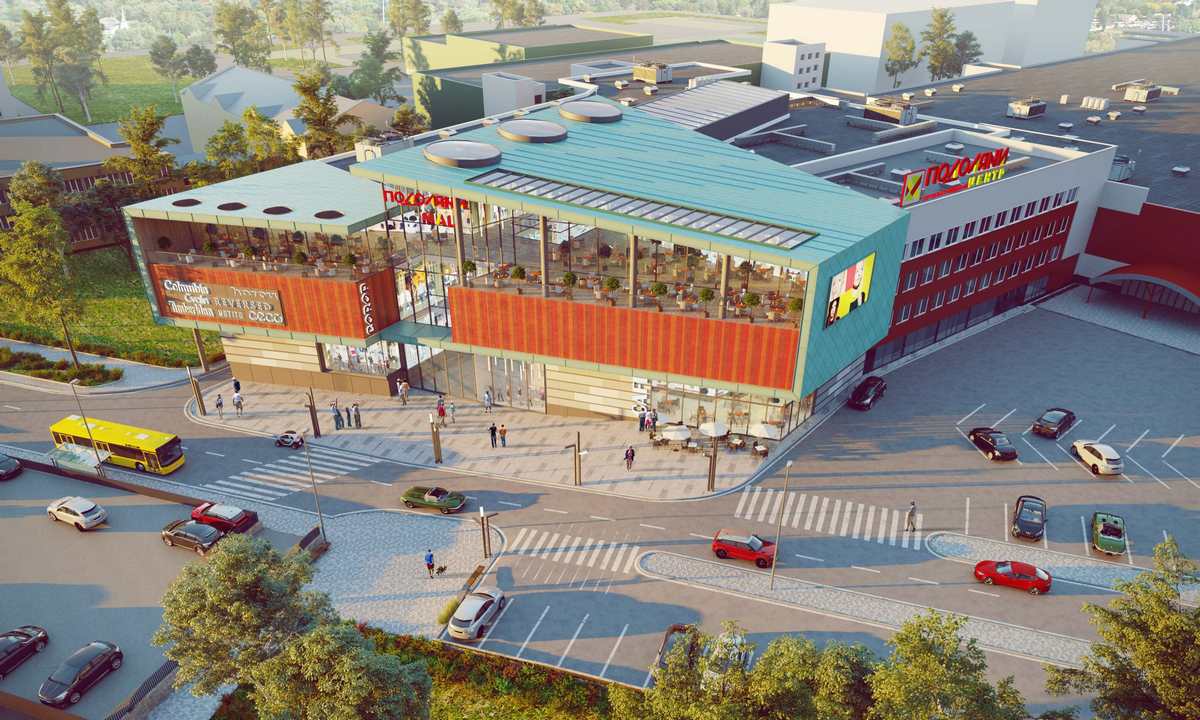
The Podolyany shopping center in Ternopil announced the opening of the second phase of the complex — Podolyany Mall — for April 2026. The plans were disclosed to LIGA.net by the shopping center’s development director, Tetiana Chubak. After completion, the total area of the complex will increase from 50,000 to 71,000 sq. m — the second phase was constructed as a separate building.
What's inside
The new building will include retail galleries, a children's entertainment center and a modern food court with access to terraces. One of the key innovations is a 3,000 sq. m radiation shelter, reconstructed on the basis of a former factory storage facility. According to the shopping center, the shelter will be able to accommodate about 4,500 people at the same time.
"The premises comply with all requirements, including ventilation and fire-safety systems, and are equipped with shower stalls, sanitary facilities and benches."
— Tetiana Chubak, development director of the Podolyany shopping center
In addition to the shelter, the complex will get a two-level parking area of 13,000 sq. m and a rooftop solar power plant with a capacity of 745 kW, which, according to the developer’s estimate, will provide roughly 70% of the shopping center’s energy independence from the grid.
Context and significance
This is the first large radiation shelter in western Ukraine integrated into a retail project, and it appears against the backdrop of announcements for around 20 new malls in 2026. For the region and the retail market, the project carries several dimensions of importance:
- Public safety. Integrating an equipped shelter into public space is a response to real risks and a need to make places where people gather more protected.
- Infrastructure resilience. The solar plant and substantial parking reduce the complex’s vulnerability to disruptions in energy and transport infrastructure.
- Economic signal. Investing in such large projects during wartime is a marker of investor confidence and the local market’s ability to adapt.
What's next
Such decisions force a reassessment of standards for new public buildings: will equipped shelters and autonomous energy sources become the norm rather than the exception? For now this is a local case in Ternopil, but it clearly reflects a trend: construction must serve not only comfort and business, but also the safety and resilience of communities.
The first phase of Podolyany opened in December 2007; now it is time for declarations about safety to be accompanied by a series of projects and investments that make those declarations a reality.







