Why this is worth reading now
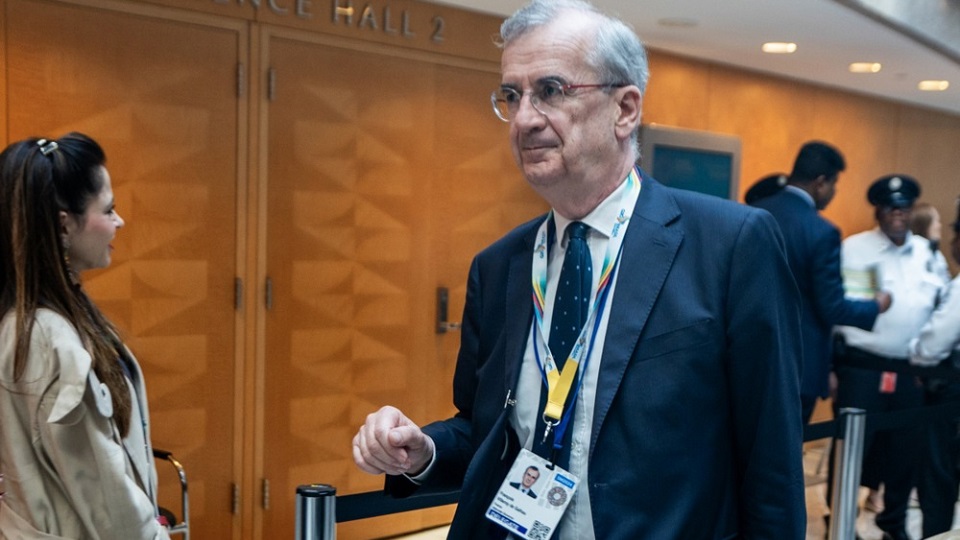
The head of the Bank of France, François Villeroy de Galhau, announced he will resign in June — one and a half years before the end of his term. The Bank of France itself reported this, AFP provided details; the Financial Times emphasizes the political consequences for Paris. For EU citizens — and for Ukraine, which watches the stability of the eurozone and the availability of financial assistance from the Western front — such changes matter not only as a personnel shift but as an element of the system.
A step into charity: the person and motives
Villeroy de Galhau, who has led the Bank of France for almost 11 years and was a member of the ECB’s Governing Council, explained that he is moving to a children’s foundation — Fondation Apprentis d'Auteuil, which works with vulnerable groups. This is not a typical move from a high financial role to private business, but a turn toward a social project, which changes how his motives are perceived and makes clear that the decision has both a personal and public dimension.
"Nearly 11 years I have spent at the head of the Bank of France and in service of the euro are — and will remain — a pride of my public service career"
— François Villeroy de Galhau, head of the Bank of France
What this means for the ECB and markets
Villeroy played a prominent role in shaping policy on interest rates and regulated products — from the well-known French savings accounts Livret A to mechanisms to curb excessive household indebtedness. His departure creates a gap in experience on the ECB’s Governing Council, where questions of monetary policy independence and political pressure are becoming ever more sensitive.
"The Governing Council has greatly benefited from the combination of realism, deep European convictions and strategic vision that he always brings to the work"
— Christine Lagarde, President of the European Central Bank
The political dimension: upcoming appointments and elections in France
The Financial Times notes that the early resignation gives the president the opportunity to appoint a successor before the 2027 presidential campaign. This is an important factor because questions of monetary independence could become a political issue during the election — especially if the far right scores highly in some scenarios. Analysts say such a move could be a way to separate a technical choice from the electoral cycle.
"Villeroy's decision to leave early may be aimed at separating the choice of his successor from the upcoming presidential elections in France, given that the independence of monetary policy is becoming an increasingly sensitive issue"
— Ludovic Subran, Chief Economist at Allianz
Brief biography and context
Villeroy is a former head of BNP Paribas, appointed governor of the Bank of France in 2015 and reappointed in 2021. As a member of the ECB’s Governing Council, he took part in decisions affecting the entire eurozone. Now his successor must be chosen amid heightened political scrutiny and high expectations for market stability.
Conclusion
This is not just a personal story — it is a move that touches on trust in central institutions, the resilience of the euro and the political dynamics in France. For Ukraine, eurozone stability matters as a factor of macroeconomic support and market predictability. The next step is up to Paris and Brussels: will the successor pass through the sieve of politics without damaging monetary independence?
Sources: Bank of France, AFP, Financial Times, remarks by Christine Lagarde and analysis by Allianz.