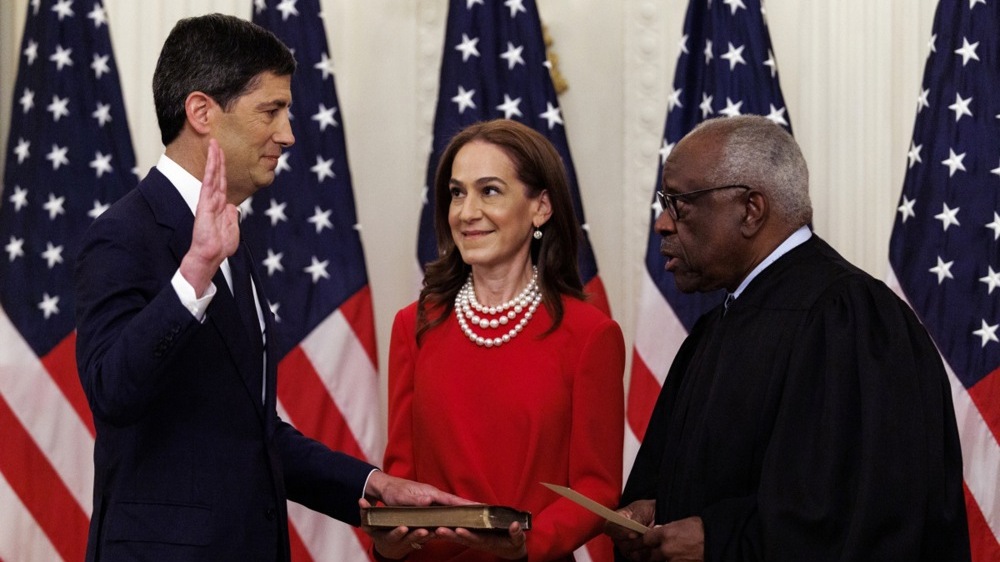
On Friday, May 22, the new chair of the Federal Reserve Kevin Warsh took the oath of office at the White House — in the East Room, in the presence of members of Trump's cabinet, Speaker Johnson, and former Vice President Dan Quayle. The oath was administered by Supreme Court Justice Clarence Thomas.
A detail that is not procedural: the last time a Fed chair took the oath at the White House was in 1987 — when it was Alan Greenspan. Warsh, by the way, is personally acquainted with him: in his remarks, he called Greenspan a person who "first showed him what this role requires".
Who is Warsh and why does Trump need him
Warsh is no newcomer to the system. He already served on the Federal Reserve Board during the Bush and Obama administrations, where he earned a reputation as a skeptic of quantitative easing programs during the financial crisis. He is currently 56 years old.
The Senate confirmed his nomination on May 13 by a vote of 54:45 — largely along party lines. The only Democrat to vote in favor was Senator John Fetterman from Pennsylvania.
Trump said at the ceremony: "I want Kevin to be completely independent and just do his job well." However, according to NBC News, back in February, in a conversation with NBC, Trump said that Warsh "wouldn't have gotten this position" if he didn't want to lower rates.
Three goals — and three obstacles
According to Charles Schwab's analysis, lowering rates from the current range of 3.5–3.75% is the most expected move from Warsh, but elevated inflation is his biggest challenge. "We expect him to try to drive rates down, but inflation above 2% will make this difficult," said Collin Martin, head of Schwab's fixed income research department.
In addition to rates, Warsh announced plans to reduce the Fed's balance sheet and change the regulator's communication style. At Senate hearings, he stated that he wants "more contentious" rate-setting meetings where "a good family argument" leads to better decisions.
There is also an institutional anomaly: Jerome Powell remains a regular member of the Board of Governors until 2028. Most former Fed chairs have left the institution after their tenure as chair ended, but a criminal investigation by the Department of Justice into expensive renovations at Fed offices — launched by prosecutor Jeanine Pirro — forced Powell to stay. Warsh will chair his first FOMC meeting next month — and his predecessor will be sitting at the same table.
"With this oath, I have accepted a high and solemn responsibility. Our mandate is to promote price stability and maximum employment".
Kevin Warsh, May 22, 2025
Warsh promised to preserve the Fed's independence in monetary policy and stated that he will never "set rates in advance" at Trump's request. At the same time, he indicated that he is open to cooperation with the administration on other matters — in particular, he proposed the idea of a new "accord" between the Fed and the Treasury Department regarding the central bank's balance sheet.
If wholesale prices rose 6% in April — confirming data on consumer inflation, which continues to expand — then Warsh's first real test of independence will come at the June meeting: will he dare to hold rates steady when Trump publicly expects them to be lowered?