What the Louvre revealed
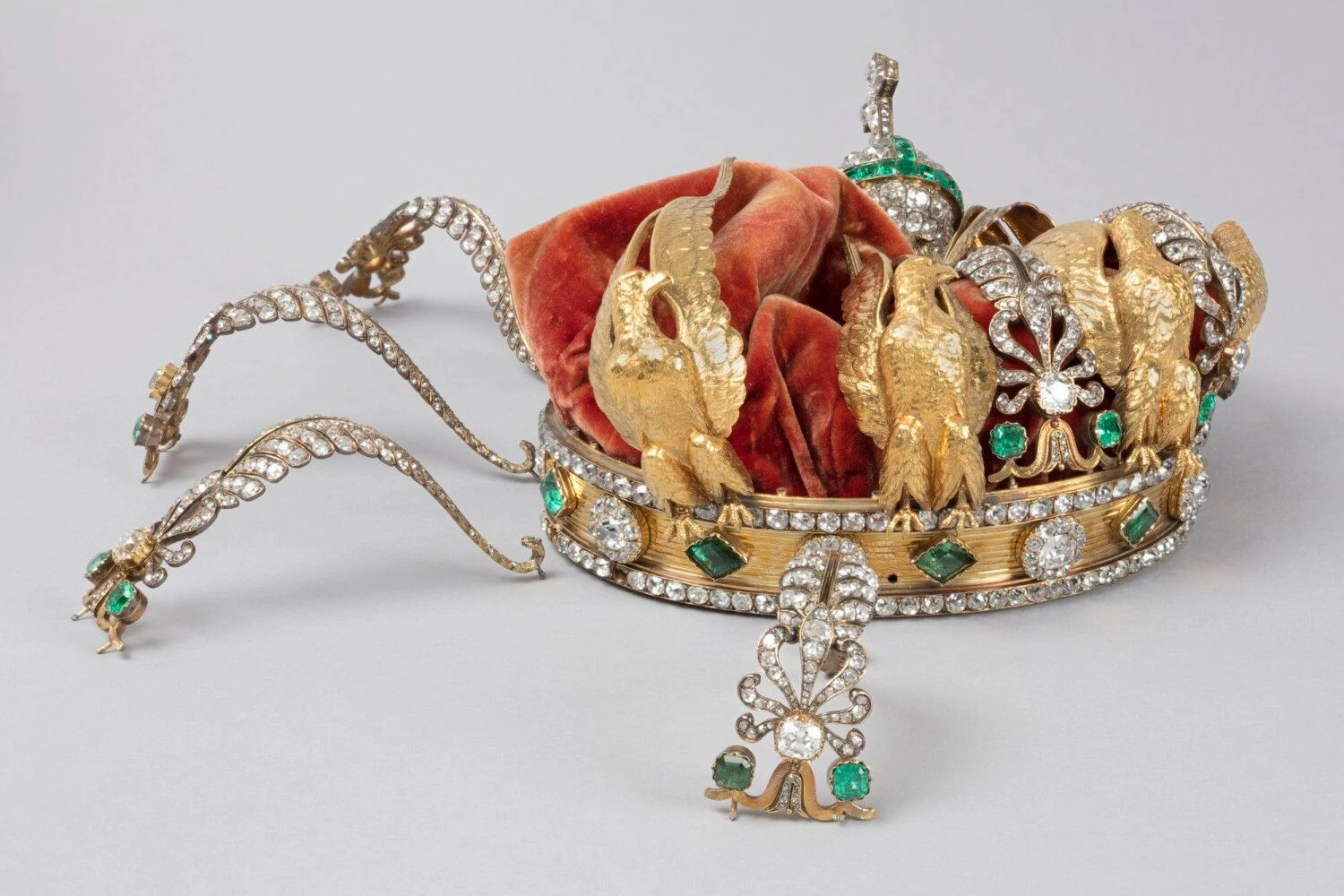
The Louvre publicly displayed for the first time the condition of Empress Eugénie’s crown, damaged during the robbery on 19 October 2025. According to the museum and in the first official report, the crown was removed through a narrow opening made with a grinding tool, which deformed the frame.
How much was lost — and what was saved
Key conclusion from the experts: the relic retained almost its entire assemblage, making full restoration technically possible. Of the eight golden eagles only one is missing; all 56 emeralds remain in place; of the 1,354 diamonds about ten very small stones are missing.
Despite the altered shape of the frame and decorative palmettes being chipped in places, the diamond‑emerald orb remained attached to the mount — an important factor for the artifact’s final appearance.
“The diamond‑emerald orb is intact and still attached to the crown’s mount”
— conclusion of the experts from the Louvre restoration group
Who will restore it and how it will be done
An advisory committee has been created for the restoration, chaired by the president of the Louvre, Laurence des Cars. The committee includes art historians, mineralogists and curators, as well as representatives of five of France’s oldest jewelry houses — Mellerio, Chaumet, Cartier, Boucheron and Van Cleef & Arpels.
According to official documents, the final restoration will be carried out by an accredited specialist selected through a competitive process in accordance with the Heritage Code. Because nearly all elements have been preserved, the work will focus not on reproduction but on conservation and correction of the shape — which increases the chances of returning the crown to display condition without simplification.
Why this matters (and why it matters for Ukraine)
First, the case illustrates how modern tools and organized actions can damage valuable artifacts without destroying them completely. Second, the careful work of restorers and the support of leading jewelry houses demonstrate that national heritage can be restored — if the state and institutions are willing to invest knowledge and resources.
For Ukraine this story resonates particularly strongly: protecting museum collections and planning rapid restoration measures are an integral part of cultural security. The Louvre incident is a reminder that even icons of world heritage require modern security protocols and swift coordination of specialists.
What next
After the competitive selection, the accredited restorer will begin work and the results will be made public. This provides museums with an example of how to combine technical skill and transparency of process — key factors in public and international trust.
The Louvre incident is not only about the 1855 crown; it is about how modern society values and protects its history. Whether the global museum community will draw the necessary lessons remains an open question.