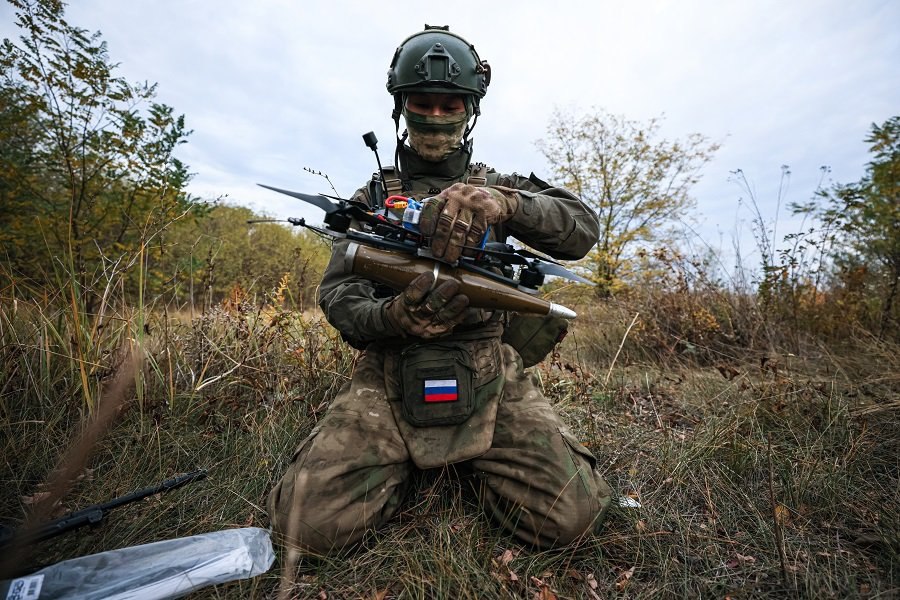
Scale of detections
Systematic intelligence work shows: the frontline is filling up with drones. According to a National Guard spokesman, in the area of responsibility of the first corps "Azov" radio-electronic reconnaissance systems simultaneously detected 1800–2000 drones — and that excludes those operating over fiber-optic links.
"Our radio-electronic reconnaissance systems detected 1800–2000 drones just in the area of responsibility of the National Guard's first corps 'Azov'. And we must understand: those are only the ones operating on radio frequencies, and there are also those on fiber-optic links, which may not have entered the detection zone."
— Ruslan Muzychuk, spokesman for the National Guard
Where it's noticeable
The command emphasizes: particularly intensive use of UAVs is observed on the Pokrovske and Ocheretyne axes. On these sectors the intensity of infantry assaults has somewhat decreased compared to previous months, but not because the threat has lessened — because the enemy has readjusted its tactics.
"Russia is using an especially large number of drones on the Pokrovske and Ocheretyne axes."
— Oleksandr Pivnenko, commander of the National Guard
Why it matters
The saturation of the sky with drones changes the practical situation on the battlefield. An increased number of drones makes effective use of armored vehicles impossible, complicates the delivery of ammunition and resupply of units, and also places additional strain on air defense and electronic warfare (EW) systems. Drones that transmit data via fiber-optic links or operate with low radio visibility are generally harder to detect with traditional EW means.
Analytical context
Analysts point out: these are not isolated cases but part of a broader trend. According to analyst Syrskyi, Moscow plans to significantly scale up its unmanned operations resources — to levels measured in tens of thousands of personnel and systems. In that context, those who have a balanced strategy win: air defense, EW, counter-drone measures and logistical reserves.
In short: it is not only a question of quantity — it is a question of technological and operational rearming of the front.
What’s next — equipment and partnership
The response must be comprehensive. Both classic solutions are needed (strengthening air defense, mobile countermeasures) and modern ones — operational EW systems, counter-battery reconnaissance, counter-drone complexes and adapting logistics to constant unmanned pressure. The expert community agrees that partner support in the form of effective EW and air defense solutions will remain a key factor in the coming months.
Conclusion. The massiveness and heterogeneity of the drone threat force a rethink of tactics: from armored operations to supply delivery. This is a challenge that requires both domestic reforms and rapid, technologically focused deliveries from partners. While drones fill the skies, Ukraine’s task is to make the air as useless to them as possible.





