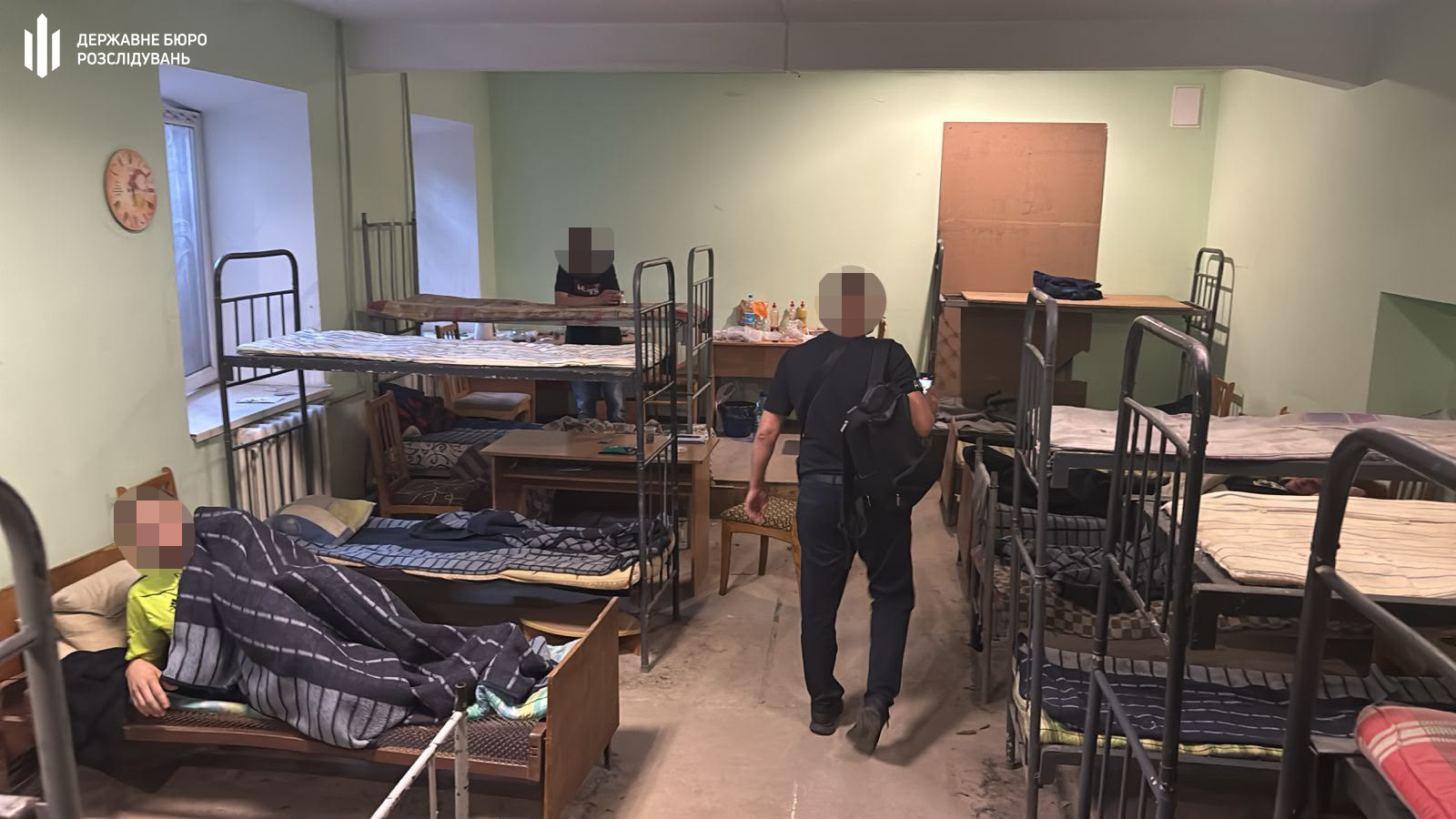
On June 16, the State Bureau of Investigation released the results of an operation at one of the district territorial recruitment and social support centers in Odesa region. What was seized during searches — rubber batons, hammers and other items — the investigation qualifies as torture instruments, not service equipment.
How the scheme worked
According to the SBI, six military servicemen of the territorial recruitment center (TCC) acted together with three representatives of a local public organization involved in locating and delivering citizens. Men were held illegally in TCC premises — without proper legal grounds for detention. They were subjected to physical and psychological violence, and the investigation established separate instances of violent acts of a sexual nature.
"During searches, law enforcement seized rubber batons, hammers and other items that were used for physical impact on citizens."
State Bureau of Investigation, June 16
All nine were arrested. Suspicions were announced under three articles of the Criminal Code: torture (Part 3 of Article 127), unlawful deprivation of liberty (Part 2 of Article 146) and robbery committed by an organized group (Part 4 of Article 186). The court chose a preventive measure — detention without the right to bail.
Motive: metrics, not oath
A key detail documented by the investigation: violence was applied not out of personal cruelty, but to improve mobilization indicators. This transforms the crime from a criminal excess into a systemic failure — when metrics become more important than the law.
The Odesa case is not isolated. As Informator.ua reports, in Zakarpattia the SBI opened a separate investigation following the death of a 29-year-old man who spent two days in a temporary detention center at a territorial recruitment center. The case was opened under an article on abuse of power by a military official during martial law.
333 times: what the numbers say
Ombudsman Dmytro Lubinets presents statistics illustrating the scale of the problem: in 2022, 18 complaints about TCC actions were received by his office, while by the end of 2025 — already 6,127. A 333-fold increase over three years. Only in 2025, based on the ombudsman's materials, 34 criminal proceedings were opened against TCC representatives.
- 28,212 proceedings for violations of military registration rules were opened by the TCCs themselves in the first half of 2025 — against citizens.
- 34 criminal proceedings were opened against TCC employees based on the ombudsman's materials in 2025.
- Video evidence of conflicts often disappears due to lack of or disabled body cameras, — Lubinets notes.
Lubinets also publicly criticizes a practice he called "busification" — detention of citizens without proper legal authority: "The law directly does not grant them such authority," — the ombudsman emphasizes regarding actual detentions carried out by TCC military servicemen.
Reform without mechanism
The authorities announced a large-scale reform of the recruitment system — digitalization, "Reserve Offices+", review of powers. But none of the publicly announced plans yet includes an independent control mechanism directly in places where citizens are detained. The Odesa case showed: internal control did not work — the crime was stopped by external SBI investigation.
If the reform does not provide for mandatory video recording in TCC premises and independent monitoring with access rights without prior notice — the next "Odesa case" will be only a matter of time, not an exception to the rule.







