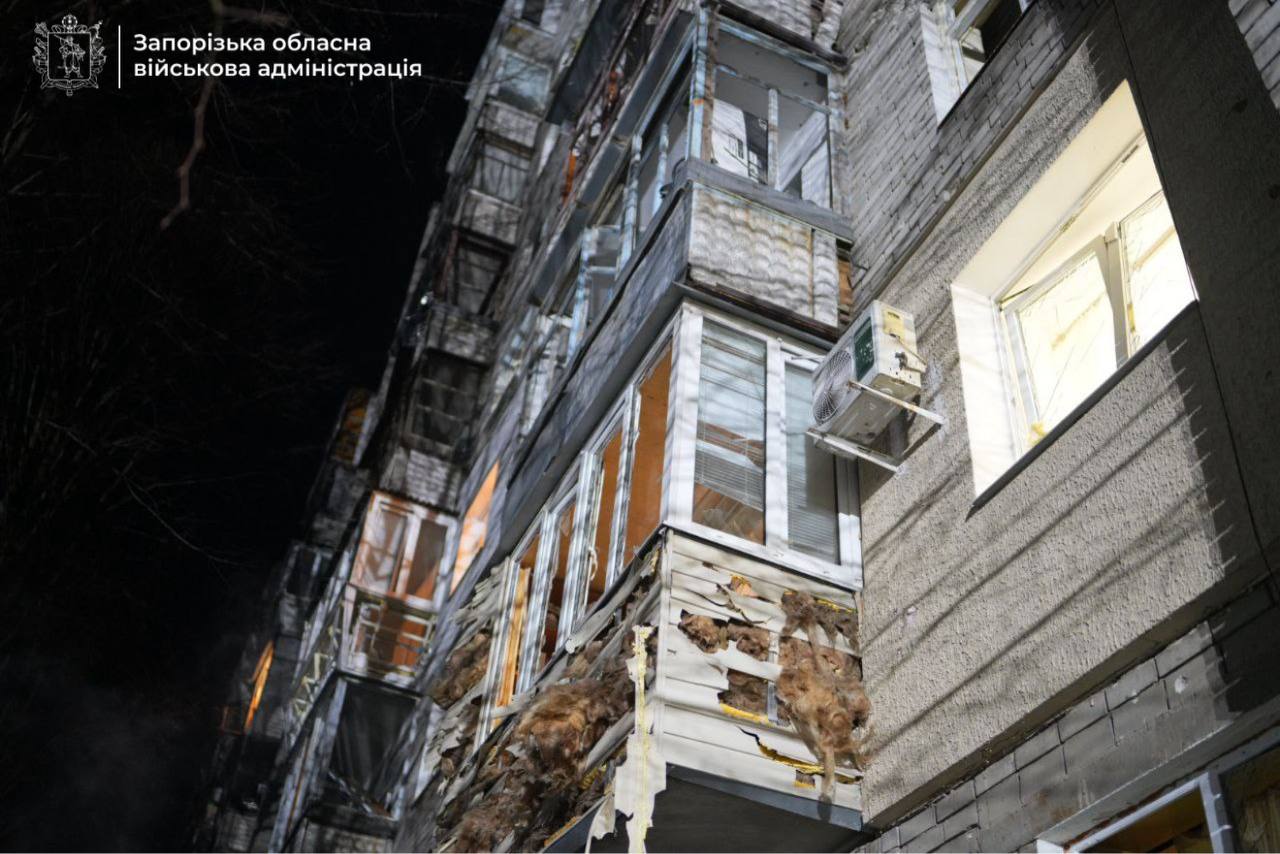
What happened in Zaporizhzhia
On the evening of December 31, at around 20:00, an air-and-drone strike was carried out on Zaporizhzhia. According to the head of the Zaporizhzhia Regional Military Administration, Ivan Fedorov, a multi-story residential building was damaged, several cars caught fire, and one person was injured.
"Emergency services are already eliminating the consequences and providing the necessary medical assistance."
— Ivan Fedorov, head of the Zaporizhzhia RMA
An air raid alert was declared in the region due to the threat of strike UAVs; an enemy drone was detected over the city. In the evening the threat was accompanied by a deteriorating situation, but the work of rescuers and medical teams limited the number of casualties.
Scale of attacks across the country
Earlier that day the enemy attacked several districts of Zaporizhzhia: reports indicate damage to three apartment buildings, three private houses and non-residential premises. The air raid alert in the city lasted more than four hours; several fires occurred, but according to services there were no fatalities during the daytime strikes.
On the night of December 31 a massive drone attack was also recorded on Odesa — six people were injured, including three children. Drones also struck Bila Tserkva in Kyiv region: there are injured people and damaged apartment buildings.
According to the UNITED24 platform, in 2025 Russia has already fired over 60,000 guided aerial bombs (KAB) at Ukraine, about 2,400 missiles and more than 100,000 drones. These figures give an idea of the intensity and tactical shift of the strikes.
Why this matters
First, drone attacks are not isolated incidents but a sustained campaign that is transforming the risks to civilian infrastructure and the safety of cities. Second, this tactic creates constant pressure on emergency and medical services: even one wounded person means resource expenditures and the risk of escalation with repeated strikes.
For the reader, this is a question of the safety of home and family: some attacks hit residential neighborhoods and children, as in the case of Odesa. It is also a test of the ability of cities and the state to maintain critical infrastructure under constant drone fire.
What next
So far operational services are responding quickly and minimizing the consequences, but the trend is predictable: increased use of strike UAVs requires strengthening air defense systems, modernizing civil protection services and international support in equipment and training.
Analysts emphasize: UNITED24 statistics and on-the-ground facts show — this is not a random escalation, but a targeted campaign of a pressure strategy. Now the ball is in the partners’ court: declarations and deliveries must be turned into practical solutions that save lives and homes.
Whether there will be enough resources and political will in 2025 to reduce risks to civilians and strengthen air defense is the key question for the coming months.





