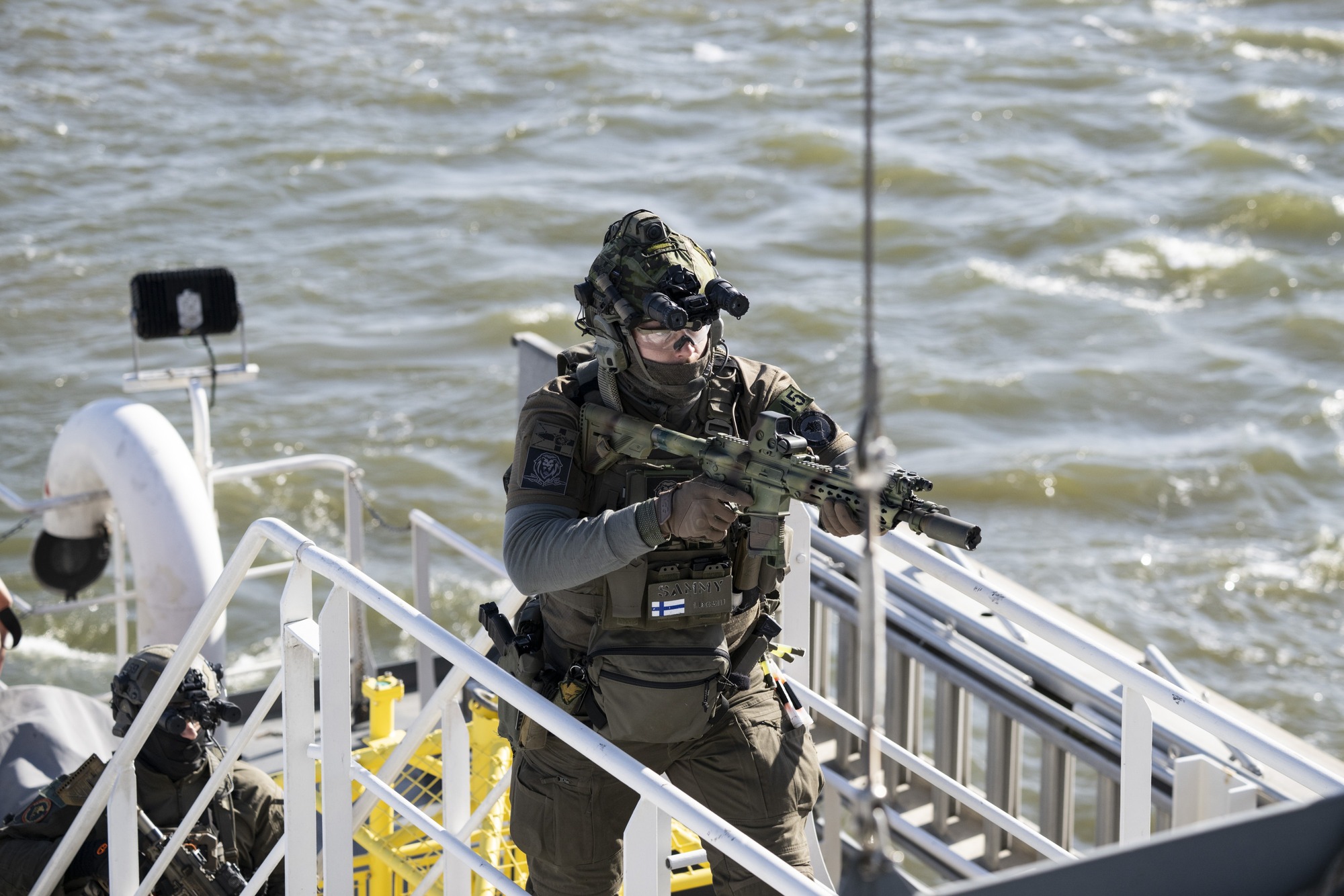
Michael Classson, Sweden's Defence Chief of Staff, formulated the threat in comments to The Times without diplomatic softening: Russia is already capable right now of conducting a limited naval operation in the Baltic — and the most likely target is an island. Not for conquest. For testing.
The Logic of "Minor Provocation"
According to Classson, the Kremlin does not believe in victory in open confrontation with NATO — and this restrains it from full-scale aggression. Instead, Moscow chooses the tactic of gradual escalation below the threshold of open war: occupy a small territory, declare a "symbolic show of force" — and wait. If the Alliance responds in a fragmented or slow manner, Russia gets an answer to the key question: how real is Article 5.
Classson emphasizes that Moscow will continue such tactics regardless of how the war in Ukraine ends. But the completion of combat operations will give it something critical — time to regroup and freed resources for operations on the eastern flank.
Gotland: A Holiday Island with Nuclear Geometry
Although Classson did not name a specific island, the strategic context is unambiguous. Gotland — Sweden's largest island — is located approximately 330 kilometers north of Kaliningrad, where Russia's Baltic Fleet is based. If air defense systems and anti-ship missiles are deployed there, Moscow effectively closes the airspace over most of the Baltic Sea — and cuts off the sea route to the Baltic states.
"This would mean the end of peace and stability in the Northern and Baltic regions."
Sweden's Commander-in-Chief Michael Bydén — on the scenario of Gotland's capture
Sweden restored permanent military presence on the island back in 2016, after the annexation of Crimea. After joining NATO in March 2024, the pace accelerated: American amphibious brigades practice landings at local airfields, Polish and British units — amphibious operations. Air defense systems RBS-15 have been deployed on the island and the 18th Regiment has been revived.
But there is a problem. Atlantic Council analysts note: to capture Gotland, Russia needs two battalion tactical groups of marine infantry from Kaliningrad — against one Swedish combat group on the island. The force ratio is between 1.6:1 to 2.1:1. This is below the textbook standard of "3:1 for an offensive," but sufficient for an operation with an element of surprise.
Trump as a Variable
This is where the second level of the scenario appears. Classson directly links the risk of provocation to Donald Trump's rhetoric about US willingness to defend European allies. The Pentagon, according to Washington Post, has already prepared a memorandum stating that the United States "is unlikely to provide substantial support to Europe" in the event of Russian military action — the nuclear umbrella remains, but conventional assistance — is in question.
According to CEPA, Russia has planned large-scale "Zapad-2025" exercises for autumn 2025, which simulate a full-scale conflict with NATO including cyberattacks and nuclear signaling. Gotland figures on the maps of staff officers from both sides — marked with zones of electronic warfare along the Swedish coast.
Where the Real Vulnerability Lies
The paradox is that Gotland's militarization — the correct response — creates a new problem. The more obvious the island becomes a NATO "unsinkable aircraft carrier," the more neighboring islands — Finland's Aland Islands, Norway's Svalbard — remain demilitarized under international treaties. They become more attractive as alternative targets for a "minor provocation."
- Aland Islands (Finland): demilitarized under the 1921 treaty, despite 58% of Finns supporting military presence on the archipelago.
- Svalbard (Norway): the 1920 treaty prohibits military bases — Russia has a coal mine there and several hundred citizens.
- Gotland: already fortified, but rapid force buildup in a crisis depends on logistics across the Baltic — where Russia is actively increasing electronic warfare suppression.
Sweden has made its choice and is strengthening Gotland. But Classson's scenario is not about a specific island. It is about the fact that NATO has still not developed a unified rapid response procedure for "minor" violations that formally may not automatically trigger Article 5.
If by the end of 2025 the "Zapad-2025" exercises demonstrate Russia's actual capability for limited naval operations in the Baltic — will NATO manage by that time to agree not on a declaration, but on a concrete protocol: what counts as a threshold for a collective response and who commands first?





