Sakharov Prize 2025: what happened and why it matters
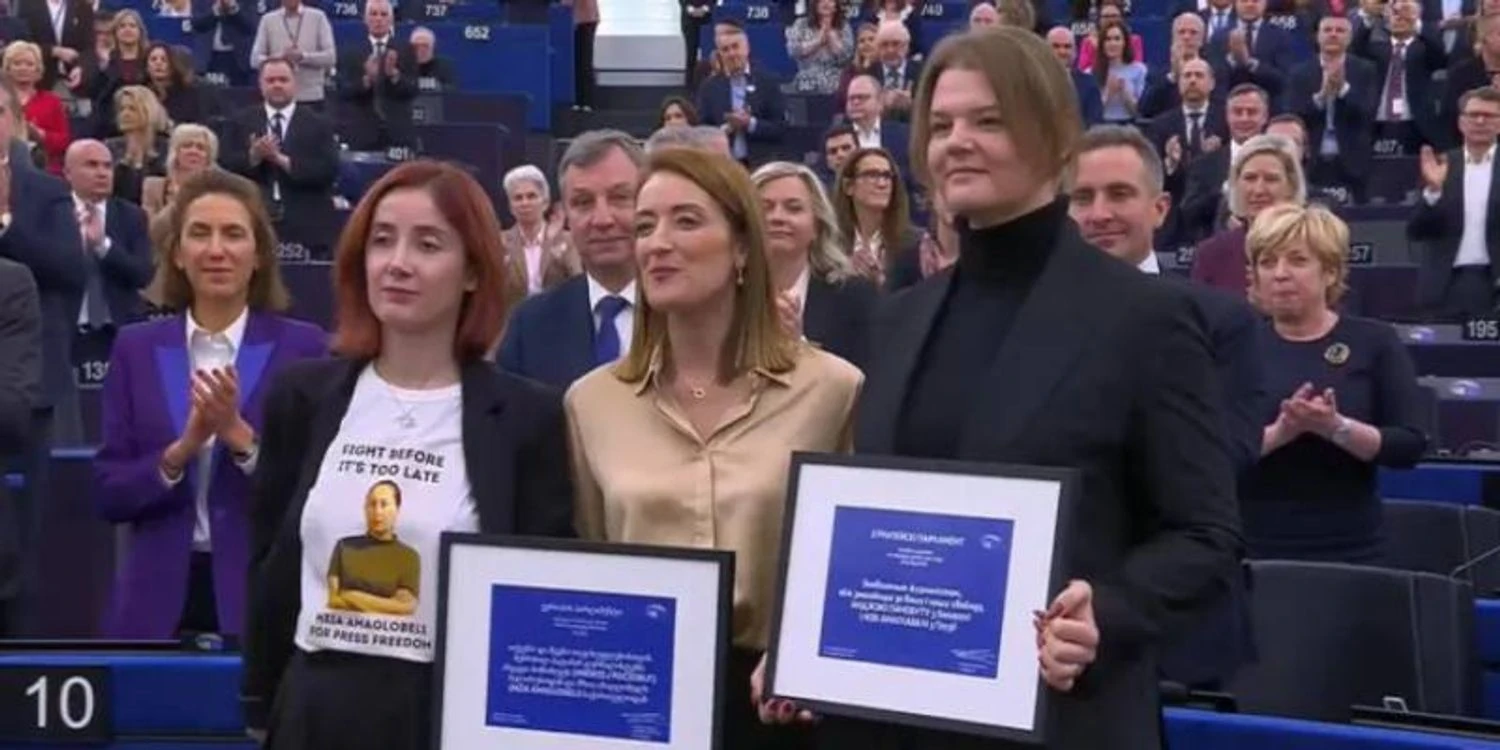
The European Parliament awarded the Andrei Sakharov Prize for Freedom of Thought to this year’s laureates — the Belarusian journalist Andrzej Poczobut and the Georgian media professional Mzia Amaglobeli. Since both are behind bars, their representatives received the awards. The information was published by the European Parliament; the reports were also circulated by Ukrainian news agencies, including UNN.
Quotes that speak for themselves
We did not choose this path, but every day we choose hope and the belief that truth and human dignity still matter. Since he cannot be here today, I hope he somehow knows: he has not been forgotten
— Yana Poczobut, daughter of Andrzej Poczobut
I accept this award on behalf of my fellow journalists who are fighting in Georgia today to save journalism as such. They work tirelessly so that you hear the voice of civil resistance in Georgia and so that the truth is not drowned out
— Mzia Amaglobeli (statement read by Irma Dimitradze)
Facts not to miss
Andrzej Poczobut was sentenced in Belarus to 8 years in a penal colony; he has been imprisoned since 2023, and was recently not included on the pardon lists. Mzia Amaglobeli, the founder of independent outlets, was sentenced in August 2025 to two years' imprisonment for allegedly "resisting the police" during an action that involved the use of stickers.
The context is broader: according to monitoring, in Georgia from May 2024 to 2 May 2025 there were 342 recorded cases of violations of journalists' rights. In Belarus, as early as March 2021 the Prosecutor General's Office opened cases against representatives of the Union of Poles, among them Andrzej Poczobut and other activists.
Europe’s stance and the practical meaning of the award
The Sakharov Prize is not only a symbol. As the EU's leading human rights award, it serves as a public marker of attention to specific cases of persecution. Awarding the prize to imprisoned journalists signals that the issue of freedom of expression remains on the European Parliament's agenda and requires not only declarations but concrete measures — from sanctions to support for independent media and legal assistance.
What it means for the region and for Ukraine
This ceremony is part of broader pressure on authoritarian practices in neighboring countries. For Ukraine, it is important that the EU maintains attention to freedom of expression in the region: this strengthens arguments in favor of international support for Ukrainian media, the protection of investigative journalism formats, and assistance programs for political prisoners and their families.
Conclusion: from symbol to action
The awarding of the Sakharov Prize to Andrzej Poczobut and Mzia Amaglobeli is a clear gesture of solidarity. The next step is up to partners: to translate symbolic support into concrete instruments of pressure and assistance — otherwise there is a risk that important messages will remain only on paper. Whether Europe is ready to reinforce this signal with practical steps is a question whose answer will determine the effectiveness of protecting freedom of expression in the region.







