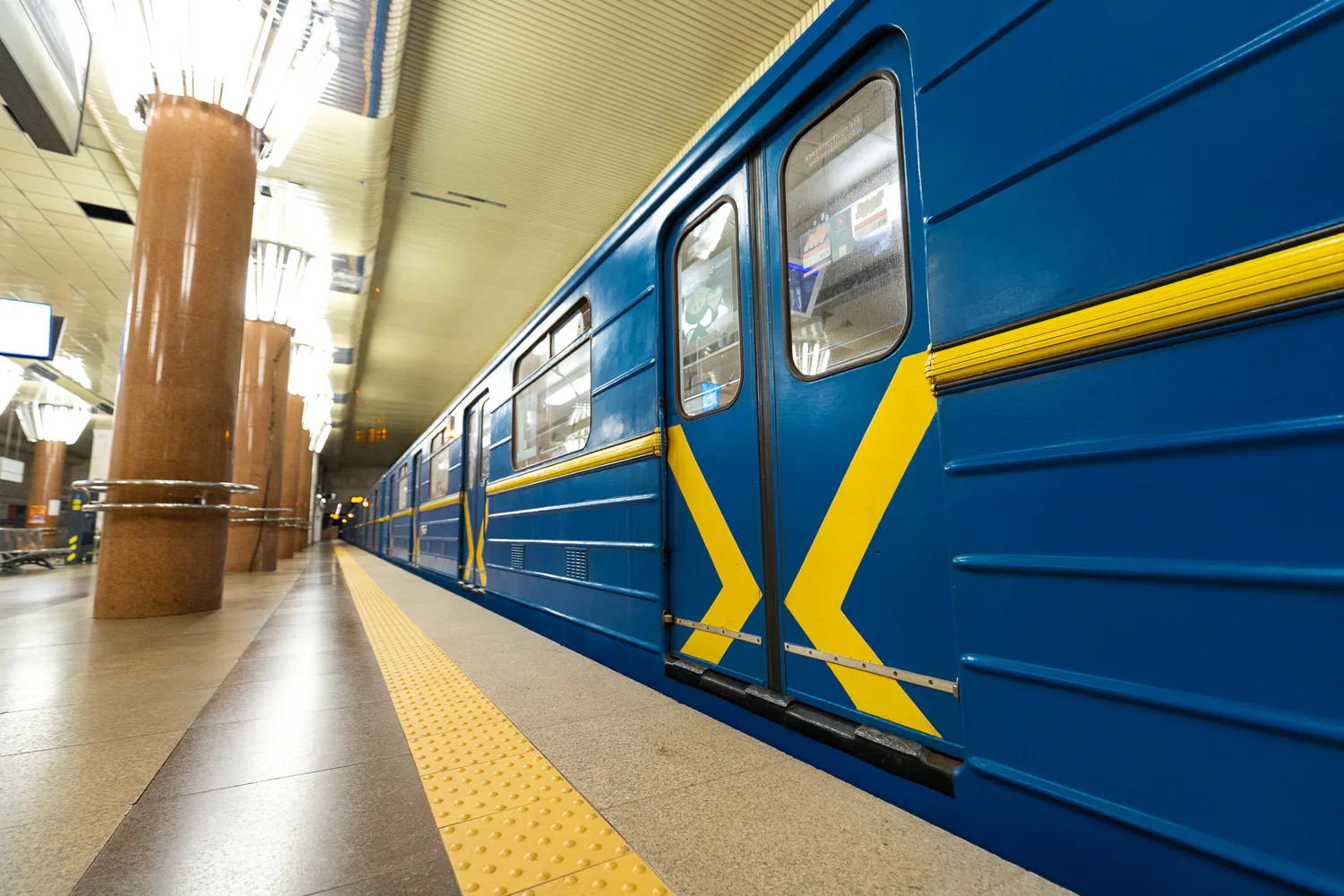
Imagine a typical morning: you're commuting on the Syretsko-Brovarsk line, an air alert is announced — and the train stops right in the tunnel for an unknown duration. This is what life looked like for Kyivans during almost every "yellow" alert in recent months. Now this is supposed to change: the Syrets-Pechersk line will operate without interruptions, and curfew will be shortened.
What exactly will change
President Volodymyr Zelensky announced the decision following a report by Prime Minister Serhiy Koretsky. According to the head of state, Kyiv will review the algorithms for public transport operations during air alerts.
In particular, during the yellow level, the Syrets-Pechersk metro line will operate fully. The city of Kyiv has been tasked with significantly expanding the number of ground public transport units to compensate for stops on the Syretsko-Brovarsk metro line during alerts and to duplicate the corresponding metro route between the "Lisova" and "Dnipro" stations with ground transport.
The president added that curfew time in Kyiv will be shortened, and authorities of other cities will be offered to review its boundaries taking into account real security needs and business operations.
Why now
The formal reason is the launch of a new two-level air threat warning system that Zelensky announced earlier: the yellow level would basically correspond to drone attack threats, while red would be announced in case of missile, including ballistic, danger and mass attacks. The logic is simple: if drones are detected over Kyiv almost daily, stopping the metro and imposing curfew with the same strictness as during a missile strike is no longer security but rather an economic and everyday life paralysis for millions of people.
But there is also a second, less official reason — pressure from below. On the eve, Kyiv Mayor Vitaliy Klitschko announced that the Capital's Defense Council suggested to the government to change security protocols and allow the Syrets-Pechersk metro line to operate without restrictions during air alerts. Kyiv also proposed to ease the curfew, in particular for logistics work and so passengers could get from train stations after train arrivals. In other words, when Zelensky announced the decision as a presidential initiative following the prime minister's report, it had already been sitting on the table for several days as a demand from the Kyiv city administration.
Who benefits
For the Office of the President to announce the change themselves, rather than wait for Klitschko to publicly push it through the city council, is a matter of political authorship. The history of confrontation between Bankova and the Kyiv city administration is not new: any decision concerning Kyivans' security automatically becomes a reason for competition over who exactly "took care of people." In this case, Zelensky took the initiative for himself, presenting the changes as a result of a government report, not a concession to the mayor's demands.
At the same time, Kyivans also win — regardless of who receives the political dividends. Business dependent on night logistics, passengers who got stuck at train stations because of the curfew, and simply people tired of standing in a tunnel during another "yellow" alert, receive real relief, not just a declaration.
An honest frame
There is no clear villain here: the decision is technically correct and long overdue. But the fact that it appeared only when the city administration publicly announced its demand raises a question: why didn't such algorithm adjustments happen earlier, through regular channels, without public dispute over authorship? If it's about the safety and convenience of millions of people, decisions should be made proactively, not after an opponent first voices the problem.
One practical question also remains open: will the new scheme withstand a real stress test? The entire structure is based on the "yellow" level meaning a drone threat and "red" meaning missiles. But what happens if a missile attack begins suddenly during morning rush hour, when the Syrets-Pechersk line is already operating at full capacity, and the signal to raise the alert level arrives with a delay?