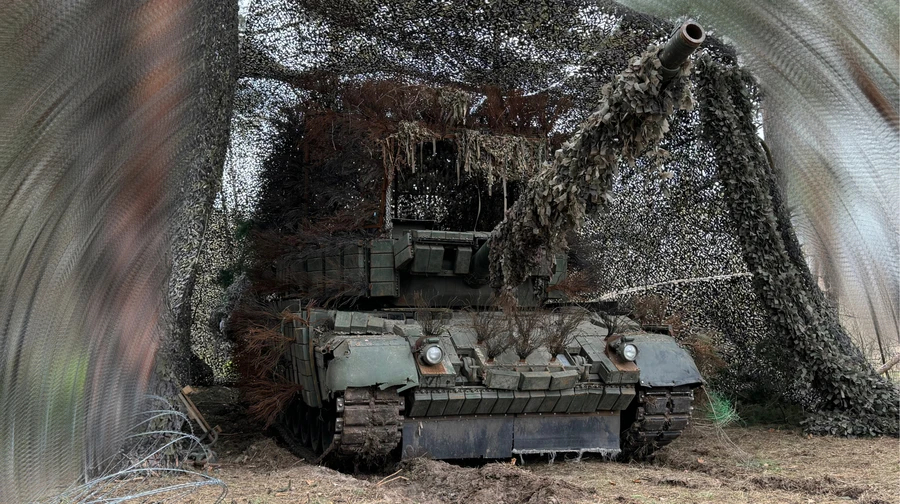
A Leopard 1A5 from the 1st Tank Battalion of the 5th Separate Heavy Mechanized Brigade received 52 hits from Russian FPV drones and Molniya-type loitering munitions over the course of one day in February 2026. The crew survived. The tank was returned to service. This is reported by Oborona citing soldiers from the brigade.
What saved the vehicle
The Leopard 1A5 is a tank developed in the 1980s, not originally designed for an environment where drone-kamikaze swarms operate. The 5th Brigade's crews adapted it independently. Back in September 2024, the brigade developed its own protection standard, which received the unofficial designation Leopard 1A5V.
The modification provides several levels of protection simultaneously:
- "Mangal" — a welded cage above the turret that forces drones to detonate before contact with armor;
- Ukrainian-made ERA — dynamic protection blocks on the turret, glacis, sides and stern;
- Chain-link mesh on the sides — catches FPVs before detonation;
- Grates and chains on the engine-transmission compartment — absorb shrapnel;
- "Hedgehog" — tangled steel cables that damage drone propellers when they approach.
On top of everything — a camouflage net with branches in position: the tank stands in a bunker, and even with constant enemy air surveillance, the time between detection and bringing the next drone to bear provides a chance for survival.
"Molniya" — not FPV
Among the 52 strikes were not only FPVs. Molniya is a loitering munition made of plywood, plastic and cardboard with an electric motor. According to Oborona, it carries 3-5 kg of explosives (often a TM-62 mine), flies up to 40 km at speeds of 72-90 km/h and is difficult to recognize by radars due to its hull materials. Its task is not the maneuverability of FPVs, but mass and explosive effect. The combination of both types in a single attack is an attempt to overwhelm the defense: FPVs strike accurately, Molniyas strike hard.
Tactical context
According to the brigade's soldiers, modern tank combat in this sector of the front essentially rules out maneuvering in open terrain. Equipment operates from prepared covered positions, and movement only occurs under cover or at night. This contradicts the classical doctrine of Leopard 1 employment, but reflects the reality where even a brief stop in open terrain means detection.
"The tank withstood 52 drone strikes. The crew is alive. The vehicle is in service."
Oborona, April 2025, citing the 1st Tank Battalion of the 5th Separate Heavy Mechanized Brigade
Leopard 1A5s that arrived from several European partners were initially criticized for outdated armor. The 5th Brigade's experience shows that the level of protection is determined much more by field modifications than by the original design.
An open question remains: if 1A5V-level protection allows for withstanding over 50 strikes per day, will this standard be officially scaled up to all Leopard 1A5s in the Armed Forces of Ukraine — or will it remain an initiative of individual battalions pending centralized funding and ERA component supply?