When a Patriot missile costs over a million dollars and a Shahed costs around $50,000, the mathematics of air defense becomes a bloody economic failure. This is precisely the gap that "Baton" from Edrone is stepping into — an interceptor that has passed codification and appeared on Brave1 Market amid the most intense attacks of the entire war.
Two drones — two tasks
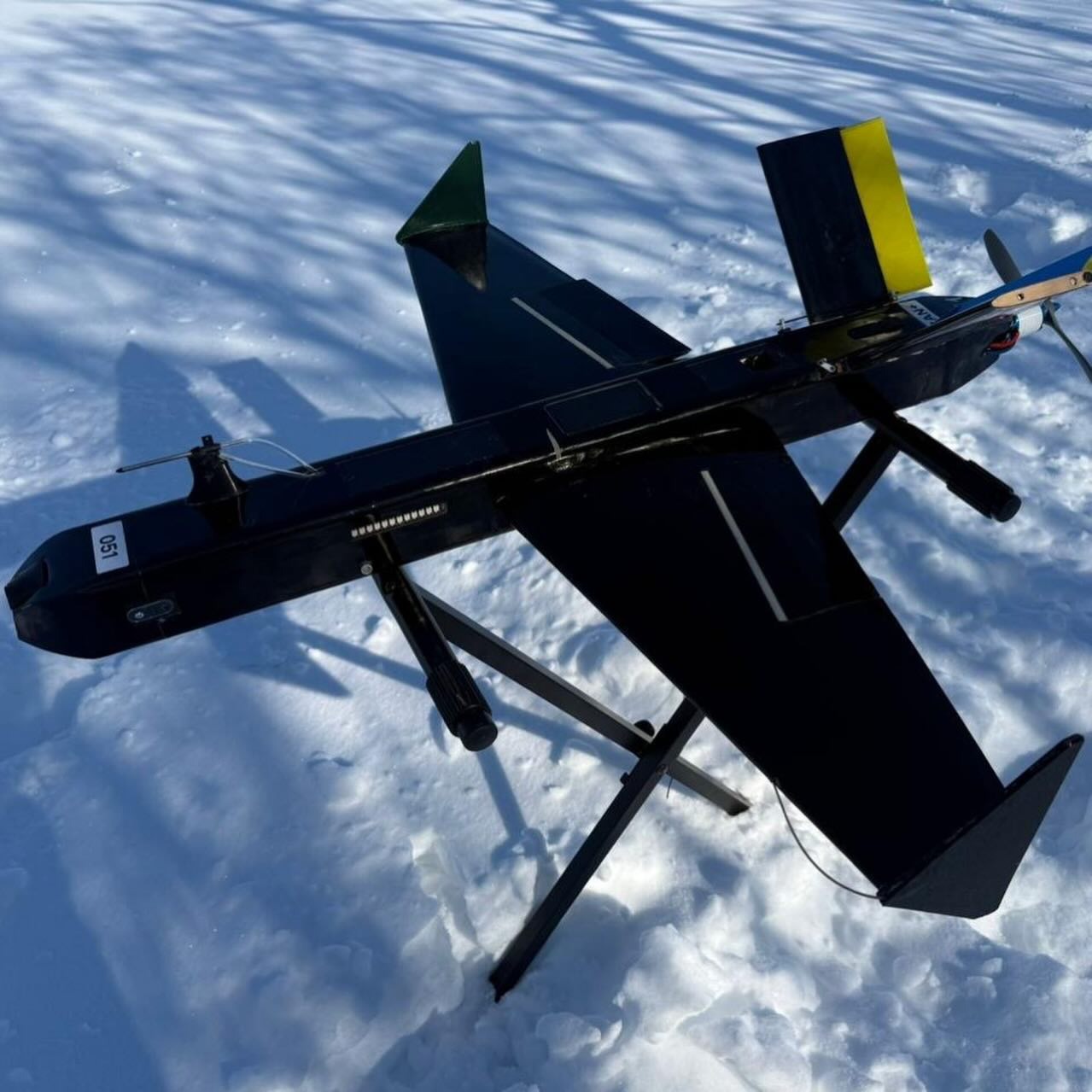
The lineup consists of two modifications with fundamentally different application logic. Baton Interceptor Wing — fixed wing, high speed, designed for mass threats: waves of Shaheds flying toward power plants or water utilities. Baton Interceptor Copter — multirotor, more flexible in maneuvering, for more targeted interceptions over specific objects.
According to Edrone's CEO Viktor Yevpak, both variants will initially be deployed in Cherkasy region, after which coverage is planned to expand to front-line zones.
"You have no idea how much work and effort it cost us to prepare and test. We worked under conditions of limited time, resources, and very bad weather."
Viktor Yevpak, CEO Edrone
Context that changes the scale
Baton is entering the market not in a vacuum. According to analysts at drone-warfare.com, in winter 2025–2026 Russia launched approximately 19,000 combat and reconnaissance drones in 90 days — with monthly production of roughly 3,000 units. Meanwhile, 40–60% in some salvos consisted of unarmed foam "Geranium"-decoys worth about $10,000, aimed at depleting expensive interception systems before the actual strike.
This is why on Brave1 Market, the price of one interceptor ranges from 50,000 to 100,000 hryvnias ($1,140–$2,275), as noted by Ukrainian Pravda. At such a cost, even a "disposable" interceptor is economically justified against any target in a salvo — unlike an air defense missile.
Edrone — no newcomer
The company already has a reconnaissance-strike FPV copter Baton DRAKON in its portfolio, positioned as a competitor to DJI Mavic, and Baton Optic — a strike drone with fiber-optic control, codified in May 2025. Interceptors are a logical completion of the lineup: from strikes on ground targets to protecting airspace over your own facilities.
What this means for infrastructure protection
Ukrainian manufacturers are demonstrating a competitive approach: according to Interesting Engineering, the SkyFall P1-SUN drone costing about $1,000 shot down over 1,500 Shaheds in four months. The Pentagon is already studying Ukrainian developments for its own needs — Military Times confirms that the American side is in negotiations to purchase interceptors from several Ukrainian companies.
- Codification passed — drones can be officially purchased through DOT-Chain and Brave1 Market
- First deployment — Cherkasy region, critical infrastructure facilities
- Two types of threats — mass salvos (Wing) and targeted interceptions (Copter)
- Price logic — interceptor cost is tens of times less than the target cost
The main unknown is not technical specifications, but production scale: Russia is increasing the pace of attacks faster than most manufacturers can supply interceptors. If Edrone can reach serial production within the coming months — Baton will become a real element of layered defense. If not — another promising development that remains in pilot project status until the next wave of attacks.