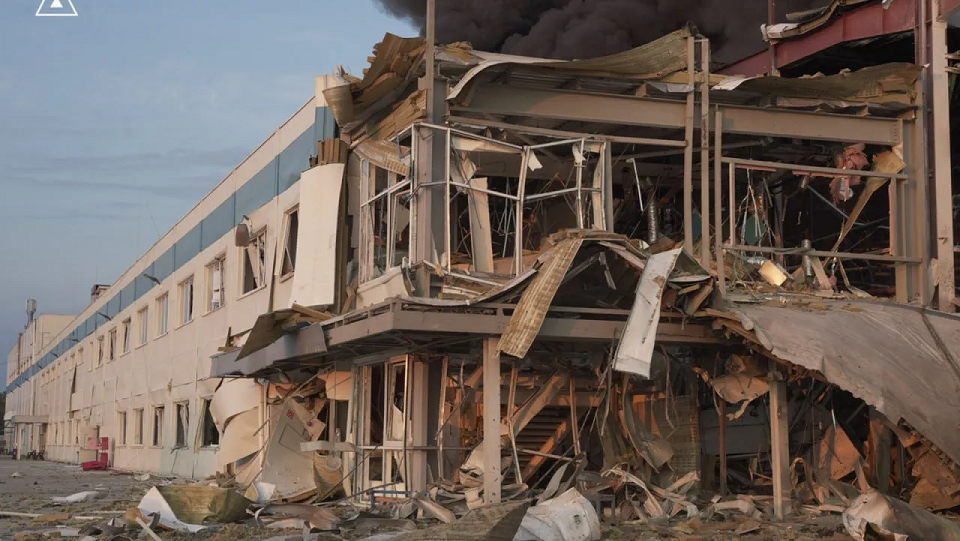
In mid-April, seven Russian drones destroyed a grain terminal of American agricultural company Cargill in southern Ukraine in three minutes. A truck driver standing nearby filmed the attack. "This is impossible. This is impossible," can be heard in the recording, which was verified by The New York Times. For the company itself, the strike was a second publicly unwelcome incident: in 2022, Russia seized part of Cargill's assets in occupied Kherson region.
Systematics, not coincidence
Until summer 2025, Russia had practically not deliberately attacked American businesses in Ukraine. "I don't remember Russia specifically attacking American companies in Ukraine before 2025," Jim O'Brien, who held the position of assistant secretary of state for Europe and Eurasia before Trump returned to power in January 2025, told NYT. After that, something changed.
In June 2025, the Kyiv office of Boeing came under fire — the company employs about a thousand specialists in Ukraine. In August, two cruise missiles hit the plant of American electronics manufacturer Flex Ltd. in Mukachevo — hundreds of kilometers away from the front line. Then came Coca-Cola's turn: attacks were recorded on a power plant and a solar station near the company's plant outside Kyiv. Local authorities believe the American plant itself was the target. Facilities of Mondelez, Philip Morris, and grain giant Bunge also came under fire.
According to a February 2026 survey, 47% of American companies in Ukraine suffered losses during the full-scale war, 38% lost employees.
Asymmetry of response
Washington's response proved minimal. After the Flex plant strike in August 2025, Trump only said: "I told him I didn't like it" — and changed the subject. In 2026, the administration did not publicly condemn any documented attack on American assets. NYT sources described Washington's response as "acknowledgment of concern." The State Department limited itself to a statement that it "calls on both sides to refrain from attacks on American business interests."
"The administration's response is silence. Complete silence."
Senator Jean Shaheen (Democrat, New Hampshire), member of the Senate Foreign Relations Committee, after a briefing by representatives of Coca-Cola, Cargill, and Bunge in February 2026
Shaheen signed a bipartisan Senate resolution condemning "targeted attacks on American companies in Ukraine to deter American investments." The resolution remains a declaration — without enforcement mechanisms or sanctions.
Mirror contrast
In parallel with silence over strikes on American assets in Ukraine, Washington took the opposite step in another direction. After Ukraine struck the Sheskharis oil terminal in Novorossiysk on November 25, 2025, the State Department sent Kyiv an official diplomatic note of protest. The reason: the terminal services Kazakh oil through the Caspian Pipeline Consortium, where American Chevron is a shareholder.
Ukrainian Ambassador to the United States Oksana Stefanishyna publicly confirmed receipt of the note: "We heard from the State Department that we should refrain from attacks on American interests." In other words, American interests in Russia turned out to be better protected than American interests in Ukraine — at least at the level of diplomatic responses.
What lies behind the silence
Russia's motivation remains a subject of debate. Some Ukrainian business circles believe the attacks are an element of a general campaign against economic infrastructure without regard to the owner's nationality. Another version: Moscow is testing whether Washington will protect its investors in a country with which it just signed an agreement on a joint investment fund. On April 30, 2025, the United States and Ukraine signed an agreement on the Reconstruction Investment Fund, which gives American investors priority access to the energy sector.
Andy Handler, head of the American Chamber of Commerce in Ukraine, called on Trump to "stand with American business in Ukraine" and "show Putin that the United States protects its own." Russia continued the attacks.
Alexander Romanishin, former deputy minister of economy of Ukraine, formulated the stakes precisely: either Washington sends a clear signal that American business abroad is protected, or it silently accepts a precedent that "other authoritarian regimes will study very carefully."
If by the end of 2026 the Trump administration does not respond publicly to at least one documented attack on American assets in Ukraine — the companies that remain will have every reason to reconsider whether it's worth staying.