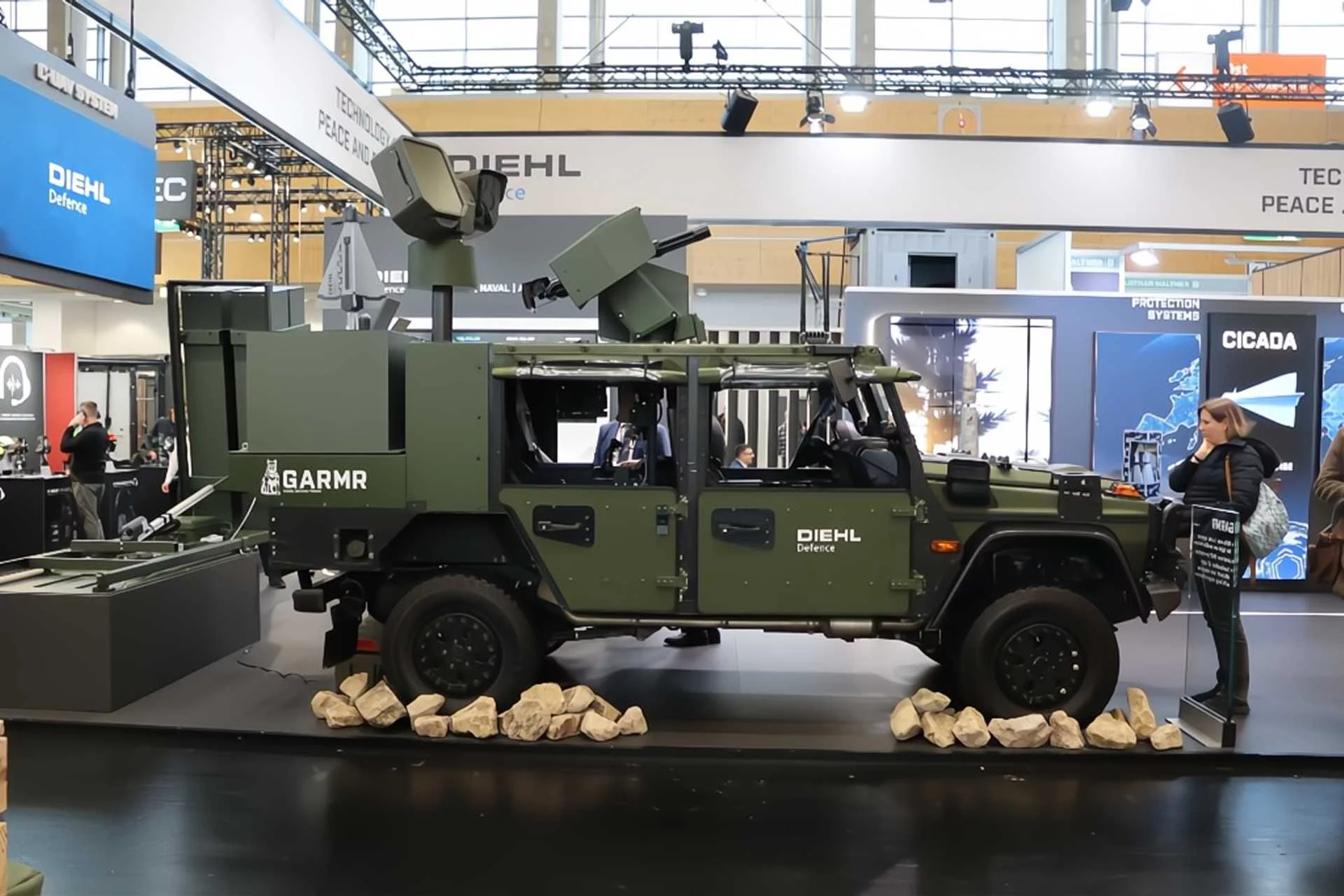
What was presented at Enforce Tac 2026
At the Enforce Tac 2026 exhibition in Nuremberg, German company Diehl Defence showcased the mobile counter-UAS system Garmr — an updated version of the Kinetic Defence Vehicle (KDV). According to Army Recognition, the system is designed to intercept targets at ranges of over 70 km and combines interceptor drones with an architecture that supports artificial intelligence.
"The system is intended to protect critical infrastructure, mass events and to be used in high-intensity combat conditions."
— Army Recognition
How Garmr works
The system relies on a modular architecture. It builds an air picture using radars and electro-optical sensors and can operate within an integrated air-defence network. Artificial intelligence algorithms automatically detect and prioritize targets, but the decision to employ weapons remains with the crew — a "human-in-the-loop".
"AI algorithms automatically detect and prioritize targets, leaving the decision to employ weapons to the crew."
— Army Recognition
Defense is organized in two rings: close-in — machine guns of 7.62 mm and 12.7 mm calibers (effective roughly up to 1–2 km), and medium-to-long — interceptor drones Cicada and Hornet Block 2. Cicada can employ either a fragmentation warhead or non-kinetic means (for example, a net) for interception.
Why this matters for Ukraine
Garmr does more than add another system to the catalogue — it demonstrates an approach relevant to Ukrainian defence: networked solutions, combined (kinetic + non-kinetic) countermeasures, and accelerated target processing using AI. For protecting critical infrastructure, logistics hubs and mass venues, such a system could become an operational link between local air-defence assets and longer-range AD systems.
Practical implications: integration into existing air-defence networks, training personnel to operate in a "human-in-the-loop" mode, and operational logistics — especially given that the manufacturer estimates a delivery time of about six months after ordering.
Context and consequences
Announcements alongside Garmr — the jet-powered drone Hildegard (up to 500 km/h) and the autonomous ground robot Mandrill (up to 100 km/h) — point to an overall trend: manufacturers are increasing speed, autonomy and integration into networked systems. Analysts stress that it is the combination of non-kinetic and kinetic means that increases sites' resilience to mass drone attacks.
Now the task falls to operators and procurement officers: technical declarations must be transformed into real export logistics, integration into air-defence networks and crew training — only then will such systems operate where they are most needed.