Forty percent of people experience vasovagal syncope (VVS) at least once in their lifetime — a sudden disruption of heart rhythm and blood pressure triggered by stress or prolonged standing. One-third of them will experience it again. The main danger lies not in the loss of consciousness itself, but in the fall: people break bones, suffer head injuries, and some fall at the worst possible moments — on stairs or near roads.
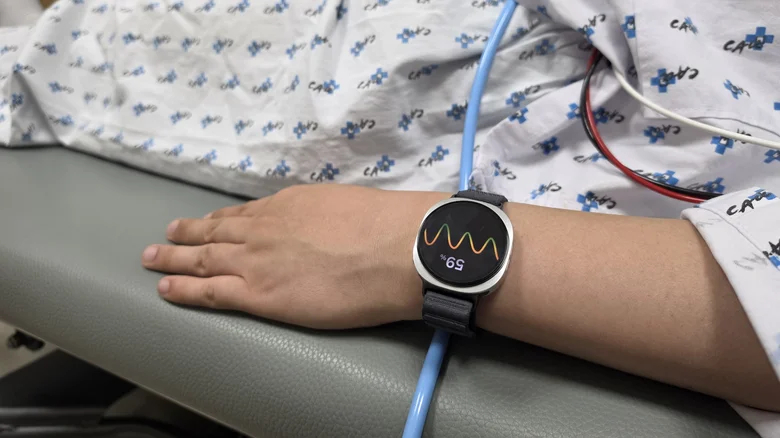
This is where Samsung made an unconventional move: not an implant, not a hospital monitor, but a mass-market consumer device. In collaboration with the cardiology department of Chung-Ang University's Kwandong Hospital, the company tested 132 patients with VVS symptoms and trained an algorithm to read PPG signals — an optical sensor that tracks heart rate variability through the skin of the wrist.
What the study showed
The model warned of impending unconsciousness five minutes in advance with 84.6% accuracy, 90% sensitivity, and 64% specificity. In clinical terminology, this means: nine out of ten actual episodes were detected by the system, but in approximately three cases out of ten, the signal turned out to be false. For a warning device, where the cost of an error is an unnecessary alert rather than a missed attack, this is an acceptable balance.
«Up to 40% of people experience vasovagal syncope during their lifetime, and one-third experience it again»
— Cho Chun-hwan, professor of cardiology, Kwandong Hospital
The results were published in European Heart Journal – Digital Health (volume 7, issue 4) — the first study in the world where a commercial smartwatch demonstrated the potential for early diagnosis of syncope in clinically significant parameters.
An unexpected angle: not technology, but a care model
Five minutes is significant. A person has time to sit down, call someone, stop the car. For patients with recurrent VVS who already know their condition, this is a fundamental difference between a controlled situation and another fall.
However, there is a structural problem: the function is not yet built into Galaxy Watch as a ready-made product — this is a laboratory proof of concept. Samsung announced plans to «expand cooperation with medical institutions», but did not specify concrete timelines for the function's rollout to end users.
- PPG sensor — standard in most modern smartwatches, which theoretically opens the door to similar algorithms on other platforms
- Sample of 132 people — sufficient for publication, but small for regulatory approval as a medical device
- Specificity of 64% — means a real risk of «false alarm syndrome» if the function is deployed without proper calibration for the individual user
According to Choi Chon-min, head of Health R&D in Samsung's MX division, the goal is to transition from «care after the event» to a preventive healthcare model. This is not new rhetoric for technology companies, but VVS is one of the few cases where a five-minute warning window truly has clinical significance.
If Samsung files for regulatory approval — with the FDA or EMA — and expands the sample to several thousand patients, the function could become the first precedent where a mass-market wearable device is officially recognized as a tool for syncope prevention. If not, the research will remain marketing-useful but medically inert.