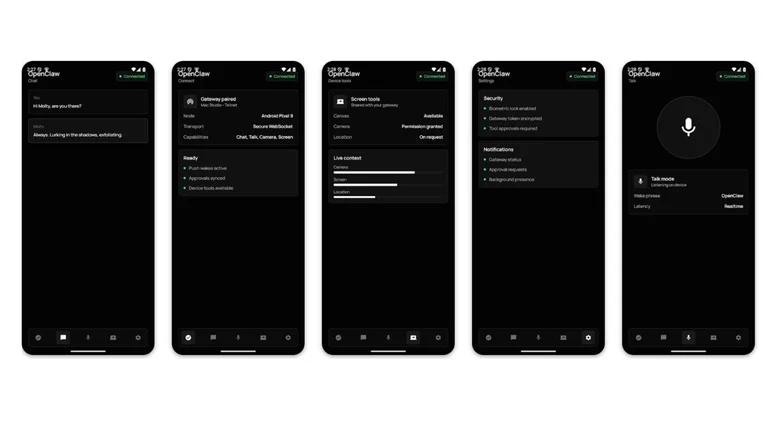
Open-source AI agent OpenClaw, known in the community as "Molty," has appeared in the Apple App Store and Google Play. But what looks like another AI chatbot on a smartphone is fundamentally different — and this difference explains why Apple allowed it on the platform in the first place.
Not an agent, but a node
The mobile OpenClaw application is not a standalone assistant. By architecture, it is a companion node: the phone connects via WebSocket to a Gateway — a server component that the user runs themselves on macOS, Linux, or Windows. The agent lives there, data is stored there, decisions are made there. The smartphone only adds a camera, microphone, geolocation, and Canvas interface to this system.
This is not a cosmetic detail. Since no data passes through a corporate server, the App Store listing states: "the application does not collect data." This self-hosted architecture is likely what allowed it to pass Apple's review — the company has blocked agent applications for years due to concerns about broad access to devices.
What the agent can actually do with a smartphone
After connecting to the Gateway, the agent gains access to functions atypical for ordinary mobile AI: photos, contacts, calendar, reminders, real-time geolocation. The key detail is that private commands are disabled by default and are only enabled after explicit user permission. Pairing occurs through explicit confirmation on both devices.
"Actually, I'm building a whole website on a Nokia 3310 right now by calling OpenClaw"
@youbiak on social network X after the application launch
A joke, but one that accurately describes the idea: the phone becomes input and output for the agent, not its brain.
Context: who is behind this and how serious is it
OpenClaw was created by Peter Steinberger — founder of PSPDFKit, a well-known company in the PDF tools space. The project is written in TypeScript and is model-agnostic: it connects to any model through its own API keys or to a local model without internet access. On GitHub, the project has collected over 68,000 stars — for a self-hosted tool, this is an exceptional number.
Before the mobile application launch, iPhone users primarily accessed the agent through Telegram or WhatsApp. The native application removes this intermediary — but adds another mandatory element: a constantly enabled Gateway on desktop or server.
Where the line between convenience and actual use lies
OpenClaw is free and open source — but the barrier to entry remains the technical readiness to deploy your own server. DigitalOcean already offers a 1-Click Deploy to simplify this step, but most people who download the application from the App Store will face a blank screen without a configured Gateway.
The question that will determine the scale of the project: will a hosted Gateway option appear by the end of 2025 with the same privacy guarantees — or will OpenClaw consciously remain a tool for those who know how to read documentation.







