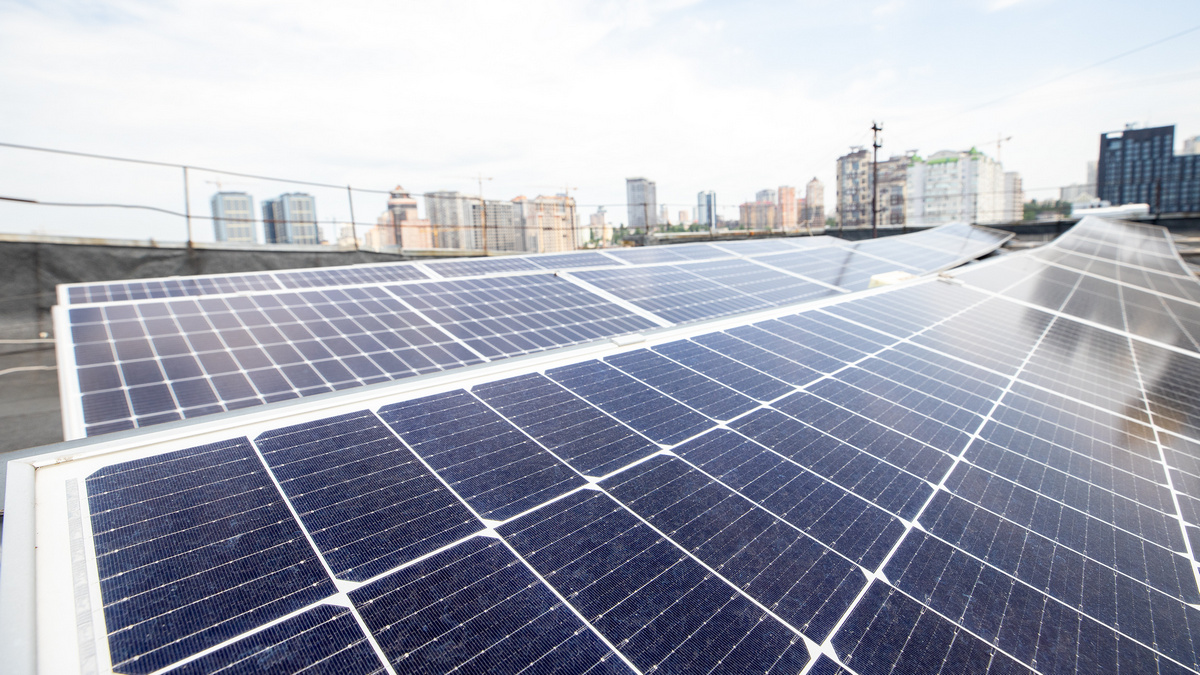
If you have a solar panel on your roof and are used to receiving money under the "green" tariff for every kilowatt-hour you supply to the grid, there's a new complication. The National Commission for State Regulation of Energy and Utilities (NCREGU), through decision No. 1360 of August 11, has for the first time introduced time windows outside of which home solar power generation is not paid at the preferential rate.
What's changing in practice
Now the "green" tariff applies:
- from 04:00 to 23:00 — from April 1 to October 31;
- from 06:00 to 21:00 — from November 1 to March 31.
Everything generated outside these hours will be purchased by the supplier not at the fixed "green" tariff, but at the hourly price of the "day-ahead" market — that is, at the market value, which can be either higher or lower.
Why this will barely hit solar panel owners' wallets
For a typical home solar system, nighttime generation is essentially zero: panels don't produce electricity in the dark. Therefore, the limitation of hours 23:00–04:00 in summer or 21:00–06:00 in winter looks more like a formality than a real blow to household income.
More importantly, the new time frame coincides with the period when solar generation on a national scale creates the greatest load on the grid.
The problem of excess, not shortage
In April, Vitaliy Zaichenko, head of Ukrenergo's management board, reported that the transmission system operator is forced on certain days to limit solar generation to 2,000 MW — precisely because of its excess during sunny hours. Home solar systems, despite their small individual contribution, collectively became a notable factor in this overproduction.
So the regulator's new decision is an attempt to synchronize incentives for panel owners with the actual needs of the energy system, rather than simply cut payments.
One more clarification in the same decision
The NCREGU also established that the hourly volume of electricity for calculations cannot exceed the contractual rated capacity of the generating facility — this closes the possibility of inflating the volumes subject to payment at the preferential rate.
Context: a dispute Ukraine recently won
The topic of the "green" tariff for renewable energy has a long and contentious history. In June 2020, the Cabinet of Ministers signed a memorandum with renewable energy investors, which formed the basis of law No. 810-IX: the tariff for solar systems was reduced by 15%, for wind farms by 7.5%, and the government in return promised 100% tariff payment and debt repayment by the end of 2021.
Modus Energy became the first investor to challenge this decision in international arbitration. In early 2026, Ukraine won that case.
An open question: will time-based limitation become the first step toward full hourly tariffs for all "green" generation, including industrial facilities, if the load on the grid continues to grow in summer?