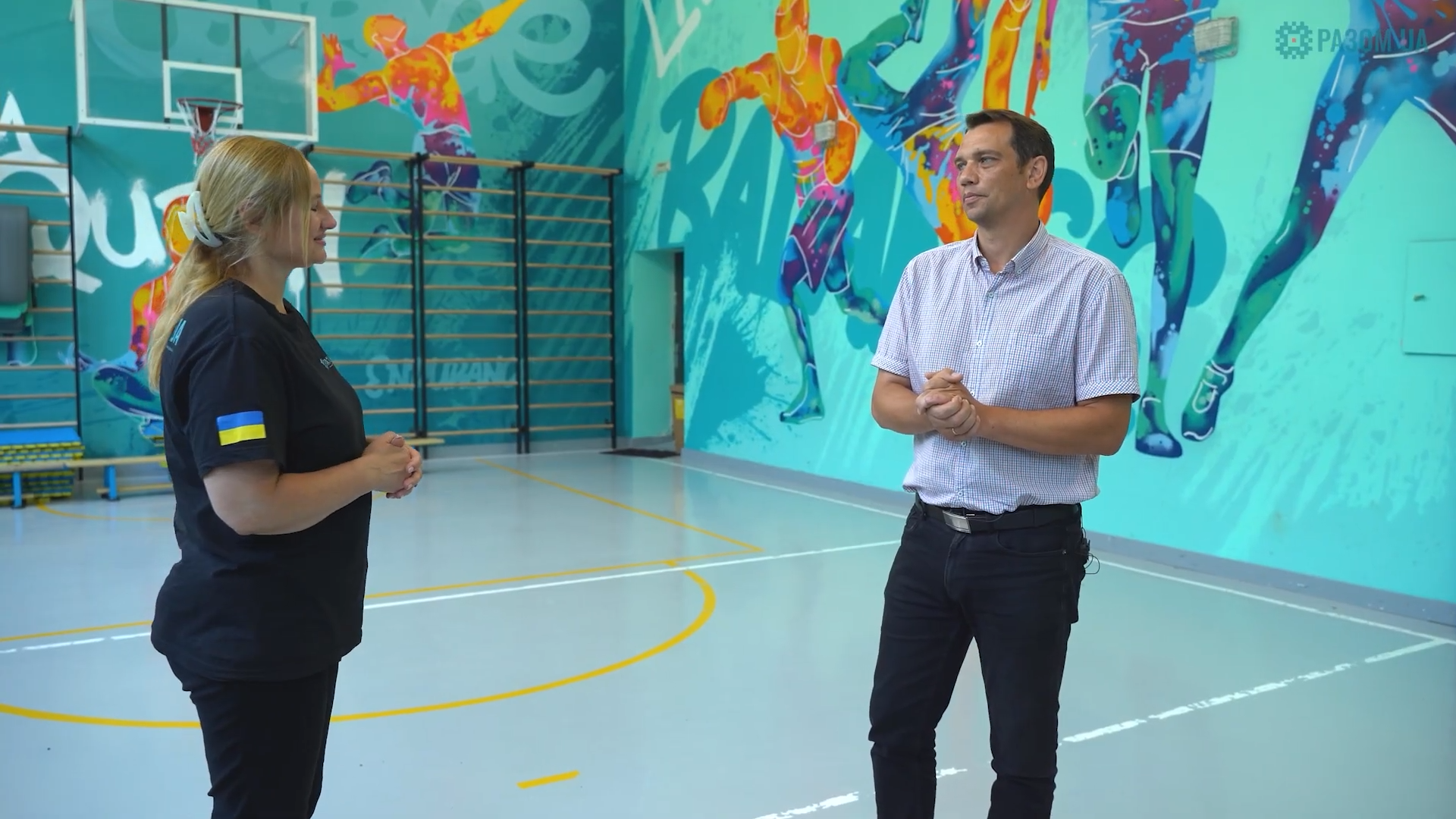
At Sviatopetrivsky Lyceum, something is constantly happening. Children gather in the hall, student government works nearby, the gym is occupied almost all day with classes and training sessions, and reconstruction continues on the grounds.
Behind all this is a large team. And director Sergiy Zashchytynsky, who has worked here since 2003.
Planned international relations, but stayed in school
Sergiy Zashchytynsky grew up in a family where his mother was an educator and his father was an agronomist. He himself initially had no plans to link his entire life with school.
He was interested in international relations with a historical focus. After studying as a historian, he came to the then Petrivska general education school — the future Sviatopetrivsky Lyceum.
This happened in 2003.
For some time, he combined teaching with business — he was involved in collecting and processing recyclable materials. When he became head of school, he had to give up the business.
"School, you know, draws you in. I was constantly in the rhythm of communicating with young people, experienced, intelligent people, teachers, educators, colleagues".
A director who doesn't want to sit "on the other side of the desk"
Sergiy Zashchytynsky became director in 2021.
He describes his work simply: it's constantly being available, making decisions every day, and having much less time for personal life. At the same time, it's constant contact with people and children who, he says, don't let you fall out of rhythm.
Even the director's office has its own peculiarity here. Zashchytynsky says that usually he doesn't sit at the main director's desk when someone comes to him with a problem. He sits closer.
"In order to feel closeness with that person and with the problem we came here to solve. To show that I am also close to you and I'm here specifically to solve this problem".
Important decisions, the director says, are not made unilaterally at the lyceum. They are discussed with deputy directors, teachers, the education department, and community representatives.
"We are all changing. And I am changing. I can also change my view if it is argued convincingly to me".
February 24: a basement that wasn't yet a shelter
One of the biggest trials for the lyceum was the full-scale invasion.
The director's first message to teachers on February 24, 2022, was brief: full-scale war has begun, children are not coming to school.
After that, teachers and parents were asked, if possible, to come and help put the basement room in order.
At that moment, it was difficult to call it a proper shelter — it was essentially a storage room.
"I didn't see panic. I saw unity. Parents and teachers came, helped, and we created conditions where people could at least stay".
Pallets were used to make benches, school desks became tables. According to the director, in the first months of the full-scale war, until the end of May, about 150 people stayed in the room.
Later, a shelter project was prepared, a cost estimate was made, and repairs were completed. Starting September 1, the lyceum returned children to in-person classes.
But another problem arose: the number of shelter spaces was much smaller than the number of students. At that time, about 1,300 children were studying at school, while the shelter, according to the act, could hold 466.
Therefore, the lyceum was forced to combine in-person and distance learning formats.
"We looked at it this way, that we were lucky. Our facility is intact. The windows are intact. There is a shelter. The teaching staff is wonderful".
From 350 to 1,600 students
Over the years of Sergiy Zashchytynsky's work, the school has changed not only because of the war.
When he started working here, about 350 children were studying at the facility. With that number, the director recalls, you could practically know almost every student by name and surname.
Today there are about 1,600 of them.
The reason for such rapid growth is active construction in Sviatopetrivsky and the appearance of many young families. People also move here from other regions of Ukraine.
Among the students are children for whom the Kyiv region became a new home because of the war. According to the director, about 200 children from families of internally displaced persons study at the lyceum, including from Mariupol, Donetsk, and Luhansk regions.
"There is absolutely no division between 'ours,' 'not ours,' newcomers or non-newcomers with us".
Over one hundred teachers — and "it's a family"
The lyceum today also has over one hundred teachers. There are people who have worked here since the school opened in 1986, there are young specialists, and there are teachers who lost their homes on occupied territories because of the war and started a new life in the Kyiv region.
When the director is asked to describe his teaching staff, he answers with one word — family.
"In this family, someone is creative, someone is athletic, someone is ambitious, someone is professional, whom you can turn to for support. And someone is psychologically more resilient. We, like a family, solve all our issues".
Support here is not limited to work matters. When someone on the teaching staff needs help because of the war or personal circumstances, colleagues unite.
Zashchytynsky says that it's important for a person to understand: they are not left alone with their problem.
"The school is alive"
The central hall became one of the symbolic places in the lyceum.
There was no full-fledged assembly hall for a while, so it was the hall that turned into a space for meetings, greetings, music, dancing, and other school events.
Nearby is the student government room — a place where children can communicate, spend breaks, discuss their ideas, and plan events.
"As soon as you walk in — something is always happening somewhere. The school is alive".
School president and real elections
Student government at Sviatopetrivsky Lyceum is not a decorative structure.
Students participate in choosing music, events, fairs, dances, discos, and the lyceum's representatives. And the school president is elected during a proper vote.
Candidates give presentations, voting is conducted in secret, using ballot boxes.
"When a child goes through elections at school and understands how the electoral process works, it's much easier for them in adult life".
The director himself also comes to student government for advice on certain matters.
Parents, children, and teachers — one triangle
Another key position of the director is that school cannot work separately from family.
He speaks of three components of one process: the child, teachers, and parents.
"This is the triangle that must work in harmony and in symbiosis".
Such partnership manifests itself not only at parent meetings. When, for example, there was a problem with the shelter flooding, after notification in parent group chats, people, together with children, came to help — and the problem was solved within a few hours.
At the same time, the director emphasizes: school can teach, support, and help the child socialize, but cannot completely replace parental upbringing.
To talk to teenagers, you need to be where they are
A separate part of modern school is social media.
Zashchytynsky admits: a significant part of teenagers' lives today happens online, and school cannot simply ignore this space.
"To be part of today's teenagers' lives, you need to speak their language and be part of the process".
That's why the lyceum actively develops its own pages on social networks. Sometimes, the director jokes, parents find out about their children's achievements from there.
At the same time, he calls the new generation much more pragmatic. Graduates increasingly analyze not only the prestige of a profession, but also how in-demand it will be, whether they will be able to earn and support themselves.
Young people have also begun to pay special attention to working professions — electricians, installers, welders, and other specialists whose demand remains high.
Sports as part of the lyceum's philosophy
Sviatopetrivsky Lyceum is known not only for its academics.
Sports became one of the biggest areas. The facility's teams participate in "Plich-o-plich," cheerleading, taekwondo, volleyball, basketball, and other disciplines develop.
There is no more room for trophies in the trophy case. According to the director, the lyceum's students have become European champions, vice world champions, and Ukrainian champions.
"My favorite players are my children who perform".
Zashchytynsky himself played basketball in his youth and still calls sports "a whole planet of life."
For him, sports activities are not just about medals. It's about discipline, physical development, character, and the ability to work as a team.
School operates in two shifts
1,600 students in a building that was once designed for 350 is a daily organizational challenge.
The lyceum operates in two shifts. The schedule needs to be synchronized with the cafeteria operation, buses, physical education classes, the gym, and shelter capacity.
Before the start of the school year, the administration essentially builds a complex system where one process depends on another.
This is why the lyceum's reconstruction has become not a matter of comfort, but a necessity.
Construction was supposed to begin in 2022 — but the war started
The history of the future new building began before the full-scale invasion.
In 2022, the facility was supposed to enter the active construction phase. Builders were already preparing the grounds and waiting for the end of the heating season.
And then the big war began.
Funding changed, the project implementation was stopped. Later, the school, education department, and Bilohorod village council returned to the reconstruction issue. The project had to be revised — including due to new security requirements and the need for a full-fledged shelter.
Today, the project provides not just a new building, but a comprehensive reconstruction of the educational facility: construction of a new section, renovation of the old building, insulation, roof replacement, changes to the grounds, and relocation of sports facilities.
A shelter where classes can continue
One of the most important features of the new building is the future shelter.
It will not be one large room where all children go down during an air raid, but a classroom-based system.
"These will be classrooms where children will go down and continue their studies".
The new building also plans to create modern educational classrooms for various specializations.
The cafeteria is also being updated. Previously, it could accommodate about 80 children during one break. After expansion, they plan to feed about 200 at the same time.
According to the plan, the completion of the major reconstruction is expected by the end of 2027. However, the director emphasizes that construction may require adjustments.
Children of war: "They went through a more difficult stage"
One of the most difficult topics of conversation is the generation of children for whom the full-scale war became part of school life.
Graduates of 2025 and 2026 are schoolchildren, a significant part of whose education took place during the war, air raids, and constant uncertainty.
Zashchytynsky is convinced: this experience made them stronger.
"They live today in extremely difficult conditions. And if we transition to peacetime conditions, they will handle it. They went through a more difficult stage".
The director calls modern students pragmatic, independent, and patriotic. According to his observations, many graduates talk about wanting to stay in Ukraine and be useful to the country.
The school became part of his own family
For Sergiy Zashchytynsky, the lyceum is more than just a workplace.
It was here that he met his future wife, who came to school as a young specialist psychologist. They continued to work together there.