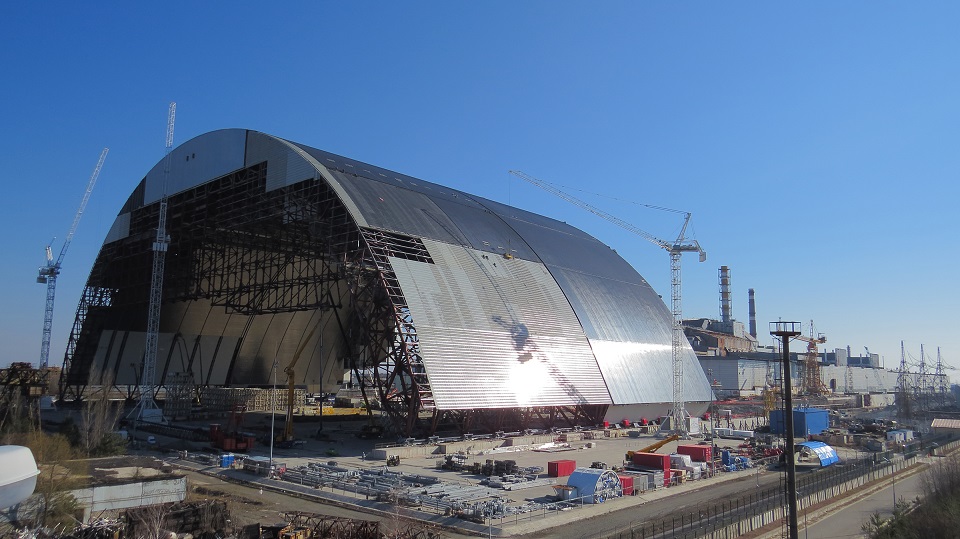
On February 14, 2025, a Russian Shahed-2 drone penetrated the outer shell of the New Safe Confinement (NSC) — a steel arch 110 meters high erected over the destroyed fourth reactor unit of the Chornobyl Nuclear Power Plant. The structure cost $2 billion and was designed to last 100 years. It had 85 years remaining until its scheduled retirement.
What broke and why it's dangerous
The strike compromised the confinement's airtightness and disabled the temperature and humidity control system inside. Ventilation is what protects steel structures from corrosion. As warned by Baltazar Lindauer, director of the nuclear safety department at the EBRD, without repair of the ventilation system, irreversible metal corrosion will begin before the end of this decade.
"Without a sealed shell, the entire system will fail… We can no longer maintain humidity within the required limits."
Sergiy Tarakanов, director of Chornobyl NPP — Financial Times
Senior nuclear specialist Sean Burnie (Greenpeace Ukraine) clarifies: if corrosion begins, no one will be able to predict how much longer the structure will hold. Meanwhile, the "Shelter Object" — the old Soviet sarcophagus — still remains beneath the arch and is capable of collapsing at any moment, even without additional damage.
How much it costs and who will pay
French companies Bouygues Travaux Publics and Vinci Construction Grands Projets — the same firms that built the NSC — conducted a preliminary technical assessment. Their conclusion: the facility requires comprehensive restoration. The EBRD estimated the cost at a minimum of €500 million — nearly a quarter of the original cost of building the entire arch.
EBRD President Odile Renaud-Basso clarified: this is a rough estimate without detailed engineering calculations. Firm donor commitments are needed by the end of 2027 so that full repairs can begin in 2028 and be completed by 2030. In parallel, on July 1, 2025, a fifth grant agreement was signed between the EBRD and the state enterprise Chornobyl NPP — €30 million was allocated from a special international cooperation account for urgent work. These funds will go toward structural inspections, temporary shell repairs, and restoration of the sealing membrane.
- October 2025 — a temporary protective screen installed over the largest hole.
- 2026 — planned completion of sealing small punctures and partial membrane restoration.
- 2028 — start of full-scale repairs, provided €500 million is raised.
- 2030 — deadline, after which corrosion becomes irreversible.
Continental threat with a local bill
Chief Engineer of Chornobyl NPP Oleksandr Titarchuk framed the situation directly: "This is not a Ukrainian problem. This is a continental threat that is being ignored." The EBRD will coordinate fundraising through the International Chernobyl Cooperation Account — the same mechanism that once united 45 donor countries to build the arch. If repairs are not completed by 2030, the confinement could become completely non-functional, and then dismantling the dangerous sarcophagus inside will become technically impossible for an indefinite period.
The Kremlin denied involvement after the strike and accused Ukraine of "provocation." The IAEA has not officially assigned responsibility to either side.
The question is not whether €500 million will be found — 45 countries built the NSC and will gather again. The question is whether firm commitments can be made by the end of 2027: if the donor round stretches due to changes in administrations or negotiation fatigue among partners, the window for full-scale repairs will close along with the functionality of the arch itself.







