Spys Ukraina is not a newcomer who blindly pointed a finger at the map. It is the same player who five years ago paid over 5.7 million UAH for a special permit for gold in Dnipropetrovsk region, and this year abandoned it because the actual metal content in the ore turned out to be three times lower than calculated. Now the same structure, controlled by Turkish Onur Group, is entering the graphite market in Khmelnytsky region. This is no longer about gold — this is about reassessing risks and searching for an asset that depends less on the accuracy of geological exploration.
Why graphite, not gold
The difference between the failed gold project and the graphite one is not just in the metal. The reserves of the Burtyn deposit are already confirmed in categories B+C1 and C2: 113.4 million tons of ore, of which 6.6 million tons is actually graphite. This is a much more predictable asset than a gold ore body, where the actual content can deviate from expectations by three times. For an investor who just lost money due to geological uncertainty, this is critical.
Moreover, graphite is not just another mineral resource. It is one of the key components for lithium-ion battery anodes, and that is precisely why it made the EU's list of critical raw materials. A local cluster is already forming in Khmelnytsky region: in February 2026, Czech Solartec bought the adjacent Maidan site near Shepetivka. Two independent foreign investors within a few kilometers of each other in a matter of months — this is no longer a coincidence, but a sign that the region has caught the attention of those who calculate ahead, not randomly.
What does "start of procedure" mean
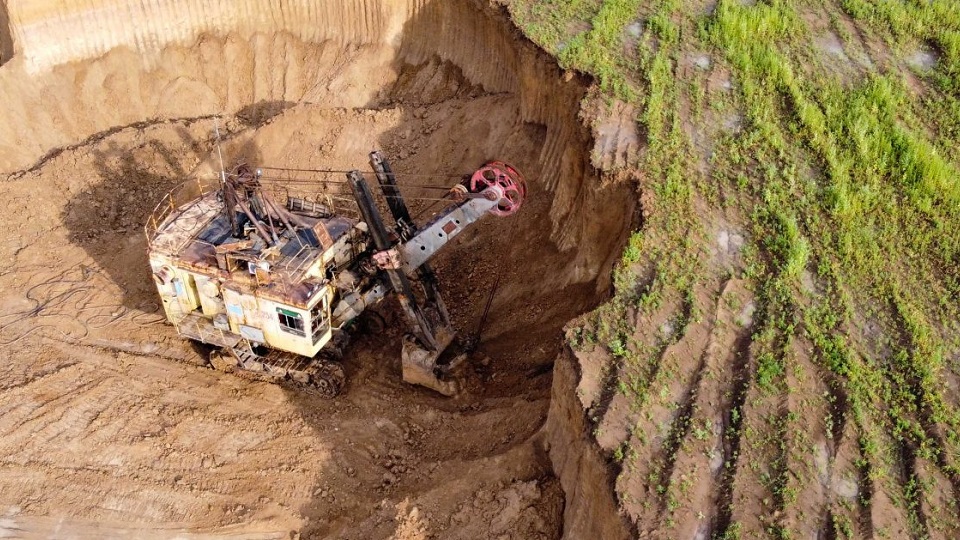
It is important to understand the scale of what has already happened and what lies ahead. For now, it is only a matter of notification of planned activities — the first step in the environmental impact assessment procedure. The company still needs to prepare an EIA report, undergo public discussion, and obtain a conclusion, without which mining is prohibited. A quarry with an area of 105 hectares with a planned volume of up to 1 million tons of mining mass per year is classified as a first-category facility — meaning the procedure will be full, with all stages of public control.
For local residents of Horodnivka, this means that the coming months are precisely the time when they can influence project conditions through public discussions, rather than being outraged afterward about dust or flooding when the quarry is already operating.
Lesson for the industry
Three times lower gold content than expected is not force majeure, but a typical risk of subterranean geography, where accurate data emerges only after drilling at one's own expense.
The story of the Zhovtovods area is a good case study of how a special permit, purchased at auction for millions of hryvnias, can turn out to be empty after real exploration. Onur Group is not the only one learning from this: in 2018–2019, a similar path in Ukrainian graphite was already taken by BGV Group of Hennadiy Butkevych, entering Kirovohrad region. The difference is that now several foreign groups — Turkish, Czech — are entering graphite at once, and they are doing so on assets with already confirmed reserves, not on auction lotteries.
The question for the coming year is simple: will the project pass public discussion without significant reservations, or will residents of Horodnivka and environmentalists find grounds to demand changes to mining conditions — and will Khmelnytsky become a Ukrainian analogue of graphite clusters that Brussels is already eyeing in search of an alternative to Chinese raw materials.