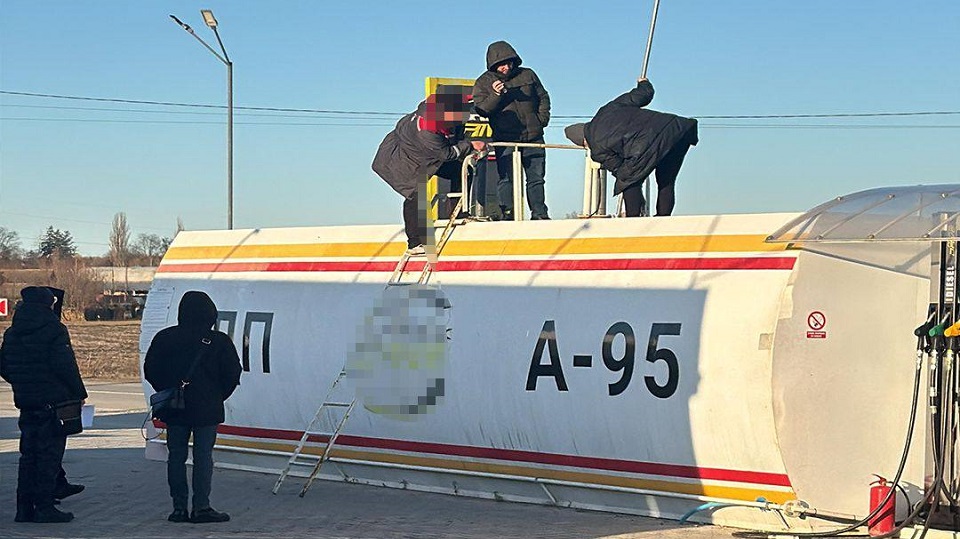
What the court decided
The Sadgora District Court of Chernivtsi found a member of an organized group that set up the production and sale of counterfeit fuel in Chernivtsi and neighboring regions guilty. He was sentenced to 3 years' imprisonment with confiscation of property and destruction of the illegally produced petroleum products and the production equipment.
"The defendant was sentenced to three years' imprisonment with confiscation and destruction of the illegally produced gasoline, as well as the production equipment and raw materials"
— Bureau of Economic Security (BES)
According to the court ruling, about 186,048 liters of fuel and other petroleum products were seized during searches at six filling stations, as well as eight tank trucks and trucks used for the production, storage and transportation of the counterfeit product.
How the scheme operated
According to the investigation, the group numbered seven people. From December 2023 to November 2024 they organized illegal production and sale: in total more than 300,000 liters of fake fuel were produced and sold for over 17 million UAH.
The court register names Pavlo Bilousov (from Kremenchuk) as the founder and director of LLC "Ompi Oil Trade", and Chernivtsi resident Oleksii Dovbysh as co-owner of PE "Trend Logistic 2022"; the owners split the assets equally.
Why this matters
Counterfeit fuel threatens transport safety, complicates logistics and undermines trust in the market. During wartime, stable fuel supply chains are a matter of both economic and operational security. Confiscating tank trucks and storage tanks not only punishes the guilty but also prevents the rapid resumption of illegal production.
The court decision also has an economic dimension: recovering losses and returning assets to the state circulation restrain shadow schemes that consume millions of budget hryvnias.
Consequences and outlook
The materials of the criminal case were referred to the court after the accused was returned to Ukraine; the confiscated property was transferred to state revenue. This is a precedent that reinforces the message from law enforcement: large counterfeit networks are vulnerable to targeted investigations and coordinated oversight.
It is worth noting that the BES has reported similar operations: in November 2025 the agency discovered an underground fuel depot in Kyiv that supplied counterfeit product to several filling stations, and it shut down illegal stations in Odesa — indicating the systemic nature of the problem.
Now the question is not only about punishment but about how to lock in control mechanisms: regular inspections, digital monitoring of supply chains and criminal liability for organizing such schemes. Whether the state will turn the verdict's signal into a permanent protection of the market and citizens is the key question for the coming months.







