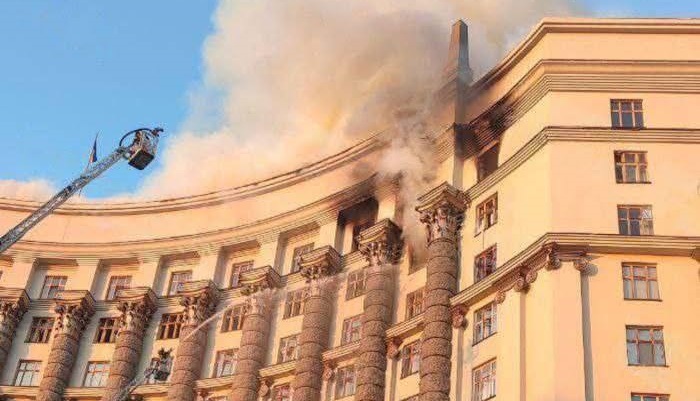
On the night of September 7, 2025, Russia delivered one of the largest combined strikes throughout the full-scale war: 810 drones and 13 missiles targeting more than 20 cities. In Kyiv, one of nine Iskander-K cruise missiles hit the Cabinet of Ministers building on Hrushevsky Street — the first time in years of war. The roof and upper floors were damaged, with a fire covering 800 square meters.
The question of how to rebuild the government building became the center of a discussion that was probably not anticipated in advance. And here a Japanese philosophy from the 15th century comes into play.
Why the "Iskander" Did Not Destroy the Building
According to Defence Express, the Cabinet was hit by a 9M727 missile — a cruise modification of the Iskander-K system, not a Shahed-type drone as initially reported. Analysis of the debris showed: the warhead weighing 450 kg did not detonate. The fire was caused by ignition of rocket fuel. EU Ambassador Katarina Mathernova, who inspected the impact site the next day, emphasized: if the warhead had functioned normally, the building would have turned into ruins. The fire was contained to three floors thanks to the rapid actions of rescuers.
As noted by military-political analyst Alexander Kovalenko, the strike on the office of Prime Minister Yulia Svyrydenko is no coincidence: Russia deliberately broke an unspoken rule not to attack government quarters and decision-making centers.
Kintsugi: Making the Scar Visible
Kintsugi (金継ぎ) — a Japanese ceramic restoration technique where cracks are not hidden but filled with lacquer containing gold or silver powder. Damage becomes the main decorative element. The philosophical foundation is wabi-sabi aesthetics: beauty lies not in perfection but in uniqueness acquired through experience and time.
"This approach demonstrates that modern restoration is not only about restoring architecture, but above all about preserving memory, identity, and truth."
Department of Cultural Heritage Protection of the Kyiv City Administration
The idea to apply this principle to the government building was proposed by People's Deputy Anna Bondar. The initiative was discussed at a meeting of the Advisory Council as part of the Polish initiative Dom Odbudowy Ukrainy — a platform that has already united Polish and Ukrainian experts for almost four years around restoration issues. The discussion was joined by Mikhail Krasutsky, director of the department of cultural heritage protection in Warsaw. The context is symbolic: Warsaw is a city that knows what total reconstruction after complete destruction means.
What This Means in Practice
Kintsugi on an architectural scale is not merely a metaphor. It is a concrete restoration solution: not restoring the facade and structures to their "original appearance," but preserving and highlighting the traces of the strike as part of the building. Such an approach is practiced in post-conflict restoration of landmarks — from Dresden to Beirut — though it always sparks debate between "authenticity" and "memorialization."
- The Cabinet building was constructed at the beginning of World War II — it is not just an administrative facility but an architectural monument.
- A decision on the restoration approach has not yet been made — discussions are at the expert level.
- Warsaw's experience with reconstruction after 1944 makes Polish partners not incidental participants in the discussion.
The question that remains open: if the state chooses kintsugi for the government building — will this choice become a precedent for hundreds of damaged monuments throughout the country, or will it remain a singular gesture for the most high-profile object?







