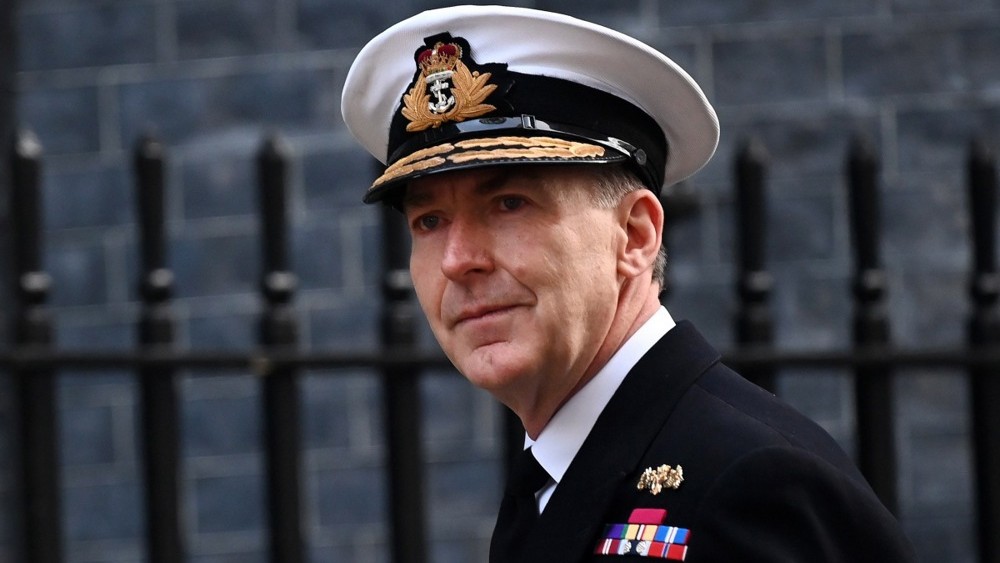
On April 23, at the 18th Kyiv Security Forum, Admiral Tony Radakin, who headed the UK Defence Staff from 2021 to 2025, outlined what he himself called Putin's uncomfortable arithmetic. The conclusion: the full-scale invasion gave Russia the opposite of what the Kremlin had expected.
What went against the Kremlin's plan
Before the invasion, Putin publicly justified it by the need to stop "NATO expansion." The result — the Alliance's expansion to Finnish and Swedish borders, strengthened military presence on the eastern flank, and consensus in Europe on increasing defense spending.
Radakin did not limit himself to geopolitical generalizations. According to him, Russia became entangled in a war that costs it incomparably more than any territorial gains. In August 2025, in a speech before the Center for Strategic and International Studies (CSIS) in Washington, he cited specific figures: over the past year, Russia captured half a percent of Ukrainian territory at the cost of over 400,000 killed and wounded; this year — approximately the same amount of land for another 200,000 losses. In total — over a million victims for the sake of a "special military operation."
"A country with almost no navy dispersed the Black Sea Fleet. A country with almost no air force destroyed the strategic bomber aviation."
Admiral Tony Radakin, CSIS, August 2025
At the KBF in April, the admiral formulated this even more concisely: "Russia got entangled in a mad war. We need to use this."
Why "using this" is not so simple
It was here that Radakin's speech took on a different tone. Russia's strategic weakness does not automatically mean safety for the West. The admiral acknowledged: the arsenals of many NATO countries are half empty, and full-fledged deterrence requires an "arsenal of democracy" — transatlantic in format, with the US and all democracies of the world.
This context is important: intelligence services of several Western states have already warned that after the active phase of the war in Ukraine ends, Russia could restore its capacity for limited operations against Baltic states in two to three years, and for a large-scale offensive against NATO — in seven to ten years. Carnegie analyst Michael Coffman outlined exactly such a scenario in the Wall Street Journal in 2025. NATO Military Committee Chairman Admiral Rob Bauer at the same KBF added a separate dimension: the decision to attack NATO may be made not in Moscow, but in Beijing, given Russia's strategic dependence on China.
The dilemma Radakin left open
Putin, according to the British admiral's assessment, is caught in a trap: either agree to a ceasefire without achieving declared goals — or continue the war, which systematically weakens Russia. Neither option is a win for the Kremlin.
But for the West, this trap is not free either: if Europe does not manage to replenish its arsenals and modernize weapons before Russia restores combat capability, the strategic advantage that Radakin observes today may prove temporary. The question is not whether Russia has suffered a strategic defeat — but whether NATO will manage to consolidate this advantage before the window of opportunity closes.





