Most tourist guides describe Kamianets-Podilsky through its beauty — canyons, towers, panoramas. But a more precise key to the city is layers of defeats and revanche inscribed in stone. A church that became a mosque. A minaret topped with the Virgin Mary. An Armenian quarter in the middle of a Polish city. If you read the architecture literally, it is one of the most honest chronicles of Central Europe.
Old Castle: A fortress that grew from the rock
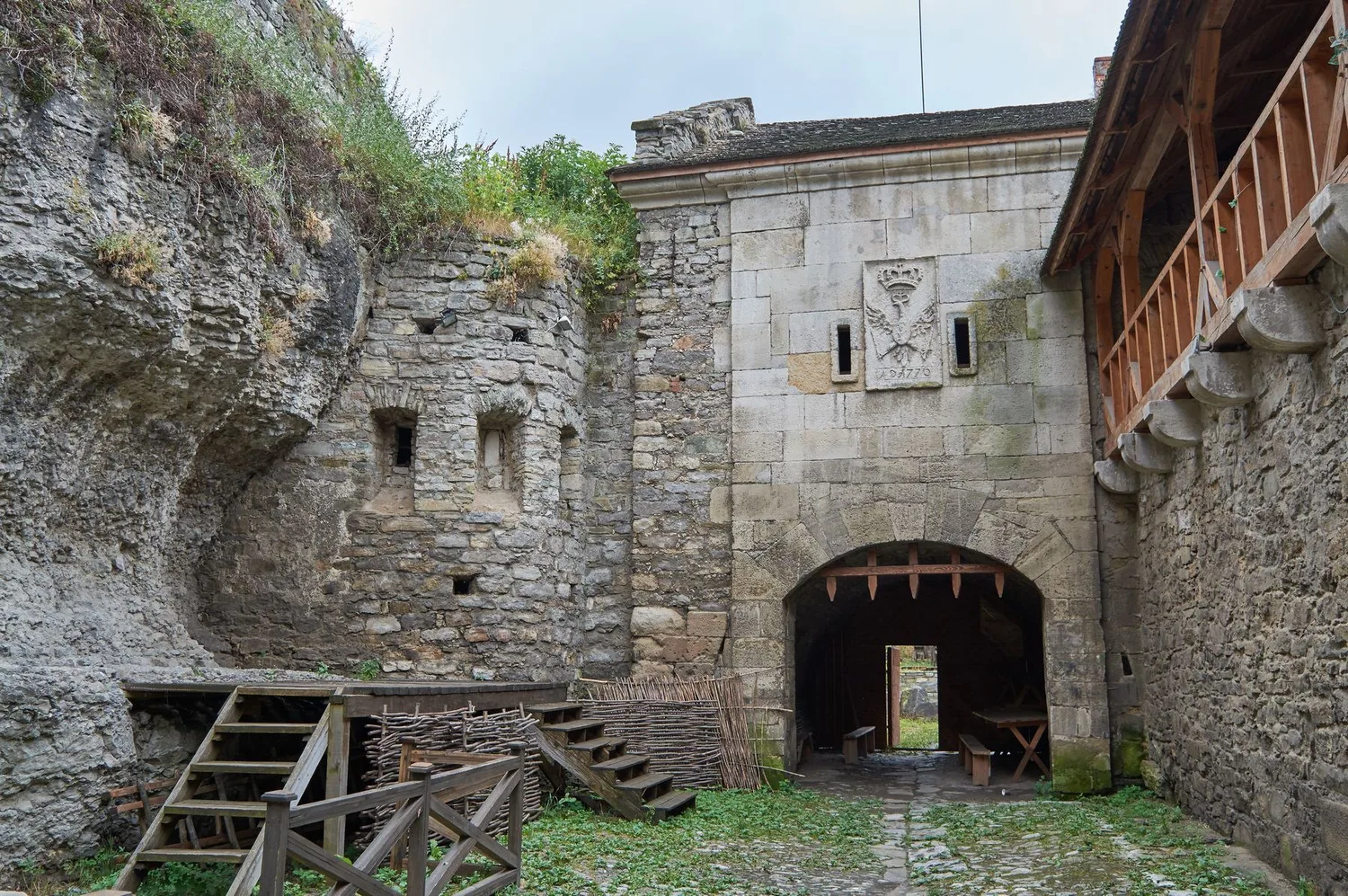
The Kamianets-Podilsky fortress was built in the 14th century on an island surrounded by the Smotrych Canyon and the Smotrych River. Massive walls and towers rise directly above the precipice — architecture here is not decoration but an extension of the terrain. Inside is a fortress museum with artifacts from several epochs, from the Middle Ages to Ottoman occupation. In the evening, the fortress is illuminated, and its silhouette above the canyon reads quite differently than during the day.
Cathedral of Peter and Paul with a minaret: the city's most honest symbol
This is the main paradox of Kamianets, embodied in stone. The church was built in the Romanesque style, gradually acquiring features of the Renaissance and Mannerism. After the Ottoman Empire conquered the city in 1672, the cathedral was transformed into the main city mosque and a minaret 36.5 meters high was added to it. When the Turks left — the minaret remained, but a figure of the Virgin Mary was installed on its top. Today this hybrid stands as an unplanned monument to the idea that the victor does not always manage to completely rewrite the city.
«After the Turks captured Kamianets in 1672, the cathedral was transformed into the main Muslim mosque. A minaret 36.5 meters high was added to its western side»
Andy Travel Club, research on the architecture of Kamianets-Podilsky
Smotrych Canyon: A natural reserve, not just decoration
The Smotrych River canyon is not just an impressive backdrop for photographs of the fortress. It is a natural reserve with rare plants and animals, where cliff areas preserved during centuries have remained inaccessible for construction. From here, the best panoramic views of the island part of the Old Town open up — views that are absent from most tourist photos.
Dominican Monastery: The oldest church with bad luck
The oldest church in Kamianets belonged to the Dominican order. The temple preserves its original architecture both externally and internally — but its bell tower has been in scaffolding after a 1994 fire for three decades now. This is not neglect — it is chronic lack of funding for restoration, which most landmarks in Ukraine outside major cities face.
Ruska Gate: An entrance guarded by the townspeople themselves
The Ruska Gate was the main southern entrance to the city. Its peculiarity — its construction and maintenance were organized by the Ruthenian (Orthodox) community of Kamianets, one of several ethnic communities that divided the city among themselves. Nearby — the Armenian Bastion of the 16th century, built by Kamianets Armenians under the direction of Italian engineer Camillus, who in the 1530s–40s held the position of head of city fortifications.
Armenian quarter and well: A diaspora that built the city
The Armenian community in Kamianets existed alongside Polish, Ruthenian, and Jewish ones — each had its own quarter, its own places of worship, its own jurisdiction. The Armenian well is not only an architectural monument but a point where legends about the city become concrete: who built it, whose water was used, who paid whom. Nearby — caravanserais, commercial courtyards that remind us of the city's transit role on routes between East and West.
Polish Market and Town Hall: A center where jurisdictions converged
The main square of the Old Town has preserved the town hall — the administrative center of the Polish community when the city was officially divided among several self-governing communities. Around the square — dense construction from the 16th–18th centuries, where each building has a specific builder and a specific commercial or diplomatic function. This is not just an open-air museum — it is an active quarter where tourist infrastructure is built into the city's original fabric.
Kamianets welcomes tourists even during martial law — the city is not on the front line, and transportation connections with Khmelnytsky are functioning. The practical question that remains open: will the restoration of the Dominican bell tower and other objects receive funding before another decade transforms «temporary scaffolding» into a permanent state — and will this change after the war ends, if the restoration of cultural heritage objects enters the reconstruction priorities.