Drone warfare has overturned the basic principle on which military economics was previously built: victory goes not to the one with more expensive and sophisticated weapons, but to the one who calculates more precisely the ratio of "cost of means – value of target". Cost is no longer a side effect of technology, but something that is shaped by parameters corresponding to a specific task.
We are primarily talking about kamikaze drones, whose direct task is to strike targets. Reconnaissance drones or signal relay drones are a separate category of reusable products and are not considered in this material. It would be incorrect to compare prices of unmanned aircraft of different classes with each other – the point is that different tasks require different technological solutions. But these solutions are based on one logic: inflict maximum damage on the enemy at minimum economic cost.
Expendable material that causes significant damage
FPV drones became an asymmetric response to a lack of strike weapons. The National Security and Defense Council notes that such drones emerged out of the necessity to replace artillery shells that were in short supply. Currently, it is the most widespread type of drone, manufactured by over 160 companies of various scales.
In essence, such a drone is expendable material, which is why manufacturers minimize its cost: the smallest models cost from 15,000-20,000 hryvnias, larger ones – 30,000-60,000 hryvnias. It is these drones that allowed the formation of kill zones in front-line areas and made it impossible for enemy heavy equipment to move without significant losses on the opposing side.
The flight range of FPV drones depends on the type of communication and varies from 1 to 50 km. The main advantage is precise guidance, which is why such drones are used both against personnel and against equipment, striking weak points.
Interceptor drones
This type saw widespread use primarily against "Shaheds". The most well-known is the P1-Sun, with a stated starting price of 1,000 dollars. The drone has a plastic fuselage and a short flight range of 23 km, but is capable of striking "Shaheds", whose cost according to various estimates reaches 40,000-70,000 dollars.
This makes it economically justified to use even several P1-Sun drones against one enemy UAV. However, the economic aspect is not the only criterion: saved lives cannot be measured.
Middle and deep strike – a different level of targets
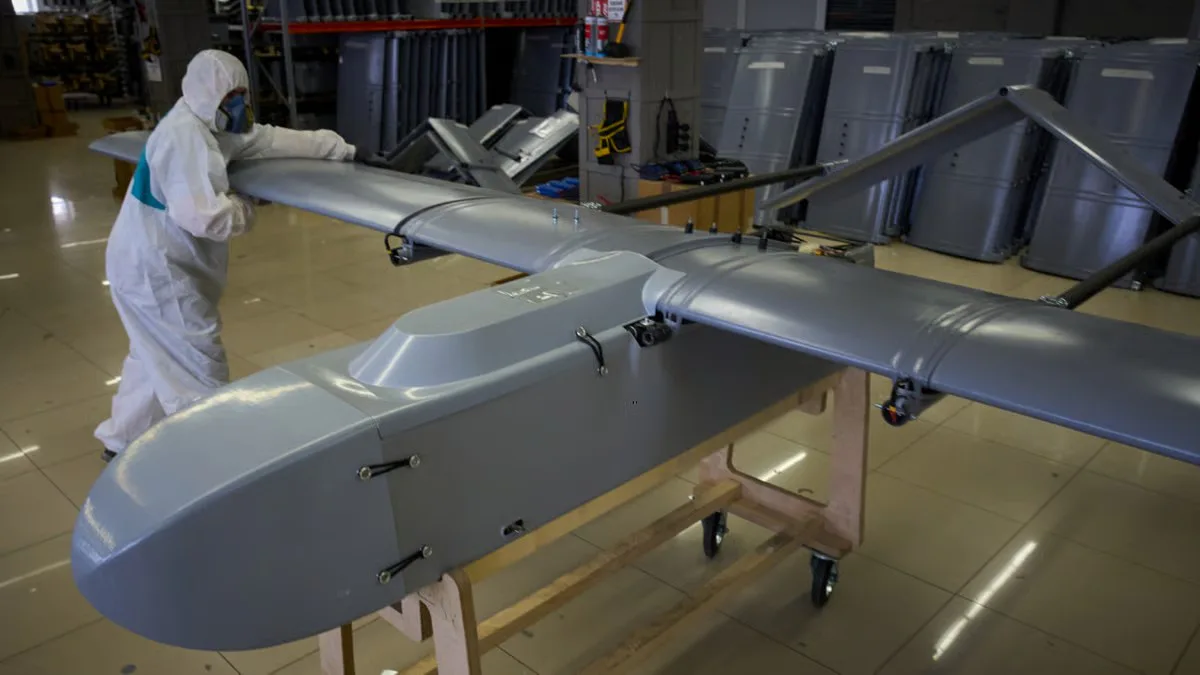
More powerful strike unmanned aircraft are designed to strike targets in enemy rear areas. Depending on the strike distance, they are divided into middle strike (medium range) and deep strike (long-range strike). There are significantly fewer companies manufacturing such drones than FPV manufacturers, as these products require larger investments and are more technologically complex. In terms of their life cycle, they are also predominantly single-use drones.
An example of a long-range UAV is the Anubis, produced by the American-German-Ukrainian Auterion Airlogix Joint Venture GmbH. Depending on the version, the drone is used at medium distances or at ranges up to 1,600 km. According to open source data, the cost varies from 50,000 to 100,000 dollars depending on the configuration. Artificial intelligence and a warhead weighing 45-50 kg allow it to be used not only against equipment but also against buildings – for example, enemy training centers.
"Behemoth", developed by GLEFA and Culver Aerospace companies, is capable of striking targets at distances up to 300 km, carries a combined warhead weighing 75 kg, and flies at low altitudes.
Formally, the Fire Point-manufactured FP-2 belongs to the middle strike class, although it is more powerful: it carries a warhead of up to 200 kg at a distance of up to 700 km. Former serviceman of the unmanned systems battalion of the 59th Assault Brigade SBS Oleksandr Karpyuk (Serzh Marko) named the cost of such a drone – 42,000 dollars.
A separate class is "deep strikes". Here, designers seek a compromise between warhead weight and flight range. What is evaluated is not only the cost of the target the drone is capable of striking, but also the cost of the alternative – for example, cruise missiles, which are several times more expensive. Fire Point CEO and CTO Irina Terekh emphasizes: striking a target is only half the battle; it is important to overcome air defense layers and electronic warfare countermeasures.
"We are also doing significant work against electronic warfare means – this is the most complex part of the technological challenge we face. To deliver and strike a target is actually the easiest part. Thanks to our work, we were able to break through several levels of Russian air defense to precisely strike a target," Irina Terekh said, commenting on the destruction of a Moscow oil refinery by an FP-1 drone.
The upgraded FP-1 covers a distance of up to 3,400 km with a 60 kg warhead. Cost – from 55,000 to 70,000 dollars. After penetrating Russian air defense, such drones strike, in particular, oil refinery processing units at refineries, whose replacement and repair cost several times more than the cost of the strike weapon. Added to this is the cumulative economic effect and psychological pressure on the enemy, who no longer feels safe thousands of kilometers from the front.
What determines the cost
In addition to direct costs of materials and components, the cost of a UAV is influenced by the tasks it must perform: flight range, warhead weight, and resistance to electronic warfare means depend on them. These parameters make direct comparison of drone costs of different classes incorrect – for example, interceptors and long-range strike UAVs. Even drones of the same class can differ technologically: in launch type, presence of landing gear, which also prevents averaging the price.
Ukrainian journalist and serviceman Anton Shvets points to a number of other factors that influence the final cost of a weapon: the need for modifications "on the fly" for a specific mission, warranty replacement of drones that fail to fly for technical reasons, the delivery model and related manufacturer services – including launch support by its representative, and also who covers the cost of delivery to the operator.
If the cost of a strike weapon continues to be determined not by technological complexity but by precision in calculating the "cost-value" ratio, the question for military industry shifts: whoever learns faster to calculate this formula for a specific task on the battlefield will gain an economic advantage in a prolonged war of attrition.