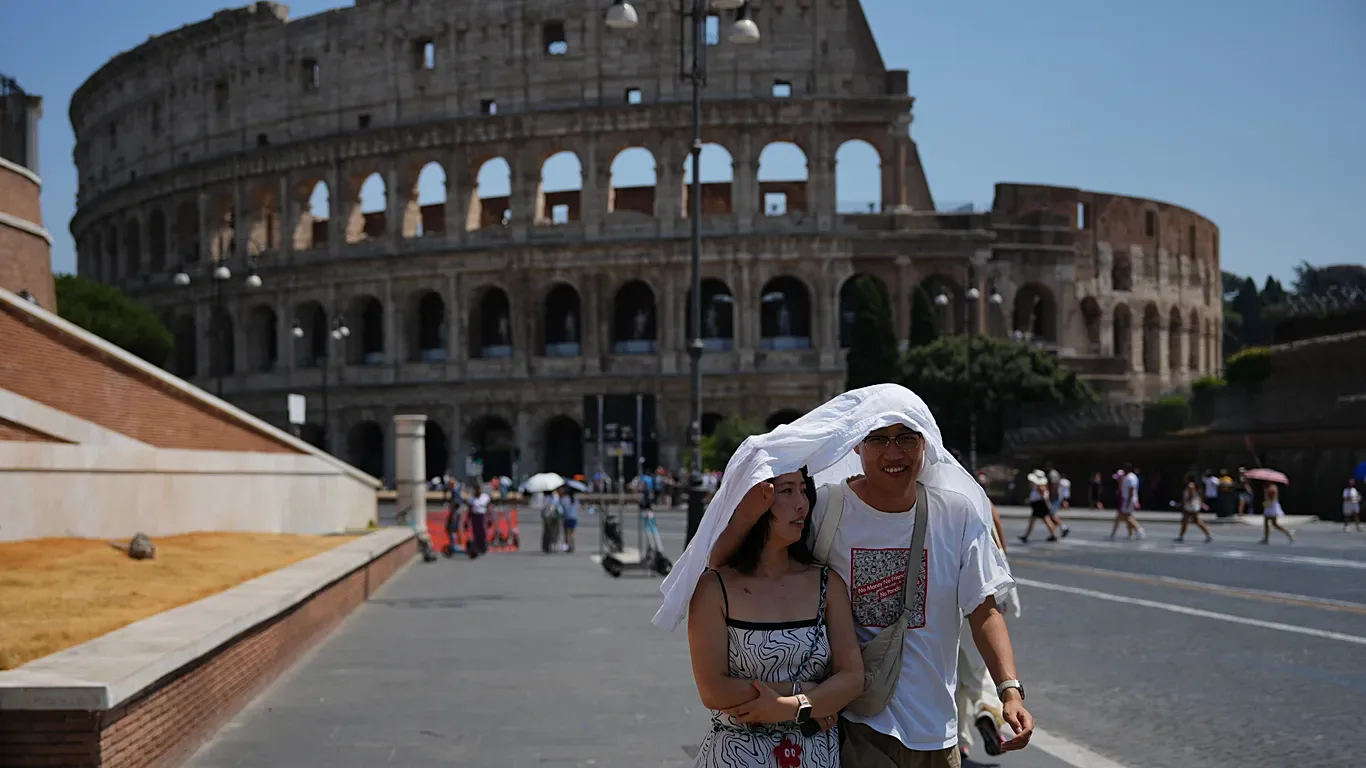
Italy's Ministry of Health has declared a red alert level for 25 out of 27 major cities in the country. Formally, this is a warning about heat of 38-39 degrees, reaching up to 40 in peak zones. But the essence of the "red level" is not in the thermometer — it is an official signal to the healthcare system to prepare for increased emergency calls, hospital admissions, and mortality, which on such days rises not among tourists on beaches, but among elderly people in apartments without air conditioning.
Italy's heat alert scale (yellow-orange-red) emerged in the early 2000s after the summer of 2003, when anomalous heat in Europe claimed the lives of tens of thousands of people, a significant portion in Italy. The red level means not simply "hot," but "risk for the entire population, not just vulnerable groups" — wording that automatically obliges municipalities to open cooled facilities and intensify monitoring of isolated elderly residents.
The African anticyclone that is in no hurry to leave
The reason is not a one-off spike, but a stable blocking anticyclone over the Mediterranean, which for several days blocks Atlantic fronts from accessing the region — those very systems that usually bring cooler air and rain. This means the heat will not pass in a day or two: meteorologists are talking about temperatures "significantly above climate normal" for at least a week in Central Italy and the Po Valley.
Meanwhile, Civil Protection has issued a yellow warning for storms in Abruzzo, Umbria, and Sicily — a paradox that well illustrates the system's instability: one part of the country is suffocating from dry heat, another faces the risk of downpours and hail on the same days.
The price counted not only in hospitals
Forest fires in Europe, caused by such heat waves, have already caused damages of 3.1 billion euros in just five eurozone countries — and this does not account for property damage and disrupted tourism seasons, which would push the figure much higher. Heat in Italy is not a local meteorological news story, but part of a broader bill that Europe is paying for summers that are becoming regularly extreme.
The question is not whether this wave will subside — it will. The question is whether municipalities will have time to use the red alert level for real action — checking on isolated elderly people, opening cooled centers — or whether this will remain merely a notation in the weather report until the next wave.