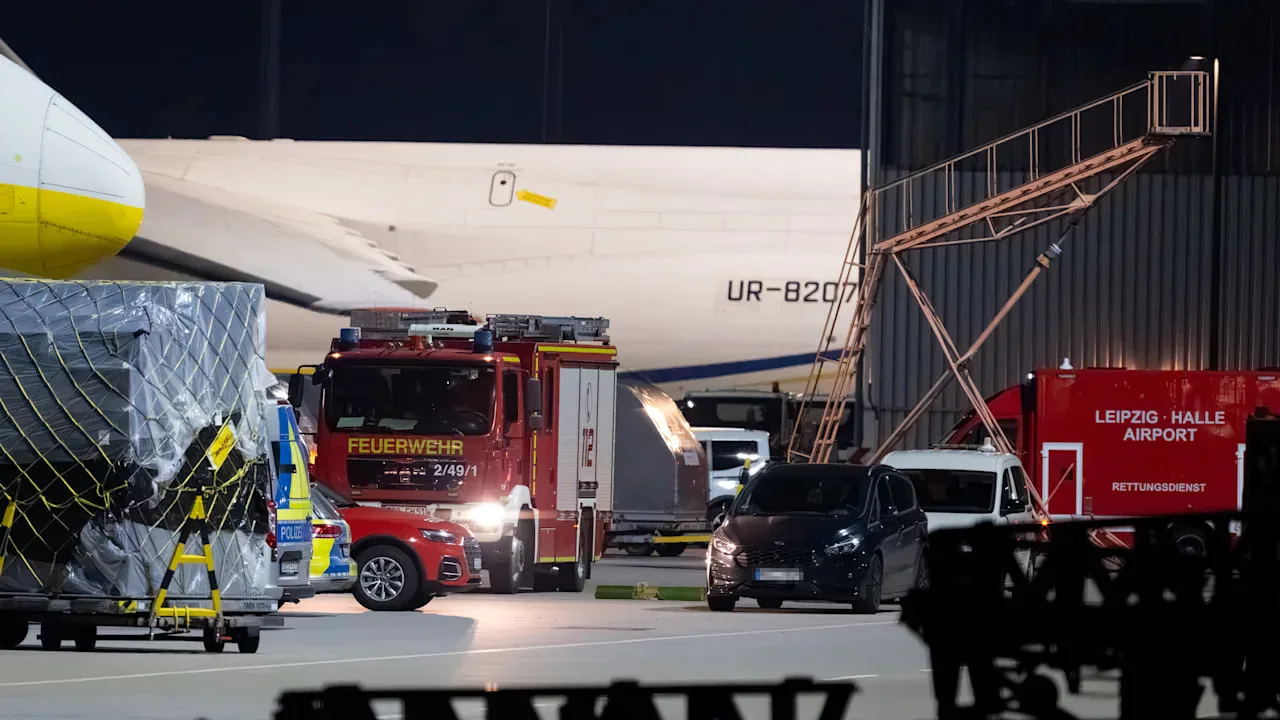
A cargo aircraft An-124 with Ukrainian registration was parked at Leipzig airport when a drone with a detonator was discovered nearby. The police of Lower Saxony opened a case under an article on crimes against state security — a formulation rarely used in Germany. The drone operator has not yet been found.
The story has a continuation that is more interesting than the discovery itself: the cargo aircraft, redirected due to runway closure, collided with an unknown object 6 kilometers from the airport at an altitude of 400 meters and landed in Hanover with damage to the nose section. No one has officially confirmed that it was the same drone or an object related to it — and this very uncertainty reveals the scale of the problem.
This is not the first incident — and that is the point
Over the past year, drones over German airports, military facilities, and infrastructure have been detected dozens of times. Leipzig is a logistics hub through which a significant portion of cargo for Ukraine passes, including military aid. A Ukrainian "Antonov" here is not a random neighbor, but a probable target or at least a convenient pretext to test the response of German services.
A practical nuance that is rarely voiced: most European airports do not have systems for detecting and neutralizing drones in real time. Closing a runway for several hours is not protection, but capitulation to a problem that no one knows how to solve quickly.
Police say there is no threat to the population. But an airport that halts flights for several hours because of one unknown drone demonstrates not control of the situation, but its absence.
Who benefits from chaos in German airspace
The version of sabotage against Ukrainian aviation is logical, but not the only one. Drones over infrastructure are also a way to test the reaction of security services, create economic losses through flight delays, and sow uncertainty on the eve of any political decisions regarding support for Ukraine. Germany is now discussing new weapons supplies, and timing coincidences are rarely accidental.
The investigation is being conducted by two police forces at once — Lower Saxony and Saxony — which in itself complicates coordination. If the drone operator is not found in the coming days, the trail will likely go cold — this has already happened in previous similar episodes in Europe.
The question for the coming weeks is simple: will this incident lead to real investment in anti-drone systems over critical infrastructure, or will it remain another item on the long list of "investigation ongoing"?