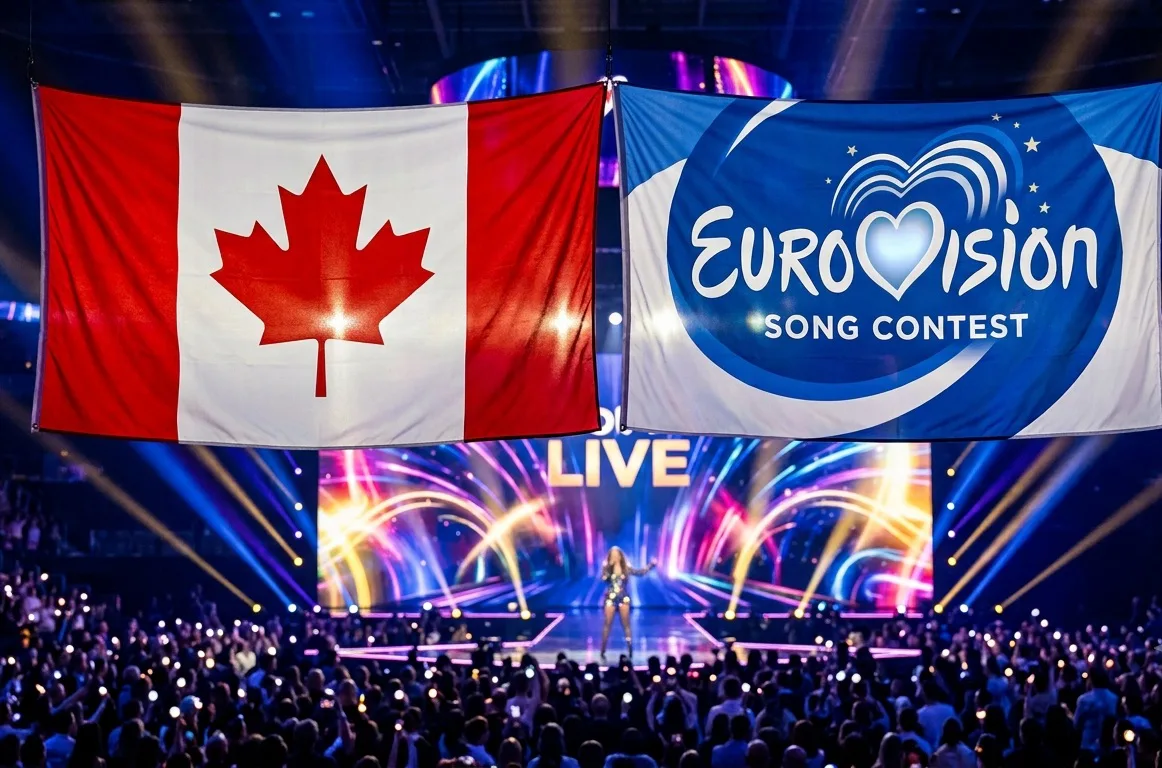
On Thursday, June 26, 2026, at the 96th General Assembly of the European Broadcasting Union (EBU) in Prague, delegates voted to grant CBC/Radio-Canada the status of full membership. The Canadian public broadcaster had been an associate member of the EBU since 1950 — and only now received full membership. Along with it — the right to submit a candidate for the Eurovision Song Contest.
But CBC is silent for now. New membership means that Canada now has the right to apply to participate in Eurovision, but CBC does not indicate whether it will exercise this right — at least for now.
150 Million and Carney's Signature
The membership decision did not arise on its own. The Canadian federal government in the 2025 budget allocated CBC/Radio-Canada an additional 150 million Canadian dollars in operating funds, partly — "to explore Canada's participation in the Eurovision Song Contest." This coincided with the election of Prime Minister Mark Carney, who seeks to strengthen ties with Europe against the backdrop of a trade war with the Trump administration and statements about turning Canada into the "51st state" of the USA.
Carney personally became involved in this plan. In his foreign rhetoric, he described Canada as the "most European non-European country," quoted Václav Havel in a speech in Davos, and promoted the idea of participating in Eurovision as a gesture of cultural, if not political, rapprochement with Europe.
Precedent: Australia as a Model
Canada is not the first non-European country on this path. Australian broadcaster SBS is an associate member of the EBU and has participated in the competition since 2015. The Australian experience demonstrates a real financial model: SBS pays annual membership fees and broadcasting costs, but does not cover all expenses for the artist's performance — for this, state funding from separate cultural funds is attracted.
Soft Power or an Expensive Symbol?
Diane Wuletic, a historian specializing in Eurovision, does not see empty populism in this move.
"It is one of the largest cultural events that unite Europeans. Since 1956, the competition has reflected political and social changes in Europe and is used by countries to shape their own image — their soft power abroad."
Diane Wuletic, Eurovision researcher historian
Wuletic also notes that participation means "membership in an event associated with liberal political and social values, especially regarding minority rights." In a context where Canada distances itself from Washington, this is not just a song — it is positioning.
However, the competition has its own crises. Wuletic recalls a recent controversy surrounding Israel's participation, because of which five public broadcasters boycotted this year's competition. Canada, if it truly takes the stage, will have to take a position in these discussions.
What's Next
Technically, Canada can debut at Eurovision 2027. The nearest competition — 2026 in Austria — will take place without it: the deadlines have already passed. The real question is not whether Canada has the right to participate, but whether CBC is ready to take on not only the financial but also the political risks of the competition — in a year when voters at home are watching what the 150 million is being spent on.
If CBC announces participation by the end of 2026 — it will be a signal that Carney views Eurovision as a foreign policy tool, not a one-time PR gesture. If not — EBU membership will remain an expensive symbol without concrete measure.