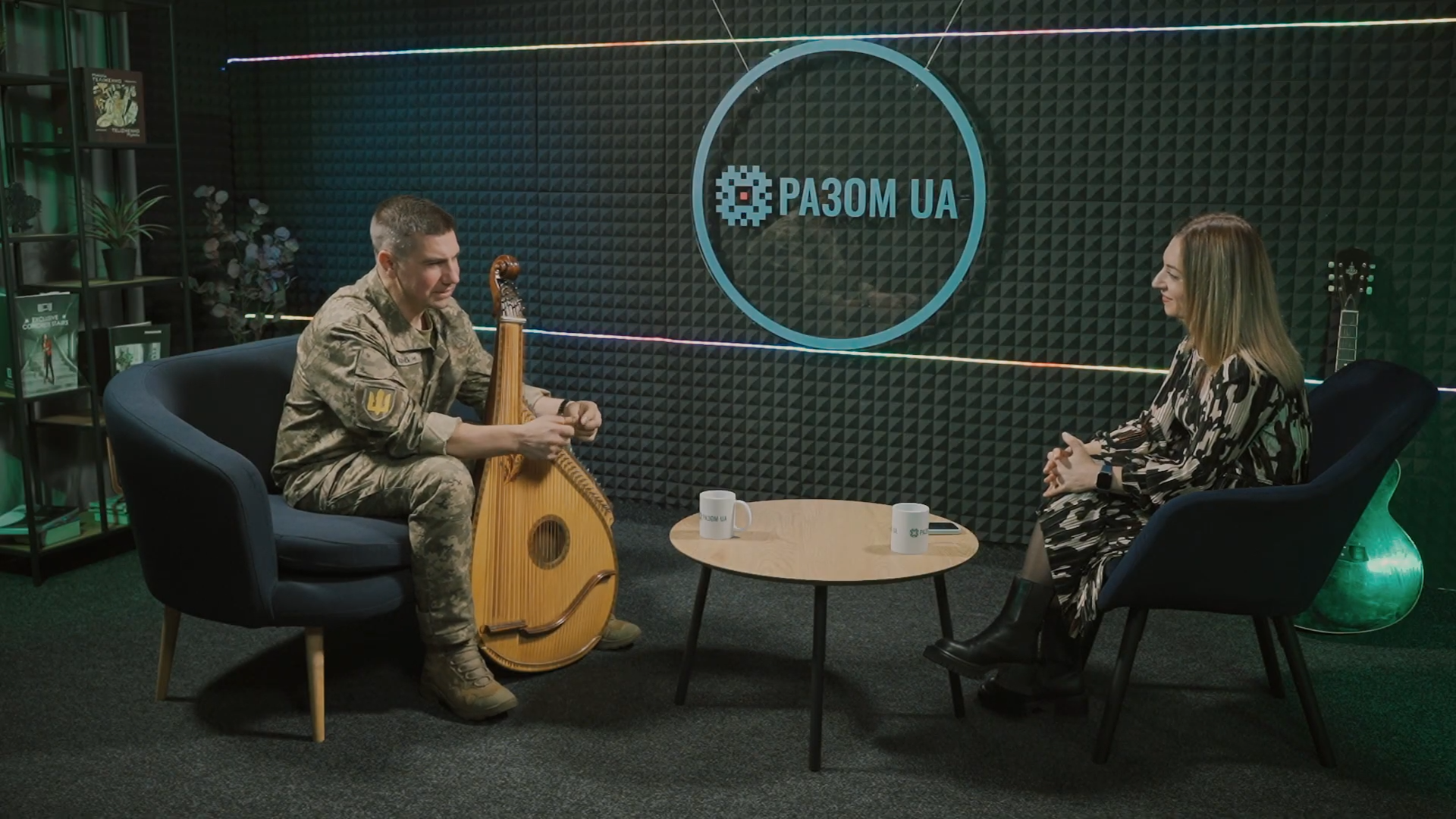
People's Artist of Ukraine, bandura player Taras Stolyar joined the ranks of the Armed Forces from the first days of the full-scale invasion. His performances are known from Kyiv hospitals to major world stages - from Italy to the USA. In the program "Forces of Art" he told how he combines service and culture, why the bandura is needed at the front and how Ukrainian music changes the minds of people abroad.
February 24: a decision without hesitation
Stoliar did not wait for the war. On February 23 he didn't believe it would start. But on the morning of the 24th he and his wife managed to leave Kyiv at five a.m.
I didn't plan on the 23rd, I didn't think there would be a war. Everyone around was talking, but I'm a poor analyst, I didn't expect it at all. We managed to dash out of Kyiv at five in the morning, we got to Zhytomyr, said our goodbyes, I returned to Kyiv and stood in line. They took me and I became a serviceman
– Taras Stoliar
By specialty he was registered as a machine-gunner, although he only fired during training. For the first four months he didn't touch the bandura.
Return to music: Riccardo Muti project
In June 2022 friends called with an unexpected offer. Maestro Riccardo Muti was organizing a project in support of Ukraine in Italy and wanted Stoliar specifically to play Myroslav Skoryk's melody on the bandura.
At first it seemed impossible – four months without an instrument, the bandura far away, the army. But after reflection it became clear: it was important to be there in uniform, as a soldier-musician.
Riccardo Muti said I was "combatant" – which means that I'm a soldier, but probably it also meant that I'm a volunteer. In Italy this was a very significant event. It was filmed by RAI Uno, the state television. Our opera was Kyiv's, I arranged Skoryk's melody with a violinist and a ballet couple danced. It was very moving
– Taras Stoliar
Cultural detachment: from the front to hospitals
Stoliar serves in the cultural detachment – a unit that performs for soldiers at the front, in rehabilitation centers and abroad. He has been to many hospitals where he saw severely wounded fighters.
It's very hard to come there, to look the guys in the eyes, especially when they are severely wounded. But you realize that you are just an instrument to help the person. The wound has already happened, but the person still needs strength to live, to be supported, to be given some positivity. There are guys who return to music. And that's great, because it really helps, it's relaxation and some new meanings in life
– Taras Stoliar
At the front it's important not only physically, but mentally. Music helps to cope with the routine of war and gives strength to carry on.
Metallica and Imagine Dragons on the bandura
Abroad Stoliar plays not only Ukrainian music. His repertoire includes "Nothing Else Matters" by Metallica and "Believer" by Imagine Dragons. He jokes that that song was actually written for the bandura, because it doesn't come out so well on the guitar.
A year ago Metallica reposted his performance on their Instagram, writing about support for Ukraine. It became one of the most viewed tracks on their profile.
When Metallica posts a bandurist in a pixelated uniform, it's a hope that they will again sway someone's opinion to our side. The cultural detachment relies on finding opinion leaders, urging them to support or strengthening the support they already have
– Taras Stoliar
In schools abroad children don't always know Metallica, but they do know Imagine Dragons. Each audience requires its own approach.
Viral video with Sting
One of the brightest stories is a performance at Sean Penn's house in Malibu, where Sting and his wife were present. Sting happened to have a day off between tour concerts.
Sting has always been an absolutely unique person for me. He's the only musician whose albums I listened to, re-listened to and knew by heart. The hardest thing was not to play his music for him, but to give a speech. I played a special cover of "Shape of My Heart" for him and gave a speech. And we asked him to sing along with the bandura. He gladly agreed
– Taras Stoliar
The video of their joint performance spread across social networks, becoming a symbol of support for Ukraine from world stars.
Mission abroad
The cultural detachment travels abroad not only for concerts. Their goal is to find people who don't yet care much about Ukraine and reach them through personal stories.
We bring our culture there, our stories, our appearance. Our wounded were with us: Yuriy Vasykevych with a leg amputation, Olya Rukavyshnykova, a violinist who was seriously wounded five times. We told that these are musicians who, either very young or deliberately as adults, went to fight but remained musicians. This takes us out of the news clichés into very personal stories. And that touches people completely differently
– Taras Stoliar
They performed in schools, universities, in front of diplomats and volunteers. Everywhere they showed that Ukrainians are not just news about war, but living people with culture and art.
The power of art
Asked what art's power is for him, Stoliar answered:
If you can influence other people, that's a power you cannot defend against. If it's about yourself – it's the core that gives you the ability to work, to realize yourself and to do something important. Art in wartime has acquired other qualities and tasks. I realized that my ability to play the bandura is not useless during war, as I thought on the first day. It's needed. And it's a thing that can do a lot, including for the state, for our victory
– Taras Stoliar
Hymn of the Ukrainian nationalists on the bandura
The episode concluded with a performance of the Hymn of the Ukrainian Nationalists on the Day of the Armed Forces of Ukraine:
We were born in a great hour from the fires of war, from the blaze of flames pain nurtured us. For Ukraine's fate anger and wrath at the enemies fed us... And now we march into life's battle firm, strong, unbreakable as granite, for tears have given freedom to no one yet, but he who fights, wins the world
Appeal
Victoria Gelgar, the program's host, summed up:
Thanks to our defenders we can be here now and film programs and simply rejoice in life. And culture – it is also a weapon. And perhaps it is through culture that we can stop wars
Stoliar added:
I think this will help stop the war. We carry our culture inside the country and abroad