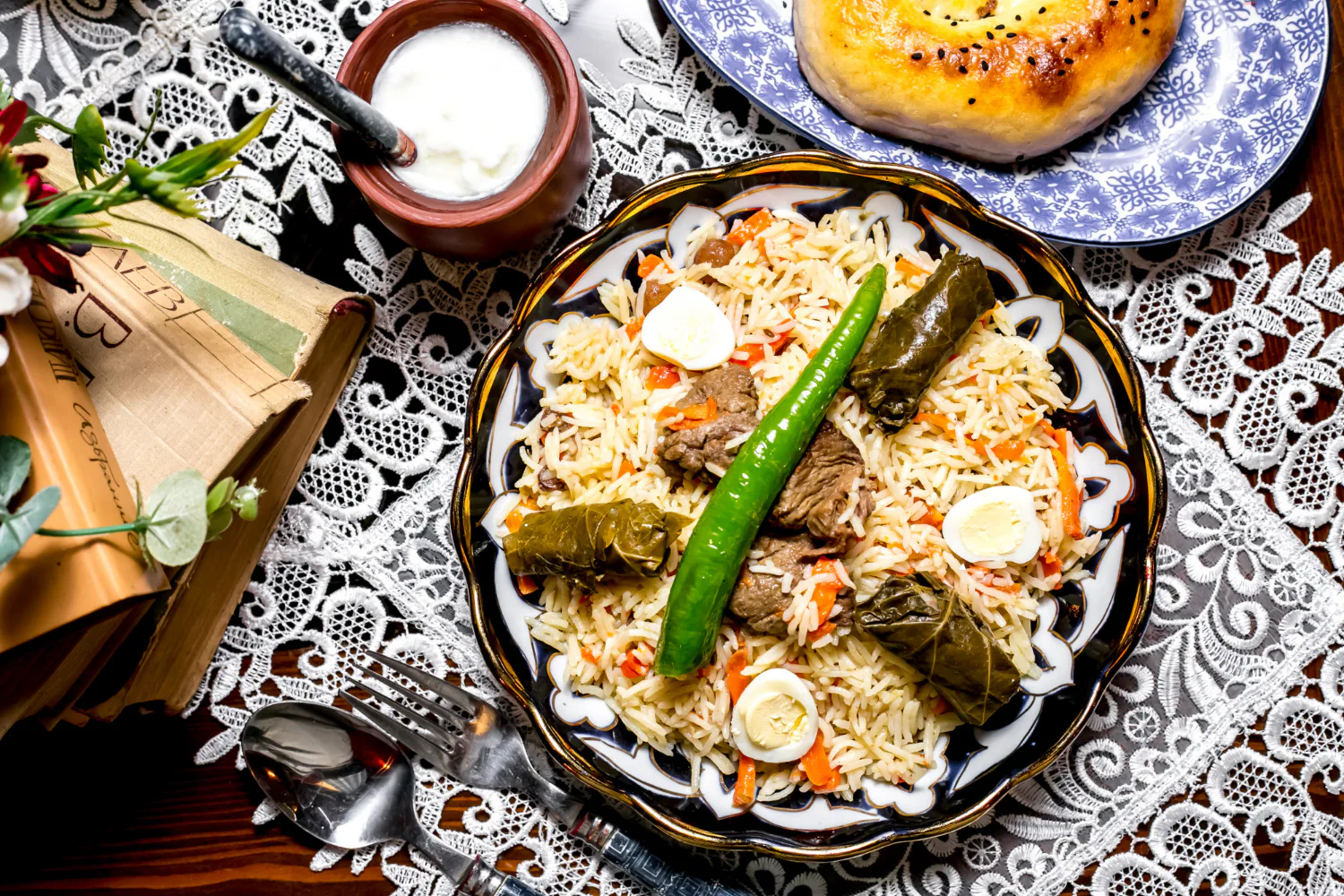
When people in Tashkent say "plov," they mean one thing. In Samarkand — another. In Fergana — a third. And everyone is ready to argue about it until morning. It is precisely this internal diversity, rather than a unified "tradition," that makes Uzbek cuisine one of the most fascinating gastronomic phenomena in the post-Soviet space.
Cuisine gathered from the roads
Uzbek cuisine did not emerge from nothing — it developed at the intersection of the Silk Road over centuries. Nomadic peoples brought meat processing techniques and tandoor. Persians — work with rice and water. Mongols and Uyghurs — manti and lagman. Arabs — shorpa. Chinese — the culture of tea drinking and a variety of spices.
It is significant that the very concept of "Uzbek cuisine" as such developed relatively late: the ethnos was finally formed only in the sixteenth century, and culinary identity — even later, already within Soviet Uzbekistan, when different regions found themselves under one state roof.
Plov: one name — five different dishes
Formally, plov is the national dish. Practically — it is several different dishes under one name, and the difference between them is fundamental.
- Fergana: fatty, rich, with devzira rice and often with chili — the spiciest version.
- Samarkand: lighter, layered, with yellow carrots, chickpeas and horse sausage.
- Bukhara: slightly sweet, with dried fruits.
- Khorezm/Khiva: fewer spices, lighter texture.
- Tashkent: ingredients are first fried — and this is already a different cooking philosophy.
Overall, researchers count over a thousand variations of plov. The technological basis remains unchanged: rice is not boiled separately, but stewed in zirvak — a rich broth of meat, oil and vegetables — until the liquid is completely absorbed. This is what distinguishes Uzbek plov from most other rice dishes in the world.
"If I have to die — let it be from plov."
An ancient Uzbek saying
In 2016, UNESCO included the culture of plov in Uzbekistan and Tajikistan in the list of intangible cultural heritage of humanity — official recognition that this is not just about a recipe, but about a social institution.
Oshpaz: the cook as a public figure
Preparing plov for major events — weddings, funerals, holidays — has traditionally been a man's job. The person responsible for this, the oshpaz (master of plov), can prepare a dish for thousands of people in a single cauldron over an open fire. In Tashkent, there are even specialized "plov centers" — public establishments that serve exclusively different types of this dish. The most famous is "Besh Kozon" ("Five Cauldrons").
A separate genre is nakhor oshi, "morning plov": it is served to guests from six to nine in the morning during wedding ceremonies. The logic is simple: the celebration begins before the heat makes the meal uncomfortable.
Beyond plov: what else shapes the cuisine
Lagman — hand-pulled wheat noodles of Uyghur origin — is served both as a soup and as a main dish with sauce. Samsa from the tandoor — triangular patties with lamb and onions — come out of the clay oven with a crispy crust and juicy filling. In Parkent in spring, "mador samsa" is made with fresh mountain herbs — a dish available for only a few weeks a year. In Khiva — shivit oshi: lagman with bright green noodles based on dill.
Bread (non) — a separate topic. Samarkand bread, Bukhara bread with nigella, Andijan wedding patyr with sour cream and butter — each region has its own shape and tandoor baking technique. According to legend, patties similar to Uzbek ones are mentioned as far back as the epic of Gilgamesh.
Hospitality as a rule, not an exception
In Uzbek culture, the table is not a background for conversation, but its center. Tea is served in bowls and poured in small portions — so it remains hot and the host constantly has a reason to approach the guest. Bread is broken by hand, not cut. Before serving main dishes — soup is mandatory.
The saying "A guest in the house is God in the house" — not a folkloric decoration, but a working standard of behavior that directly affects how much food is prepared and how the table is set even on ordinary days.
If gastronomic tourism to Uzbekistan continues to grow — and after plov was included in UNESCO's list, it has noticeably accelerated — a practical question will arise: will regional variations preserve their authenticity under the pressure of standardized "tourist plov," or will local oshpazes resist the temptation to simplify the recipe for a wider audience.