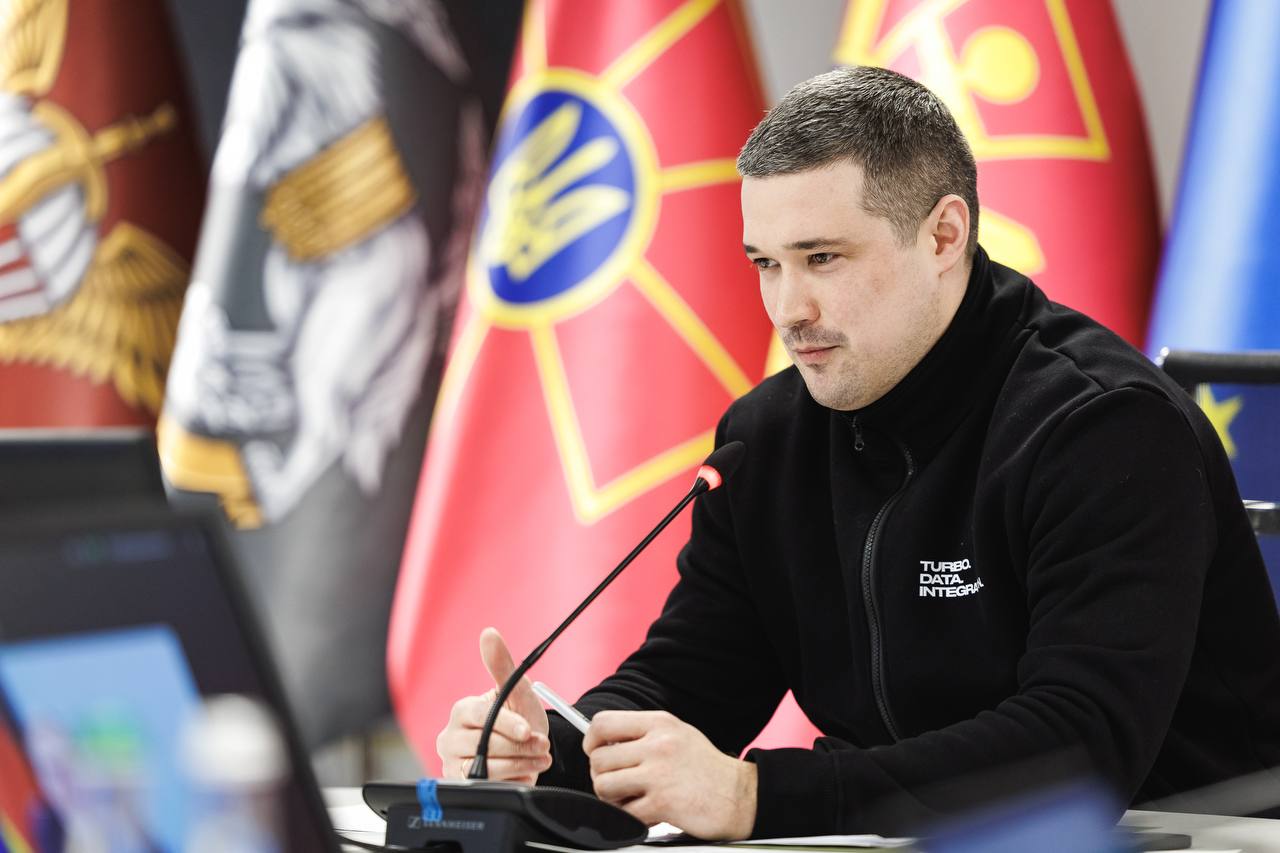
35,203 — that is exactly how many Russian military personnel were killed or seriously wounded in April 2026. The figure is confirmed by video evidence, without any estimative adjustments. Defense Minister Mikhaylo Fedorov cited it as proof that Russia has been losing more for the fifth consecutive month than it manages to mobilize.
But behind this number stands another metric — not absolute losses, but their density per unit of captured land. And it is this metric, according to Fedorov, that determines the strategic logic of defense.
Where the red line is drawn
In February 2026, the Defense Ministry formulated a specific benchmark: more than 200 killed occupants per square kilometer — a level at which further advancement becomes economically and humanly impossible for the aggressor.
"Our benchmark is more than 200 killed occupants per km². This is the level of losses at which advancement becomes impossible."
Mikhaylo Fedorov, Minister of Defense of Ukraine
At the time the goal was announced, the indicator stood at 156 per km². In April, according to Fedorov, it reached 179. The dynamic — plus 23 over two months. There are 21 remaining until the threshold.
What ISW says
Data from the Institute for the Study of War makes it possible to verify the context. According to analysts' calculations, in April 2026, Russia for the first time since August 2024 lost more territory than it captured — minus 116 square kilometers net. The pace of advancement fell to 2.9 km² per day — three times less than a year ago.
Fedorov's figure of 179 losses per km² and ISW's figure of 99 (average for January–April) do not contradict each other: the former concerns only April and counts only confirmed irreversible losses; the latter is a four-month average indicator with a broader accounting methodology.
Three levels of pressure
Fedorov describes the strategy as three-tiered:
- Ground front: holding positions and increasing the cost of every meter for the enemy through saturation with drones and artillery.
- Mid-range strikes: strikes at distances of 20–150 km against warehouses, headquarters, and logistics — in April there were twice as many compared to March and four times more than in February.
- Economic pressure: strikes against Russia's energy sector and logistics, designed to reduce resources for financing the war.
In parallel, starting in April, construction accelerated of anti-drone protection for front-line roads: only in February–April, 430 kilometers of routes were equipped — this is logistics that allows for faster rotation of units and evacuation of the wounded even under fire.
The boundary between metric and reality
The "losses per km²" indicator is a management tool, not a combat order. It records whether occupation is becoming more expensive for the aggressor faster than its ability to advance is growing. So far — it is becoming more expensive: from 156 in February to 179 in April.
But there is a structural caveat: ISW has noted that Russia partially compensates for the slowdown in ground advancement with "penetration" tactics — short-term raids without consolidation, which artificially inflate activity statistics and complicate month-to-month comparison.
If the rate of increase of the indicator is maintained — plus 10–15 per month — the threshold of 200 could be reached by the end of summer. But the real question is not when the figure crosses the mark, but whether it will stop the advance — or Russia has revised its acceptable level of losses once again.





