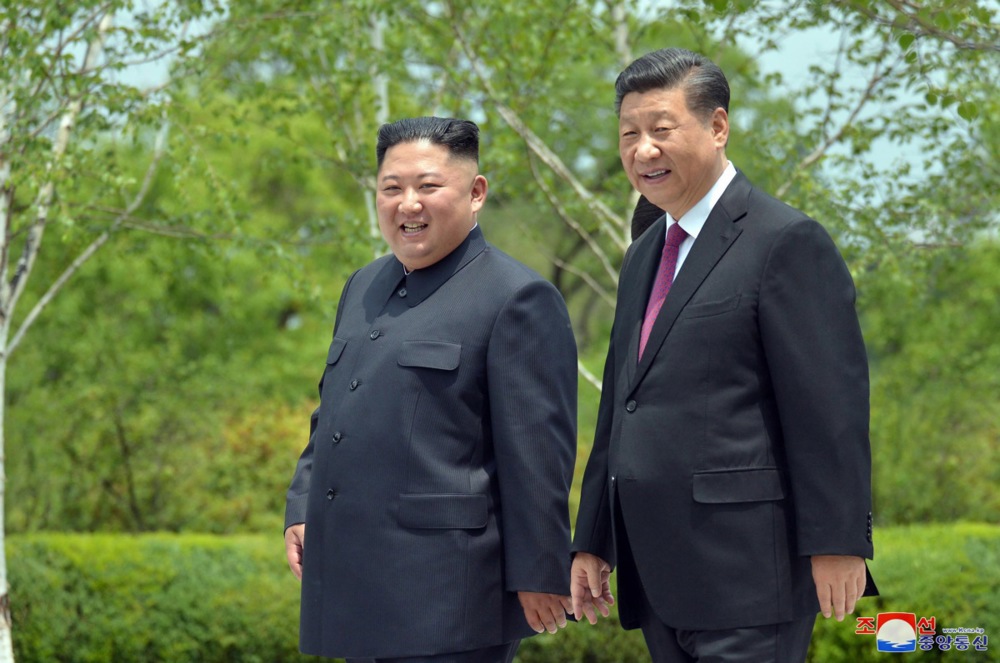
The chronology of two days speaks for itself. On Thursday, North Korea showed the world a uranium enrichment facility — Kim Jong Un personally visited the site and announced plans to increase the nuclear arsenal at an "exponential pace." On Friday, Beijing and Pyongyang simultaneously announced: Xi Jinping will visit North Korea on June 8-9. His first visit in nearly seven years.
According to South Korean military assessments, the new facility is indeed a uranium enrichment plant — the raw material for nuclear warheads. But the very fact of its disclosure may be more important than the facility itself.
The disclosure of the facility indicates that Kim sought to solidify his country's status as a nuclear power on the eve of Xi's visit.
Analysts cited by AP
What Kim wants from this visit
Pyongyang's strategy is relatively clear. According to analysts, Kim seeks international recognition of North Korea as a nuclear power — primarily from China and Russia — so that it can then negotiate with the United States not about abandoning weapons, but about reducing the arsenal in exchange for concessions. This is a qualitatively different position from denuclearization, which the West has long demanded.
Kim's nuclear diplomacy has already yielded its first result. In September 2025, he participated in a large-scale military parade in Beijing, where he stood next to Xi and Putin — this was widely interpreted as de facto recognition of North Korea as a nuclear power by the two most powerful authoritarian regimes in the world.
Inconvenient arithmetic for Beijing
China finds itself caught between two fires. On one hand, Beijing has for years declared denuclearization of the Korean Peninsula as its official position — openly recognizing North Korea as a nuclear power would undermine its own non-proliferation regime and risk a chain reaction from Seoul and Tokyo. On the other hand, Kim is actively moving closer to Moscow: North Korea supplies Russia with weapons and personnel for the war against Ukraine, which weakens China's traditional role as Pyongyang's main patron.
As Foreign Policy notes, Xi has long delayed this visit precisely because Beijing has not developed a clear response to the reality of a nuclear North Korea. Now he is going — with no publicly announced agenda.
It is telling that the trip comes a few weeks after Xi separately received Donald Trump and Vladimir Putin in Beijing. China positions itself as a key hub between all parties — and the visit to Pyongyang fits into this logic.
What "exponential" expansion means
Kim Jong Un has been deliberately expanding the nuclear arsenal since 2019 — since his diplomacy with Trump collapsed at the summit in Hanoi. Since then, North Korea has conducted a series of ballistic missile tests, including intercontinental ones, and declared itself irreversibly a nuclear power at the constitutional level. The new facility is another signal: negotiations are possible, but not about abandoning weapons.
Trump, meanwhile, publicly expresses a desire to resume diplomacy with Pyongyang. If Xi becomes a mediator between Kim and Trump after this visit, Beijing will gain serious dividends — and leverage over Washington at the same time.
The question is whether China will agree to the role Kim assigns it: a silent guarantor of North Korea's nuclear status — and what exactly Xi will gain in return to justify this concession before his own diplomatic doctrine.