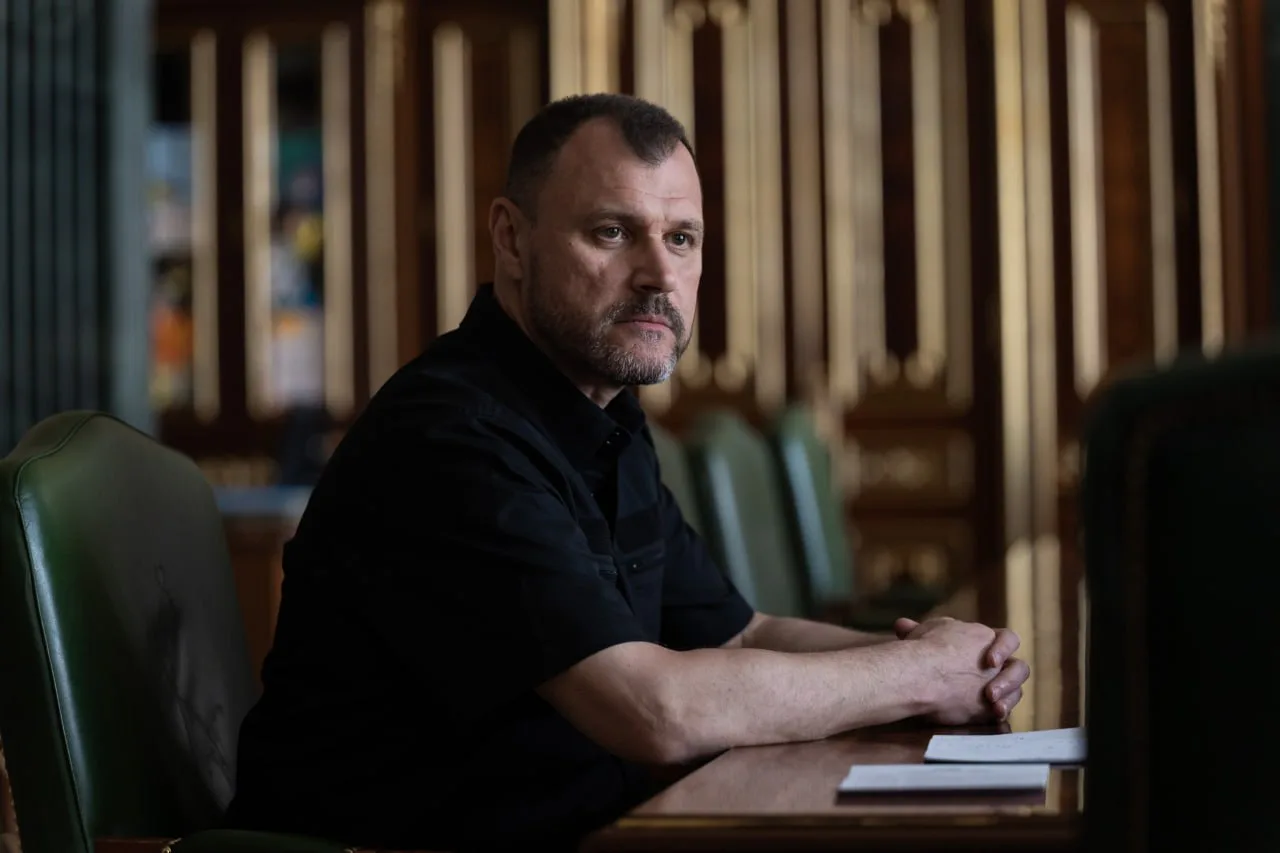
On July 17, President Zelensky announced that he had proposed the former Interior Minister Igor Klymenko for the position of Secretary of the National Security and Defense Council. The decree is already being prepared. At the same time, Zelensky did not clarify the fate of the current Secretary Rustem Umerov — according to RBC-Ukraine, presidential adviser Dmytro Lytvyn only said that "there will be a separate conversation with Rustem."
Why Now
Klymenko's appearance in the NSDC is a direct consequence of the previous scenario's failure. On the eve, July 16, the Council voted for a new government led by Prime Minister Sergiy Koretsky. The position of Defense Minister remained vacant: initially, Klymenko was considered the main candidate to replace Mykhailo Fedorov, but protests erupted in Kyiv and at least ten other cities against this. According to Hromadske Radio, against the backdrop of protests, Zelensky stated that Klymenko was just one of the candidates, and ultimately assigned the duties of Defense Minister chief to acting SBU head Yevhen Khmara.
That is, the NSDC becomes for Klymenko not a career breakthrough, but a workaround — a way to keep him in the top security circle without direct confrontation with the street.
Who is Klymenko and Why Him
Klymenko is 53 years old. A General of Police of the first rank, a Doctor of Psychological Sciences — he built his career exclusively within security structures: from a military psychologist in Kharkiv to the head of the National Police (2019–2023) and Interior Minister. Under his leadership, the Interior Ministry oversaw the "Offensive Guard," the documentation of war crimes, and the seizure of Russian assets. He is also a member of the Supreme Commander's Headquarters — that is, a person who has been sitting for years at the intersection of security and civilian decisions is going to the NSDC.
"Every decision of the NSDC of Ukraine and the Supreme Commander's Headquarters must be fully implemented within the specified time"
Volodymyr Zelensky, after a meeting with Klymenko, July 17, 2026
This sentence is the key to understanding the logic of the appointment. Zelensky wants not a strategist in the NSDC, but an executor with a security background, capable of forcing the system to work without delays. According to Ukrainian Pravda, coordination of defense production is named as a separate priority — an area where NSDC decisions previously stalled at the implementation level.
What Umerov Loses and What It Means
Rustem Umerov held the position of NSDC Secretary since July 2025 — after being dismissed as Defense Minister. In this role, he effectively became the president's chief security adviser and led the negotiation delegation after Andriy Yermak's resignation. According to Liga.net, journalists suggest a possible appointment of Umerov as ambassador to the United States, but Lytvyn did not confirm this.
- Klymenko in the NSDC — a person from the Interior Ministry system, focused on execution discipline rather than diplomatic negotiations
- Umerov — a figure with negotiating capital and connections to Washington, whose future remains uncertain
- The Interior Ministry passed to Ivan Vygvyskiy, who previously headed the National Police — again a security official within the system
The broader picture: July 2026 is a reboot of the entire security bloc simultaneously. A new prime minister, a new defense minister on a "temporary" basis, a new NSDC secretary, a new Interior Minister. None of the appointments passed without friction.
Where the Risk Is
The NSDC is a coordinating body, not a command center. If Zelensky appoints a security official to it precisely because decisions are not being implemented, then the question is not about the secretary: the problem is that the system does not respond to the NSDC as an authority. Klymenko may prove to be an effective control administrator — but will he have enough institutional weight to force ministries and the General Staff to move in a single rhythm without the president's personal mandate behind him? The answer will come as soon as the first public conflict arises between an NSDC decision and Syrsky's position.







