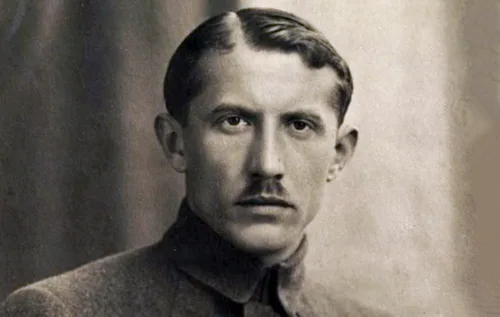
On July 15, the Cabinet of Ministers signed Resolution No. 703-r: the remains of Colonel of the UNR Army and first chairman of the OUN Yevhen Konovalets are to be transported from Rotterdam to Kyiv and reburied at the National Military Memorial Cemetery with military honors.
An Oath That Had to Wait for Independence
During Konovalets' funeral in Rotterdam in May 1938, OUN members took an oath: as soon as Ukraine gained state independence, the Colonel's ashes would return to Kyiv. Eighty-seven years have passed. Independence came in 1991, but the actual mechanism for return only began working now — in the midst of full-scale war.
Rotterdam, Atlanta Restaurant, May 23, 1938
Konovalets did not die in combat. NKVD agent Pavlo Sudoplatov spent years gaining his trust under the guise of an underground activist from Soviet Ukraine. At a meeting in the hotel restaurant's dining room, he placed a box of chocolates with a built-in explosive device in front of the Colonel. The mechanism triggered as Konovalets was walking down Coolsingel Street — the explosion occurred at 12:16 p.m., death was instantaneous.
"In 1938, during the funeral of the Leader in Rotterdam, Ukrainian nationalists took an oath: as soon as Ukraine restores its state independence, the ashes of the great Colonel will be transferred to the capital Kyiv"
Bohdan Chervak, Chairman of the OUN
Konovalets was buried on May 28, 1938, at the Rotterdam Crossveld Cemetery — at the expense of the Lithuanian consulate, since the Colonel was then living with a Lithuanian passport. He lay there for the next 87 years.
Who Must Do What
The resolution clearly distributes responsibility among five bodies:
- Ministry of Foreign Affairs — negotiate with the Netherlands for permission to exhume and transport the remains
- Ministry of Veterans and the Ukrainian Institute of National Memory — organize the entire reburial process
- Ministry of Defense — ensure military honors
- State Institution "National Military Memorial Cemetery" — receive and bury
The government has not yet announced specific dates.
Second in a Month
In May 2025, at the same cemetery with President Zelenskyy's participation, Konovalets' successor was reburied — Colonel Andrii Melnyk and his wife Sofiya Fedak-Melnyk. Their ashes were brought from Luxembourg. At that time, Deputy Head of the Presidential Office Iryna Vereshchuk publicly named Konovalets as next in line — and already had the Dutch side's permission in hand.
In other words, Konovalets' return is not a sudden decision, but part of a consistent state policy of repatriating leaders of the liberation movement. The state is deliberately shaping the memorial geography of the war — and doing so while the country is at war.
An open question remains: if exhumation and transportation depend on Dutch bureaucracy and wartime logistics — will the ceremony take place by the end of 2025, or will it be postponed again due to procedural delays, as has happened with other repatriations before?