What actually happened — and where the report stops
The SBU detained Dnipropetrovsk region resident Vladyslav Sementsov for calls for Russia to strike Ukrainian law-enforcement agencies. This is a real criminal case that deserves journalistic attention. But in the first seconds the report takes a sharp turn: from a specific criminal episode — to the formula "perhaps, Islamic extremism". Between those two topics in the piece there is only one fact: Sementsov "attended a mosque." Visiting a religious building is not evidence of radicalization and not proof of coordination with any organization. In editorial verification standards and criminal law such a link requires direct evidence: communications, transactions, joint actions, procedural materials. None of this is present in the report.
"We are not asserting" — a formula that protects the hint, not the viewer
The authors repeat several times: "we are not asserting, we are only presenting the facts." But that very phrase is the key manipulation. It relieves the newsroom of responsibility for the conclusion the viewer has already formed in their head — thanks to the pace of editing, the alarming music and the "where there's smoke, there's fire" logic. Responsible security journalism, on the contrary, must be more precise than any other, because the cost of an error here is the stigmatization of an entire religious community and a gift to Russian propaganda, which is already trying to split Ukrainian society.
Associative montage instead of an evidentiary chain
The central construction of the report is built like this: Sementsov → mosque → DUMU "UMMA" → Ismagilov → a Russian YouTube channel → the channel's owner → FIOYE → UAE list → "Muslim Brotherhood". Each transition in that chain is an association, not evidence. An appearance on a media platform does not mean solidarity with the channel owner. Membership in a federation does not mean participation in terrorist operations. "Support for opening a mosque" is not the same as "control over attendees." In criminal law and in the standards of quality journalism a link must be direct and corroborated. "Similarity of décor" is not an argument.
"If the base is mostly associative, 'we are not asserting' becomes a license for any montage of suspicions."
— From an analysis of the report's editorial standards
Context the report barely shows
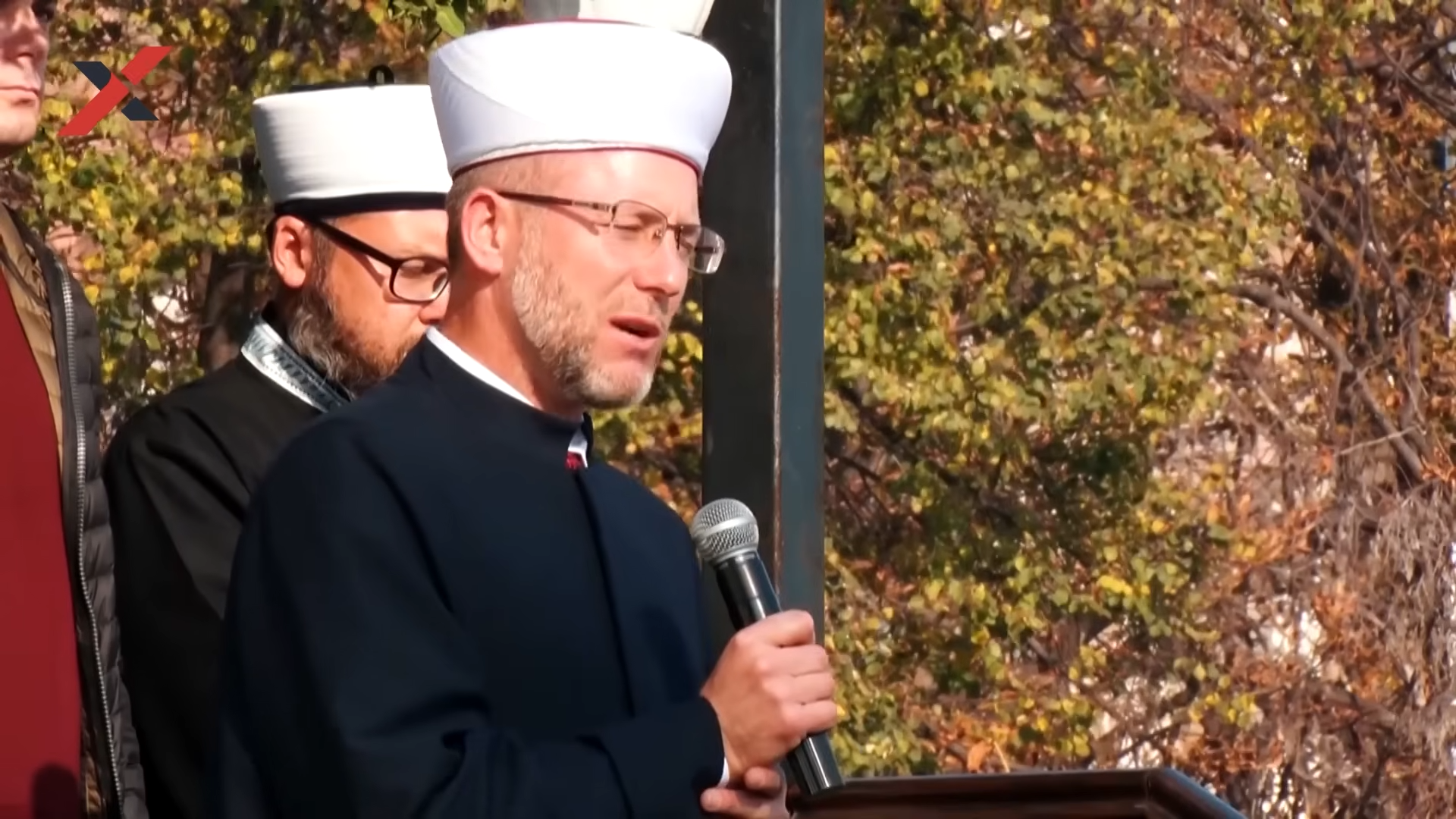
DUMU "UMMA" — one of the institutions of Ukrainian Muslims, whose main office in Kyiv was hit by a Russian missile strike. Said Ismagilov during wartime publicly attested to his involvement in the defense of Ukraine — numerous media wrote about this. Seyran Arifov on official resources framed Alraid's position as "support for Ukraine's independence, its development and stability." This is not an "indulgence" and not a refutation of all questions. But in journalism that claims objectivity, this framing must be present. Its near absence in the report is not negligence, but an editorial choice.
Halal certification: an economic issue turned into "terrorism financing"
The report presents halal certification as a "monopoly" and hints at a connection to terrorist financing. But even if concentration in the certification market is a real problem, it is a subject for economic and regulatory analysis, not an automatic bridge to terrorism accusations. Such a bridge is possible only where there are transactions, sanctions decisions, convictions or financial monitoring documents. None of this is shown in the report.
Three toxic consequences of this approach
First — collective responsibility: when a viewer leaves with the feeling that "all Muslims are under suspicion," it deepens divisions within a society at war. Second — discrediting Ukrainian Muslims, who are part of the political nation and are themselves targets of Russian terror. Third — contaminating counterterrorism analysis: instead of concrete indicators of risk (violent rhetoric, proven transactions, recruiting, links to combat structures) the public is fed "signals" at the level of associations — and that actually makes the work of those who deal with real security threats harder.
Conclusion
The TSN report provides a list of points for verification — names, organizations, addresses, fragments of statements. This can be a useful starting point for OSINT research. But it does not prove what it pushes the viewer toward dramaturgically: the existence of an operational "Muslim Brotherhood" network in Ukraine connected to Sementsov. Every key transition in this construction is made through associative montage. And "we are not asserting" is not insurance for the viewer. It is insurance for the newsroom. Countering real extremism and Russian hybrid influence requires more precise tools — and higher editorial responsibility.





